Agent Autonomy Score
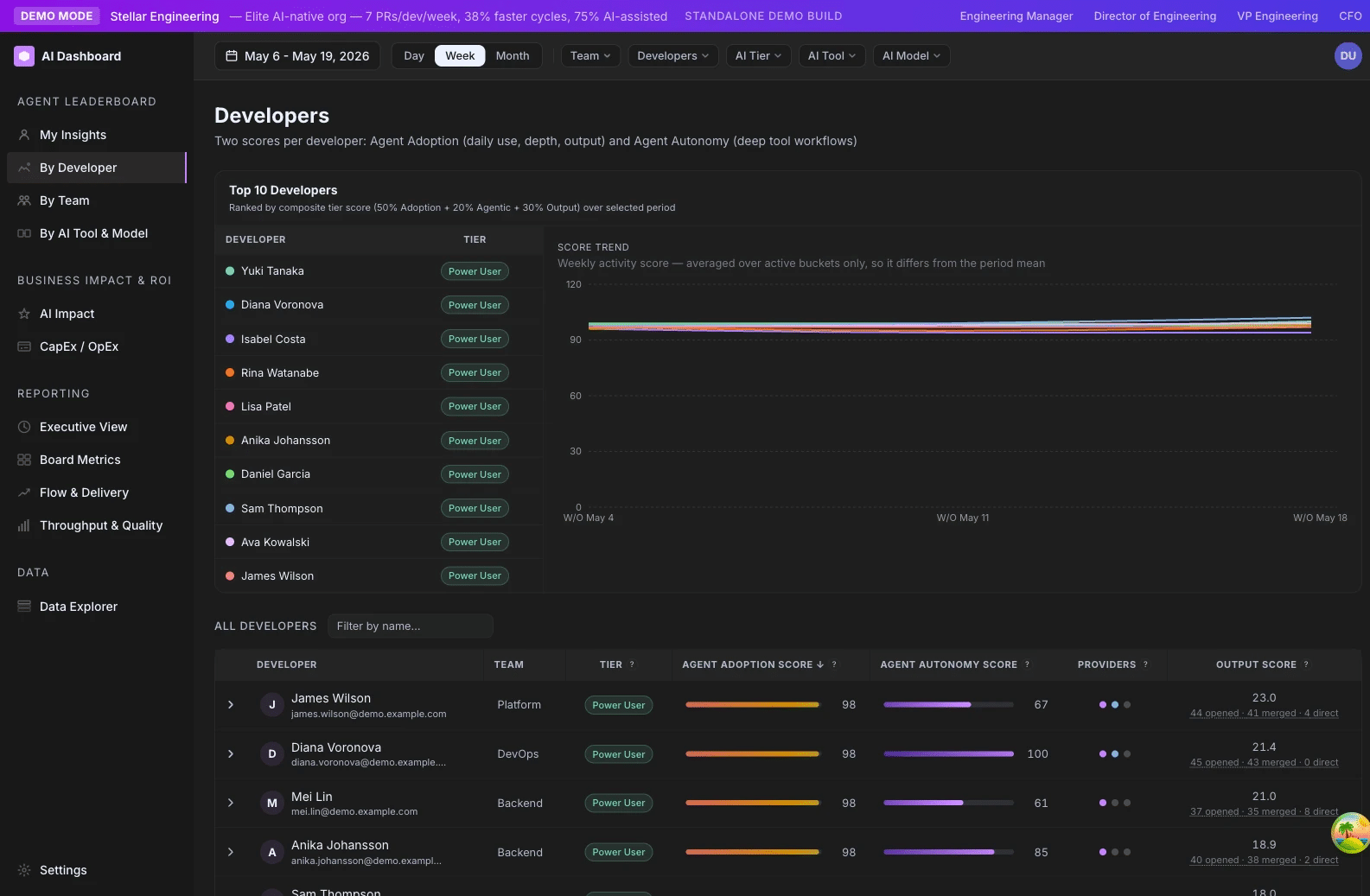
A 0–100 measure of how often a developer runs AI through multi-step, tool-using sessions — sessions with 10+ tool calls.
- Range
- 0 – 100
- Family
- Adoption & Agentic
- Cadence
- Window-based
At a glance
Where the Agent Adoption Score measures how consistently a developer uses AI, the Autonomy Score measures how autonomously. High autonomy means the developer is running AI in agentic mode — multi-step sessions where AI is calling tools, reading files, editing code, running commands. Low autonomy means AI is being used as a Q&A interface (“how do I X?”). Both are valid uses; tracking them separately surfaces a different kind of adoption depth.
Formula
Agentic Score = min(intensity / OrgP90Intensity, 1.0) × 100 × Maturity Factor
Where intensity is a developer-level aggregate of tool_result events from Claude Code and Codex sessions with at least 10 tools used. Returns 0 when the org has no P90 intensity (no data).
How GitKraken Insights calculates it
What counts as an “agentic session.” We define an agentic session as one where the developer used at least 10 distinct tools (e.g. file_read, file_edit, bash_run, web_search, etc.) within a single session. The 10-tool threshold is the heuristic that separates “I asked Claude a question and it called a tool to answer” from “Claude is doing real multi-step work.”
Providers included. Only Claude Code and Codex sessions contribute to Agentic intensity (the backend filters on provider IN ('claude_code', 'codex')). Cursor activity is excluded because Cursor’s event stream doesn’t expose per-session tool calls in a way we can score; Cursor still contributes to the Agent Adoption Score via the Cursor Boost.
Intensity. For each developer, we aggregate tool_result events from their agentic sessions over the window. The result is a single intensity number — higher means more agentic activity.
Normalization. We compute the org-wide P90 intensity across all active developers in the window. The developer’s intensity is divided by the org P90 and capped at 1.0. This is the same normalization pattern as Adoption — the bar is your team, not an industry average.
Critical: the org P90 is always org-wide, never team-filtered. A developer’s Autonomy Score does not change when an admin toggles team filters.
Maturity scaling. The capped ratio × 100 × Maturity Factor produces the final 0–100 score. At the default 0.75 Maturity Factor, a developer at the org’s P90 on agentic intensity scores 75.
Why it matters
Agentic adoption is the deeper rollout signal. A team can have high Adoption (everyone using Claude as a Q&A interface) but low Autonomy (no one letting it run multi-step). Or the reverse — a small group running highly agentic sessions while the broader team hasn’t started.
The most valuable AI productivity gains come from autonomous sessions. A developer asking Claude one question saves 5 minutes; a developer running Claude through a 30-minute agentic refactor saves 2 hours. Tracking autonomy separately lets you see whether your team is moving from the first pattern to the second — which is usually where ROI inflects.
How to read it
- 60–100Strong — developer regularly runs AI through multi-step autonomous work
- 25–59Fair — occasional agentic use; AI is partly an autonomous collaborator
- 0–24Low — AI is being used mostly for Q&A, not autonomous tasks
A team average above 40 is a strong signal that agentic workflows have taken root. Below 20 is “your team is using AI mostly to ask questions” — which is still useful but a leading indicator that you can extract more value.
Settings that affect it
- Maturity Factor — multiplies the final score (default 0.75).
- The agentic threshold (10 tools per session) is not currently configurable. Ask your account manager if you need it tunable.
How to improve it
- Train the team on agentic prompts. A 30-minute internal session on “give Claude a goal, let it run” can lift Autonomy faster than any other intervention.
- Establish patterns for safe autonomous work. “When can I let Claude refactor unattended?” If your team doesn’t have an answer, Autonomy will stay low. Publishing a one-page playbook usually unblocks it.
- Audit the Emerging Autonomy cohort. Some developers are happy using AI as a search engine forever. That’s fine — but flag the gap. If 70% of your team has Autonomy < 20, you’re not extracting deep value from the tooling spend.
- Pair an Autonomy Power User with a low-Autonomy developer. Same intervention as for Adoption, but specifically targeting agentic workflows.
Limitations and gotchas
- The 10-tool threshold is heuristic. A developer running 9-tool sessions all day will score lower than one running occasional 10-tool sessions.
- Tool count ≠ value. A 50-tool session that achieved nothing scores higher than a 10-tool session that shipped a feature. Use Autonomy alongside Output Score for the full picture.
- Cursor does not contribute to Autonomy. Cursor’s API doesn’t expose per-session tool-call events in a way we can score, so the agentic intensity sum filters to
provider = 'claude_code'andprovider = 'codex'only. Cursor still feeds Agent Adoption via the Cursor Boost. - Org P90 moves with the cohort. As your team matures, the bar rises.
FAQ
Why 10 tools as the agentic threshold? Why not 5 or 20?
10 is the empirical knee in the distribution — at 10+ tools, sessions are reliably “AI doing real multi-step work” rather than “AI calling one tool to answer a question.”
A developer has high Adoption but low Autonomy. Is that a problem?
Not necessarily. They’re using AI consistently but mostly as a Q&A tool. Whether that’s a problem depends on the work.
Why isn’t this counted toward Adoption?
We want to separate “is the developer using AI?” (Adoption) from “is the developer using AI as an autonomous collaborator?” (Agentic). Conflating them loses information.
Related metrics
| Metric | Relationship |
|---|---|
| Agent Adoption Score | Parallel adoption measure. Adoption = consistency. Agentic = depth of autonomous use. |
| AI Tier | Agentic is one of three inputs into the composite Tier (default weight 0.2). See How the metrics fit together for the canonical composite formula and per-org configuration story. |
| Productivity Uplift | Most productivity gains correlate with rising Autonomy, not Adoption. |
Where it appears
/ai-adoption/developersseparate column or panel next to Adoption. The expanded developer detail breaks down agentic activity by session count and tool diversity./ai-adoption/ai-impactdeep-dive autonomy analysis: tools-per-session distribution, top tools by usage, ranking of high-autonomy developers./ai-adoption/executivetrend line showing org agentic adoption over time.