

Last updated: October 2026
Find out what’s new, what’s fixed, or just take a trip down memory lane remembering those bugs of yesterday.
Check out our Changelog to see linked issues and past changes.
Features marked with PRO require a trial or paid plan for use on privately hosted repos
Features marked with PREVIEW require a GitKraken Account, with access level based on your plan, e.g. Community, Pro, etc
Version 19.3
Thursday, October 1, 2026
GitLens 19.3 connects to Kepler, GitKraken’s Agentic Development Environment (ADE). You can start a task on a repository, or a review of a pull request, in Kepler from the GitLens views, Launchpad, and the Commit Graph. Kepler opens with the repository or pull request ready to go. Start Work and Start PR Review can also send an issue or pull request to Kepler, and if Kepler isn’t installed yet, GitLens offers to get it for you.
You can now rebase all of your stacked pull requests in one action. Rebase Stack… replays each layer onto the one below it, from the bottom up, so none get skipped. Auto-Rebase Stack… does the same with AI resolving conflicts the whole way, and pauses for your help instead of unwinding. When the cascade is done, Force Push Stack publishes every rewritten branch, and you can hold back any of them.
Getting started takes fewer detours. With no repository open, the Commit Graph now offers ways to begin: open a folder, clone a repository, or start a new project. Start Work and Start PR Review also work without a repository. They list your issues and pull requests across your connected integrations, then find the repository locally or clone it for you. When a sign-in or upgrade screen interrupts you, it now names the commit, branch, or comparison you were opening, and opens it for you once you have access.
The rest of the release is polish and fixes. GitLens section headers match VS Code’s Modern UI. Hide Remote-only Branches in the graph now hides only what it says it does. A set of Azure DevOps link problems are fixed, and autolinked pull requests and issues no longer disappear after a single failed lookup.
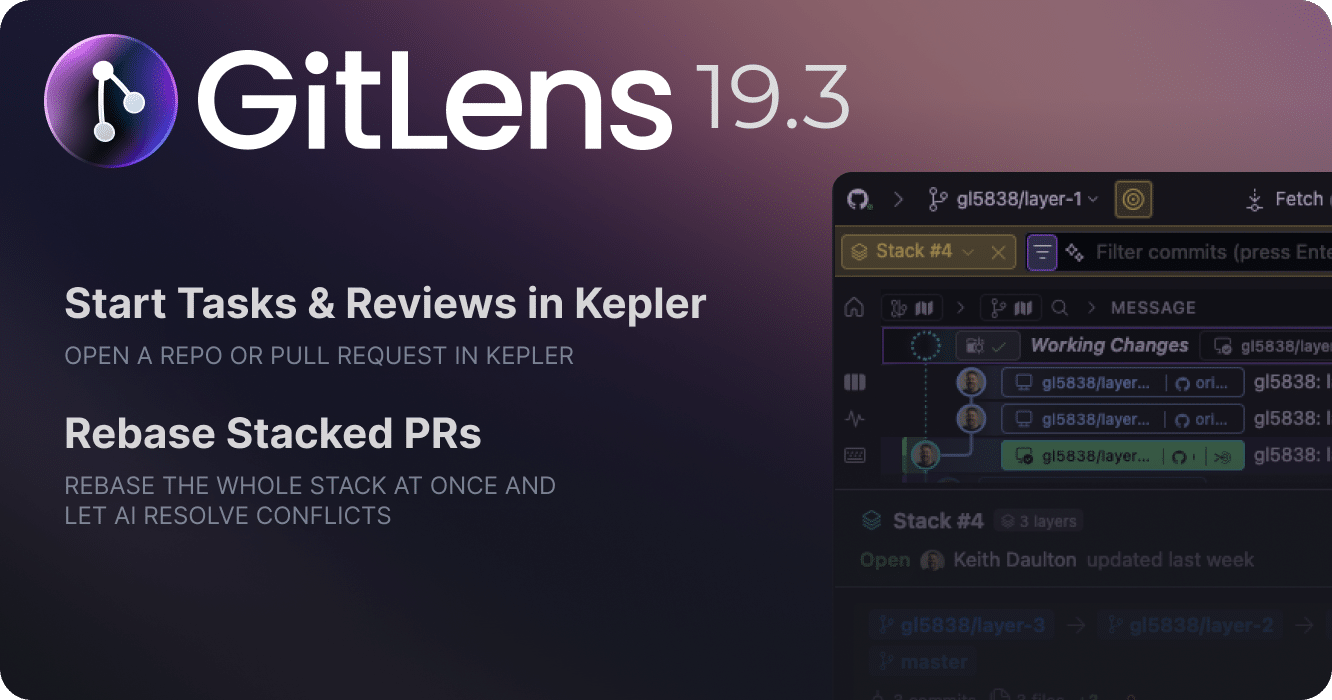
Start Tasks and Reviews in Kepler
Kepler is GitKraken’s Agentic Development Environment (ADE), and GitLens can now hand work to it from wherever you are.
Start Task in Kepler is available on repositories, and Start Review in Kepler is available on pull requests. Both appear in GitLens views, Launchpad, and the Commit Graph. Each one opens Kepler with the repository or pull request already loaded, so you can start working without setting anything up first.
Kepler in Start Work and Start PR Review — for items Kepler supports, both flows now offer Open in Kepler alongside opening in an agent or continuing manually. If Kepler is always where you want to go, set gitlens.ai.openInAgent to kepler and both flows will go straight there.
If Kepler isn’t installed, GitLens offers to get it for you. Once it’s installed, the Try Kepler banner stops appearing.
Rebase Stacked Pull Requests
Keeping stacked pull requests current used to mean rebasing them one branch at a time, in the right order, without missing one. Rebase Stack… now does the whole chain in one go. It replays each layer onto the one below it and the bottom layer onto the stack’s trunk. If you haven’t checked out a layer, it creates a local branch for it so the cascade stays unbroken. Every message tells you where you are (Branch 2 of 4), and when it finishes you’re back on the branch you started from.
Auto-Rebase Stack… hands conflicts to AI the whole way up. When it needs your help it pauses instead of unwinding. Once you’ve resolved the conflict, Continue with Auto-Rebase carries on through the rest of the stack, not just the branch you fixed.
Publishing the result — when the rebase completes, GitLens offers Force Push Stack with every rewritten branch pre-checked, so you can uncheck any you want to hold back. The offer also appears on the Auto-Rebase Summary and as the Git Force Push Stacked Pull Requests… command, so dismissing the notification doesn’t lose it. It goes away on its own once every branch is published.
Stack rebasing is only offered when the stack has drifted from its trunk, either by falling behind or by conflicting with it, so a stack that’s already current won’t prompt you. You’ll find it on the Commit Graph‘s pull request sheet and side bar stack rows, in Launchpad, in the rebase quick pick, and as the Git Rebase Stacked Pull Requests… and Auto-Rebase Stacked Pull Requests… commands.
Start From Anywhere
A no-repository state that helps you begin — when no repository is open, the Commit Graph‘s empty state now offers grouped ways to start: open a folder, clone a repository, or start a new project by opening a remote repository on the web. Start Work on an Issue and Start Review on a PR sit alongside them.
Start Work and Start PR Review without a repository — both now list your issues and pull requests across all your connected integrations, even with nothing open. Once you pick one, GitLens offers to locate the repository in a local folder, or to clone it when the integration provides a repository URL (every pull request, and GitHub issues). When an integration can’t search issues across your whole account, Start Work now says so. Bitbucket, for example, has no account-wide issue search, so instead of quietly contributing nothing to the list, it tells you and points you to open a repository.
Hand it to an agent, or don’t — Start Work and Start PR Review now follow the gitlens.ai.openInAgent setting. After you pick an issue or pull request, they ask whether to open it in an agent (or in Kepler, as described above) or continue yourself, unless you’ve already set a default. The agent pickers also remember your choice with a single Always use this choice / Always use this agent option, instead of a checkbox on every row.
Sign-in Screens That Remember What You Were Doing
Opening something in the Commit Graph while signed out, or before upgrading, used to land you on a generic screen and forget what you’d asked for. Now the sign-in and upgrade screens name the task that was interrupted, whether that’s a commit, branch, tag, or stash, a file or folder’s history, a comparison, your working changes, a branch focus, or an automatic rebase summary. Once you have access, it opens in the graph.
That includes Ctrl-clicking a commit hash in the terminal: instead of an unexplained sign-in screen, you see which commit you clicked, and GitLens holds it until you’re signed in. Comparisons and file or folder histories opened this way are no longer discarded, and if a second task arrives while the screen is open, the screen updates to describe it.
Everyday Improvements
- Section headers in GitLens views, such as Files Changed in Inspect and the Commit Graph‘s side bar panels, now match VS Code’s Modern UI headers when Modern UI is on.
- Hide Remote-only Branches in the Commit Graph now hides only remote branches with no local counterpart. Remote branches that your local branches track keep their pills and commits.
- Create Branch… with Create Branch in New Worktree now always keeps the branch name you entered. Deleting a branch that has a worktree now deletes both in a single confirmation.
- Azure DevOps pull request links are fixed: they’re no longer malformed, they keep the collection when the server sits behind a virtual directory, and they always point at your configured organization.
- Autolinked pull requests and issues no longer disappear from Inspect, hovers, and views after a failed lookup. GitLens retries the next time they’re needed.
- The GitKraken AI usage meter now reads Allowance used when your weekly allowance is fully spent, and shows enough precision to tell a nearly-spent allowance from a spent one.
Added
- Adds starting a task or a pull request review in Kepler, right from where you are in GitLens (#5760)
- Adds Start Task in Kepler to repositories, and Start Review in Kepler to pull requests in GitLens views, Launchpad, and the Commit Graph — each opens Kepler with the repository or pull request ready to go
- Adds Open in Kepler to Start Work and Start PR Review for items Kepler supports, alongside opening in an agent or continuing manually — or choose
keplerforgitlens.ai.openInAgentto go straight there - Offers to get the Kepler application when it isn’t installed, and stops showing the Try Kepler banner once it is
- Adds rebasing an entire stacked pull request chain in one action (#5838)
- Rebase Stack… cascades bottom to top, replaying each layer onto the one below it and the bottom layer onto the stack’s trunk — and creates a local branch for any layer you haven’t checked out, so no link in the chain is skipped
- Auto-Rebase Stack… resolves conflicts with AI the whole way up, pausing instead of unwinding when it needs your help — Continue with Auto-Rebase then picks up the rest of the stack, not just the branch you fixed
- Every message names where you are in the stack (Branch 2 of 4), and the cascade puts you back on the branch you started from
- Offers Force Push Stack on completion, listing each rewritten branch pre-checked so you can hold any of them back — the offer also lives on the Auto-Rebase Summary and as a Git Force Push Stacked Pull Requests… command, so it survives the notification being dismissed, and retires itself once every branch is published
- Offered only when the stack has drifted from its trunk — behind it, or conflicting with it — so an already-current stack isn’t invited into a rebase that would do nothing
- Reachable from the Commit Graph‘s pull request sheet and side bar stack rows, Launchpad, the rebase quick pick, and the Git Rebase Stacked Pull Requests… and Auto-Rebase Stacked Pull Requests… commands
- Adds start actions to the Commit Graph‘s no-repository empty state — grouped ways to get going: open a folder, clone a repository, or start a new project (open a remote repository on the web), alongside Start Work on an Issue and Start Review on a PR
- Adds Start Work and Start PR Review support when no repository is open — both now list your issues and pull requests across your connected integrations, and offer to locate the repository in a local folder before continuing, or to clone it when the integration supplies a repository URL (every pull request, and GitHub issues)
- Start Work now tells you when a connected integration can’t search issues account-wide, instead of letting it contribute nothing to a seemingly empty list — Bitbucket has no account-wide issue search, so it now says so and points you to open a repository
- Adds task-specific context to the Commit Graph‘s sign-in and upgrade screens when navigating to it from other areas of GitLens (#5820, #5784)
- Names the task that was interrupted — opening a commit, branch, tag, or stash, a file or folder’s history, a comparison, your working changes, a branch focus, or an automatic rebase summary — and confirms it will open in the Commit Graph once you have access
- Ctrl-clicking a commit hash in the terminal now names the commit and holds it until you’re signed in, instead of landing on an unexplained sign-in screen
Changed
- Changes Start Work and Start PR Review to follow the
gitlens.ai.openInAgentsetting — after you pick an issue or pull request they now ask whether to open it in an agent or continue manually, unless you’ve set a default - Changes the agent pickers to remember your choice with a single Always use this choice / Always use this agent option, instead of a checkbox on every row
- Changes section headers in GitLens views, such as Files Changed in Inspect and the Commit Graph‘s sidebar panels, to match VS Code’s Modern UI headers — with Modern UI on they use its 12px semibold header text in title case (or all caps when
workbench.experimental.modernUIUppercaseViewHeadersis enabled), and they’re unchanged when it’s off
Fixed
- Fixes GitKraken AI telling someone on a Pro trial to Upgrade to GitLens Pro when a request is refused for lack of entitlement — it now names the trial and offers to upgrade to the trialed plan (#5789)
- Fixes a comparison, or a file or folder history, opened in the Commit Graph while signed out or before upgrading being discarded instead of opening once access is granted (#5820)
- Fixes the Commit Graph‘s sign-in and upgrade screens still describing the previous task when a second one arrives while they’re open (#5820)
- Fixes Create Branch… discarding the branch name you entered when you choose Create Branch in New Worktree (#4501) — from a remote base the worktree step replaced your name with the remote branch’s own and re-prompted with A branch named ‘main’ already exists, and from a local base that isn’t checked out anywhere it quietly created the worktree on that branch instead of a new one; a requested branch name is now always honored, including the
pr/branch Open Worktree for Pull Request asks for - Fixes Delete Branch… on a branch that has a worktree deleting the worktree but leaving the branch behind — Git refuses to delete a branch that’s checked out in a worktree, so both now happen together in a single confirm with Delete Branch pre-checked; uncheck it to keep the branch. Prune Branches… works the same way
- Fixes the Delete Worktree confirm offering to delete a branch’s upstream when that upstream is already missing from the remote
- Fixes the GitKraken AI usage meter saying Nearly out when the weekly allowance is spent in full — it now reads Allowance used in the error color, in both GitLens Settings and the Commit Graph‘s account rollup
- Fixes the credits figure rounding a nearly-spent allowance to look identical to a fully-spent one (
3.2M of 3.2M creditsfor either) — it now shows enough precision to tell the two counts apart, and the account rollup’s percentage no longer rounds up to100%while credits remain
- Fixes the credits figure rounding a nearly-spent allowance to look identical to a fully-spent one (
- Fixes Hide Remote-only Branches in the Commit Graph hiding every remote branch (#5852) — a remote branch that a local branch tracks isn’t remote-only, so it now keeps its pill and its commits stay in the graph; only remote branches with no local counterpart are hidden
- Fixes a tracked remote branch still counting as remote-only when its local branch’s tip sat outside the loaded commits — tracking is now resolved from all of your branches instead of only the ones the graph had walked, which also restores the upstream half of the ref pills it affected
- Fixes the Commit Graph‘s commit hover ignoring its minimum width — the width rule was invalid CSS and silently dropped, so a short commit message rendered as a narrow sliver instead of keeping the card’s intended size
- Fixes hard-to-read text on customized Commit Graph lane colors — labels on a mid-lightness
gitlens.graphLaneNColorcolor used white text where black was far more legible; they now pick whichever gives more contrast - Fixes Azure DevOps pull requests returning
undefinedfor their base and head repository links — the repository reference Azure embeds in a pull request does not include a web URL, so the link is now built from the organization and server the pull request was read from (#5839) - Fixes Azure DevOps Server links dropping the collection when the server sits behind a virtual directory —
https://server/tfs/DefaultCollection/…readtfsas the organization and lost everything after it (#5840) - Fixes an Azure DevOps pull request’s repository links being able to point at another organization, or another server entirely, when the pull request payload said so — the links are built from the configured organization now, and a fork’s link must belong to it (#5842)
- Fixes malformed Azure DevOps pull request web URLs — the URL had a double slash after the host (both
dev.azure.comand*.visualstudio.com) and left project and repository names unencoded, so a project or repository named with a space put a literal space in the link (#5836) - Fixes autolinked pull requests and issues disappearing from Inspect, hovers, and views until the window is reloaded — a failed lookup (a rate limit, server error, or timeout) was remembered as “not found” for the rest of the session, and enrichment done before an integration finished connecting was kept for 30 minutes; failed lookups are now retried the next time they’re needed
- Fixes files you uncheck in the Commit Graph‘s Review and Compose modes getting checked again — the details panel refreshing reset your exclusions (and, in Compose, your excluded commits), so an unchecked file could quietly end up back in the review or commit plan
- Fixes the commit range appearing twice at the top of the Commit Graph‘s Review results for a commit selection
- Fixes the Commit Graph‘s Next steps permanently listing a branch’s merged or closed pull request as something to act on (#5846) — only an open pull request is offered now, and a branch whose pull request is merged or closed gets Create a Pull Request instead; the header still shows the merged or closed pull request
- Fixes entering a reference in the Git Command Palette‘s show command discarding it and going back to the command menu (#5855) — pressing Enter before the reference finished resolving chose Back, and a branch or tag name never resolved at all; Enter now waits for the reference, branch and tag names resolve to their commit in every commit step, and a reference that doesn’t resolve keeps what you typed
Version 19.2
Tuesday, September 15, 2026
GitLens 19.2 now speaks your language. GitLens follows your VS Code display language, with experimental Spanish and Chinese (Simplified and Traditional) translations available today — install the matching VS Code language pack and GitLens switches over with it, falling back to English for anything not yet translated.
The Commit Graph can now be scoped to a worktree. Scope to Worktree re-points the whole graph at that worktree — its working changes become the primary WIP row, its status drives the markers and ahead/behind counts, and every action runs with it as the working directory. History is never re-walked, so scoping and unscoping are immediate and keep your scroll position, selection, search, and filters intact.
The Graph can also save your column arrangement, sizing, grouping, and panels as the default for new workspaces, rebind or disable its keyboard shortcuts, and run your default VS Code task in any worktree with a single click. Past Codex, OpenCode, and GitHub Copilot CLI agent sessions can now be resumed too — in a terminal, or in the agent’s own extension.
Rounding things out, the Home view has been retired now that the Commit Graph covers and expands on everything it did, onboarding is consolidated into the Welcome view, and a new Send Feedback dialog puts feature requests and bug reports one click away.
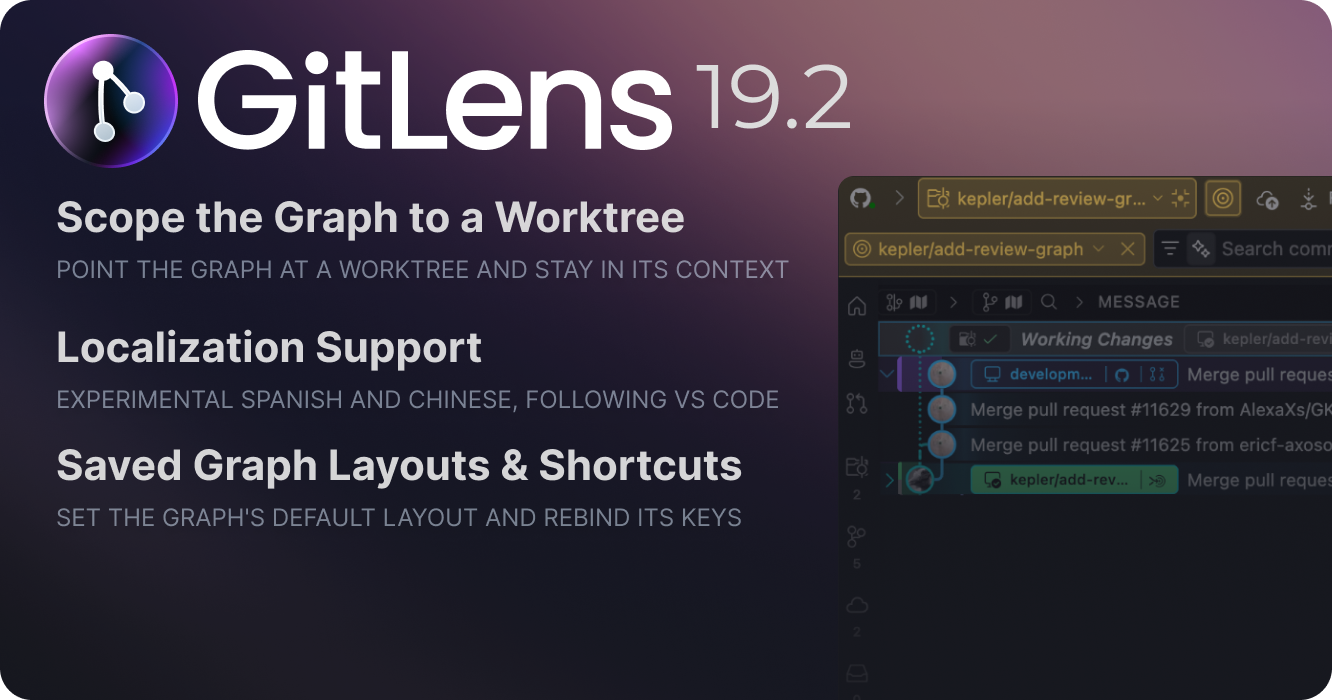
GitLens in Your Language
GitLens is now localized. It follows your VS Code display language, so installing the matching VS Code language pack switches GitLens over too — no separate setting to find.
Spanish and Chinese (Simplified and Traditional) are experimental translations in this release. Anything not yet translated defaults to English, and Git syntax, references, paths, commands, and product names are deliberately left untranslated, so what you type and what you search stays the same everywhere.
Scope the Graph to a Worktree
Scope to Worktree points the entire Commit Graph at a worktree. Its working changes become the primary WIP row, the current-branch markers, ahead/behind, and upstream status all follow it, and every action you run — commit, pull, push, switch — uses it as the working directory. Because history is never re-walked, scoping and unscoping are immediate and preserve your scroll position, selection, search, and filters.
You can scope from worktree rows in the side bar, by double-clicking a WIP row or overview bar pill, from WIP row context menus, or with the Focus in Commit Graph commands. A scoped graph tints its title bar and names the worktree’s branch in a pill — hover it for an explanation of the scope, or use its Unscope Worktree button to return to your active worktree. The scope survives reloads, and the first time you scope, a coach mark explains what changed.
Scope and focus are now independent. Focus names the branch projection — narrowing the visible rows to a branch’s history — while Scope names the worktree perspective, so a scoped graph still shows every commit unless the branch is focused too. Two settings control how they combine: gitlens.graph.scopeBehavior (whether scoping also focuses the worktree’s branch, the default) and gitlens.graph.doubleClickWorktreeAction (whether a double-click scopes or just focuses).
A Graph That Fits the Way You Work
Save your layout as the default — arrange columns, sizing, grouping, and panels how you like, then use Save as Default Layout in the column header or settings gear menus to make it the starting point for new workspaces. Apply Saved Layout re-applies it anytime, and Reset Layout restores the shipped arrangement.
Rebind the keyboard shortcuts — the new gitlens.graph.shortcuts.overrides setting lets you rebind or disable the graph’s modifier-key shortcuts (Alt+M, Ctrl+↑, and the rest) by id — hover a shortcut in the ? reference to find its id — or turn them all off with gitlens.graph.shortcuts.enabled.
Worktree Tasks and Resumable Agent Sessions
Worktree WIP rows in the Commit Graph gain a Run Default Task button that runs your chosen default VS Code task in that row’s worktree in one click. The first click asks which task to make the default; any task can be marked or unmarked as the default from the Run Task on Worktree picker, and Alt+click always opens the picker. While a task is running the button shows a spinner, and clicking reveals that task’s terminal instead of starting another.
Resuming past agent sessions now works for Codex, OpenCode, and GitHub Copilot CLI as well. Every Resume action names where it goes — Resume in Terminal or Resume in <Agent> Extension — and shows both when a session can open either way. The new gitlens.agents.resumeTarget setting picks which one Enter uses in the Resume Agent Session picker, or asks the first time with an option to remember.
Connecting agents is easier, too: the graph’s Agents side bar panel now explains why it’s empty instead of showing a generic “No items”, with a connect action named for your default agent that opens GitLens Settings and installs that agent’s hooks immediately.
Everyday Improvements
- A Generate Changelog action now works on multi-selected commits in the Commit Graph, even when the selection isn’t contiguous.
- Working changes Next steps offer Force Push alongside Pull when a branch has diverged from its upstream — the state you land in after a rebase or recompose.
- In repositories where loading commit file details has been slow, the Commits and other history views now load them on demand automatically, rather than making you find the setting yourself.
Added
- Adds localization infrastructure for GitLens using VS Code’s display language, with English fallback when a translation is unavailable
- Adds experimental Spanish and Chinese (Simplified and Traditional) translations — GitLens follows your VS Code display language, so installing the matching language pack switches GitLens over too; the translations are AI-generated and reviewed, and anything not yet translated stays in English
- Adds worktree scoping to the Commit Graph — Scope to Worktree (on side bar worktree rows, working-changes (WIP) row and overview bar pill double-clicks, WIP row context menus, and the Focus in Commit Graph commands) now re-points the whole graph at that worktree: its working changes become the primary WIP row, the current-branch markers, ahead/behind and upstream status follow it, and every action runs with it as the working directory. History is never re-walked, so scoping and unscoping are immediate and keep your scroll position, selection, search, and filters; a scoped graph tints its title bar and names the worktree’s branch in a pill whose hover explains the scope and whose Unscope Worktree button returns to your active worktree; the first time you scope, a coach mark explains what changed. Scope and focus are now independent — a scoped graph still shows every commit unless the branch is focused too; a scoped graph stays scoped across reloads
- Adds a
gitlens.graph.scopeBehaviorsetting — whether Scope to Worktree also focuses the worktree’s branch, narrowing the visible rows to its history (scopeAndFocus, the default), or scopes without narrowing anything (scope) - Adds a
gitlens.graph.doubleClickWorktreeActionsetting — whether double-clicking another worktree’s WIP row, overview bar pill, or side bar row scopes the graph to it (scope, the default) or just focuses its branch (focus)
- Adds a
- Adds saving your Commit Graph layout as the default for new workspaces (#4292) — arrange columns, sizing, grouping, and panels how you like, then use the new Save as Default Layout action in the column header or settings gear menus; the new Apply Saved Layout action re-applies it anytime, and Reset Layout restores the shipped arrangement (replacing the previous Reset Columns to Default/Compact Layout actions)
- Adds a Send Feedback dialog (#5812) — reachable from the Commit Graph‘s title toolbar and its account menu; choose general feedback, a feature request, or a bug report about GitLens and send it straight to the team, bug reports also open a prefilled GitHub issue so you can add logs and details, and feature requests offer to file one
- Adds customizing the Commit Graph keyboard shortcuts (#5813) — use the new
gitlens.graph.shortcuts.overridessetting to rebind or disable its modifier-key shortcuts (Alt+M,Ctrl+↑, …) by id (hover a shortcut in the?reference to see its id), orgitlens.graph.shortcuts.enabledto turn them all off - Adds a Run Default Task button to worktree working-changes (WIP) rows in the Commit Graph — runs your chosen default task in the row’s worktree in one click; the first click asks which task to make the default, any task can be marked (or unmarked) as the default from the Run Task on Worktree picker, and Alt+click always opens the picker; while a task is running the button shows a spinner and a Running: <task> tooltip, and clicking reveals that task’s terminal instead of starting another
- Adds a Generate Changelog action to multi-selected commits in the Commit Graph (#4088) — generates an AI changelog from exactly the selected commits, even when the selection isn’t contiguous
- Adds resuming past Codex, OpenCode, and GitHub Copilot CLI agent sessions — every Resume action now names where it goes, Resume in Terminal or Resume in Extension, and shows both when a session can open either way; the new
gitlens.agents.resumeTargetsetting picks which one Enter uses in the Resume Agent Session picker, or asks the first time with an option to remember - Adds a Force Push action to the Commit Graph‘s working-changes Next steps when a branch has diverged from its upstream (#5832) — after a rebase or recompose the branch is both ahead and behind, and the diverged step now offers Pull and Force Push side by side, instead of only pointing at Pull
Changed
- Changes the Commits view and other history views to load commit file details on demand in repositories where loading them has been slow (#5498) — the
gitlens.advanced.commits.delayLoadingFileDetailssetting now defaults tonull(automatic); set it totrueorfalseto force either behavior - Consolidates the Get Started walkthrough into a single step that opens the Welcome view (#5809) — the Welcome view is now the unified onboarding experience; the extension’s Get Started action, Launchpad’s learn-more links, and walkthrough deep links all open it directly
- Improves the flow of connecting agents from the Commit Graph‘s Agents side bar panel (#5777) — the panel now explains why it is empty instead of showing a generic “No items”, with a connect action, named for your default agent (e.g. Connect Claude Code…), that opens the Agents page in GitLens Settings and immediately installs that agent’s hooks (Manage Agents… when there is no connectable default); adds a Start Agent Session… header action (hold
Altto always pick the agent) - Changes the Commit Graph‘s worktree actions from Focus on Worktree to Scope to Worktree — Focus now names only the branch projection (narrowing the rows to a branch’s history) and Scope names the worktree perspective, so the two read as the independent modes they now are; worktree rows offer both verbs on one button (Scope to Worktree on click, Focus on Branch on Alt+click), and both are hidden for a detached-HEAD worktree, which has no branch to act on
- Changes the Commit Graph minimap’s Zoom to Scope action to Zoom to Focus — matching the graph’s vocabulary now that Scope names the worktree perspective
- Changes double-clicking a working-changes (WIP) row or overview bar pill whose branch is already focused through a pull request or a stack to re-focus it as a plain branch instead of unfocusing — reaching the same branch a different way changes what the graph shows, so it counts as a new focus rather than a repeat of the last one; the side bar already behaved this way
- Improves the Commit Graph‘s account rollup — the AI and Agents sections now name what they contain instead of showing unlabeled glyphs: Agents lists each detected agent with its MCP and hooks state, and AI names the active model and gives your GitKraken AI credits their own row; the walkthrough and refer-a-friend rows move into a footer
- Improves the Commit Graph‘s pull request sheet — it opens immediately as a skeleton and fills in when the pull request resolves, its description scrolls with a Show More toggle instead of being clipped, images pasted into a description render as chips that open in the browser, and a missing description says so; the title and number open the pull request on the remote, with Alt copying its URL
Removed
- Removes the
gitlens.graph.experimental.kanban.enabledandgitlens.graph.experimental.visualizations.enabledsettings — Agent Kanban and supported visualizations are always available from the Commit Graph - Removes the Home view — superseded by the Commit Graph, which covers and expands on its workflows (#5778); existing Home deep links now open the Commit Graph
- Moves the unsafe-repository explanation into the Commit Graph — when Git blocks repositories as potentially unsafe, its empty state now says so and points at Source Control, instead of a generic “no repository” message
Fixed
- Fixes the Commit Graph commit details Generate Commit Message silently doing nothing when the AI provider fails with an untyped error (e.g. Copilot credit limit) — the failure is now surfaced as an error notification, matching the Source Control panel
- Fixes the Commit Graph retaining outdated parent connections and file statistics after deepening a shallow clone or changing Git replacement refs
- Fixes closing Compose or Review after restarting discarding the saved work, and restores Resume when returning after navigating away
- Fixes contextual tips already seen in one Commit Graph view showing again after another view saves its seen tips
- Fixes #5827 – It’s impossible to use the “Search for commits” dialog
- Fixes the Git Command Palette and other quick picks failing to open on editors older than VS Code 1.108, such as Google Antigravity — the quick pick
promptAPI is proposal-gated there and throws when set (#5807) - Fixes all GitLens webviews staying blank when the Google Antigravity extension is installed — its
postMessagepatch mangled the binary messages GitLens sends to its webviews, which are now recovered (#5818, #5797) - Fixes AI operations staying in their in-progress state after a request fails on rate limits, exhausted funds, or a missing entitlement (#5781) — Review, Compose, generated explanations, and the rest now end and report the failure as soon as the request fails, instead of appearing to keep working until the error notification is dismissed; the notification’s Switch Model and Upgrade offers stay available afterward
- Fixes a Review that failed this way reporting no failure at all — it now surfaces the actual reason instead of reporting the run as cancelled
- Fixes GitLens AI staying without a model after verifying your account’s email — the resolved model and GitKraken AI usage allowance now refresh on verification, and when a trial starts or ends, instead of staying empty until a window reload or opening the model picker (#5621)
- Fixes clicking an issue or autolink in a branch’s hover on the Commit Graph clearing the graph (#5224) — the link now opens in your browser and the graph stays put
- Fixes Commit Graph ref pills permanently missing their pull request and issue badges when the graph loads before your GitHub connection is ready — the badges now appear once the connection is recognized, instead of needing a window reload
- Fixes Commit Graph ref pills losing their pull request badges after a transient lookup failure (rate limit, server error, expired session) — a failed lookup is no longer cached as “no pull request”, and the graph retries instead of leaving the pill blank
- Fixes opening a stacked pull request from the Commit Graph giving up after 5 seconds and dropping you out to the browser — the sheet now resolves the pull request and its stack directly, instead of waiting for the repository’s entire open pull request list to load
- Fixes Commit Graph reveals landing short of the target commit in the list layout — a reveal now waits for the row height to settle, and a row-height change keeps the viewport anchored instead of leaving it scrolled to the old position
- Fixes reordering Commit Graph columns moving the grouped columns into whichever column is dropped at the group’s position
- Fixes the Commit Graph header and push flow offering nothing when a branch’s upstream was deleted on the remote — a gone upstream is now treated as unpublished, so Publish is offered
- Fixes author avatars failing to load in the Commit Graph as new authors scroll into view — each lookup sent an empty ref instead of the commit’s sha and was rejected
- Fixes opening an agent session hosted in a terminal only raising the VS Code window — it now shows the terminal or tab actually running the session, including when that session is in another window
- Fixes the Repository Health banner continuing to show after applying one of its suggested optimizations — acting on a suggestion now quiets it for 30 days, the same as dismissing it
- Fixes the merge conflict check failing on Git 2.33–2.37, and the cherry-pick and rebase conflict checks failing before Git 2.40 — each was gated on an older Git version than the flags it uses
- Fixes typos and inconsistencies in user-facing text (#5849) — corrects misspellings, broken grammar, and stray punctuation across notifications, quick picks, and settings descriptions, including a misspelled “acccount” in the Launchpad snooze prompt, a stray brace in the deep-link clone progress title, a missing space before the em dash in the Cloud Patch created notification, the Open Current Branch on Remote picker titling itself “Open Current Branch Name”, and seven Reveal settings reading “otherwise they revealed”
- Fixes four settings descriptions rendering a dead
#…#link because they named a setting that does not exist —gitlens.advanced.blame.delayAfterEdit, the deprecatedgitlens.views.commitFormatandgitlens.views.stashFormat, andgitlens.ai.openInAgent - Fixes the Git CodeLens and status bar click-command settings describing Search for Commits within Selection as “Shows the Inspect”, and the deprecated
gitlens.outputLevelnaming the debug logging commands without their “(Trace)” part - Fixes stale
eamodio/vscode-gitlenswiki links in three view format settings
- Fixes four settings descriptions rendering a dead
Version 19.1
Tuesday, September 1, 2026
GitLens 19.1 now supports live agent status for more coding agents – Codex, GitHub Copilot CLI, and OpenCode sessions now appear everywhere Claude Code’s already do — the Agents side bar panel, details panel, Graph WIP rows, and more. Each session displays the agent’s state with full right-click controls so you can jump in when your Agent needs you without distrupting your focus. You can start an agent session or run a VS Code task on any worktree without opening it, and the graph will follow your active terminal to the worktree it’s in. Install GitKraken Hooks for each agent to integrate its status directly into your GitLens workflows from GitLens Settings.
Everyday Git operations are expanded and given a sharper flow – Fixup commits arrive in the graph, autosquash lands in rebases, and tags can finally be pushed — while the Git Command Palette has been rebuilt around one consistent confirmation design. The graph itself says more per row, with multiple branch and tag pills, WIP rows that name the branch they sit on, and hidden refs you can actually find again. Search gets more intent-aware, and finding nothing now offers counted broader alternatives instead of a dead end.
GitLens also starts looking after the repository itself, keeping up the routine work git gc performs quietly in the background so history loads fast, with a new experimental Repository Health visualization to show what it noticed and what each suggested optimization costs before anything is applied.
Rounding things out, a pending rebase can be handed straight to automatic (AI) conflict resolution from the Interactive Rebase Editor, and a new GitKraken AI usage meter in the Account section of GitLens Settings gives you more visibility into what you’ve used and when it resets.
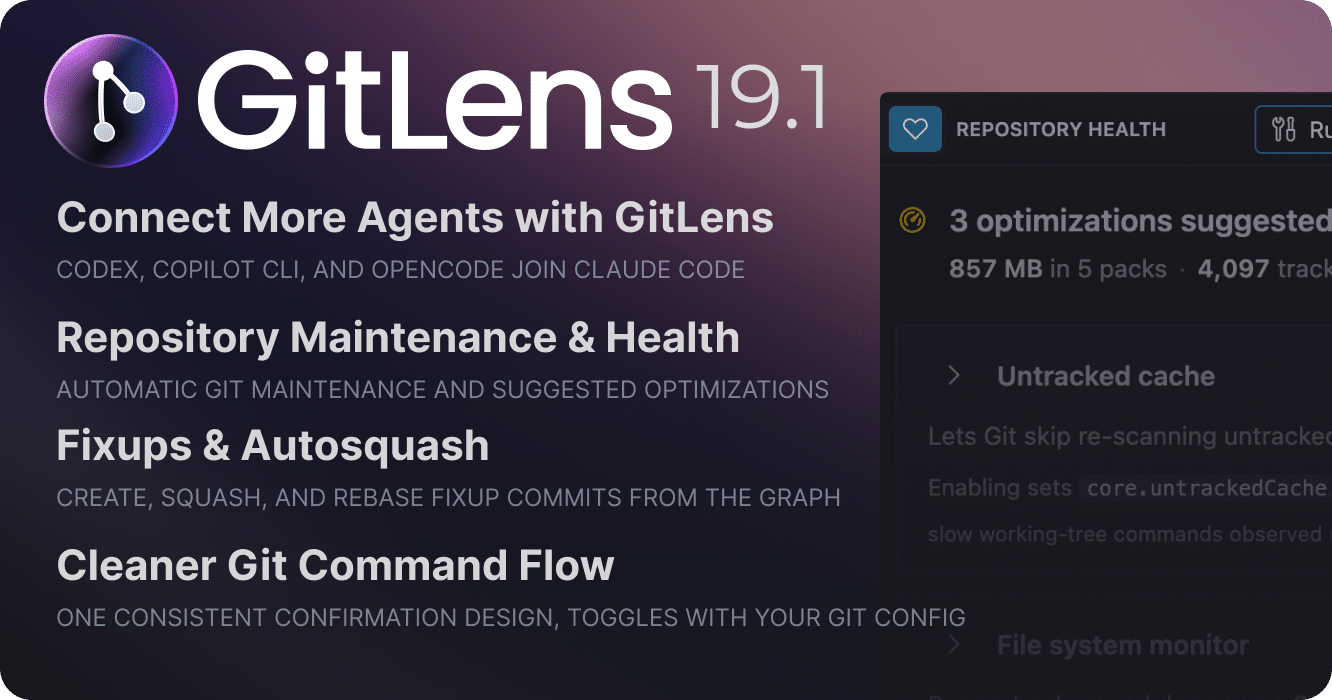
More Coding Agents Integrated in the Graph
Live agent status is no longer Claude Code’s alone. Codex, GitHub Copilot CLI, and OpenCode sessions now appear everywhere agent status is shown to ensure full visibility into your coding agent sessions throughout your workflows. Each agent carries its own icon so sessions from different agents stay distinguishable, and GitKraken Hooks can be installed for them from GitLens Settings. Agent sessions also gain full right-click context menus, with permission actions, View Plan, open and resume actions, worktree and terminal actions, and Archive Session.
Put a worktree to work without opening it — A Start Agent Session… action on WIP rows and worktrees opens a terminal at that worktree running your default coding agent CLI, and a Run Task on Worktree… action runs a VS Code task — from tasks.json, or an auto-detected one like an npm script — with the worktree as its working directory, so build, test, and launch tasks can target a worktree you never had to open.
The graph follows your terminal — While a graph is visible, switching to a terminal (or a Claude Code conversation tab) selects the working changes row of the repository or worktree it’s in — without raising the graph, opening the details panel, or switching repositories. It’s on by default, with toggles in the graph’s “…” menus and a one-time tip the first time it moves your selection.
Fixup Commits, Autosquash, and Push Tags
Fixup commits in the Commit Graph — a new Fixup Commit… action on any commit seeds the working-changes commit box with a fixup! <subject> message. Once a message resolves to a target, the commit button becomes a split button: Commit Fixup creates the fixup to squash later, while Commit Fixup & Squash folds it into its target immediately. A Squash Fixups… action on the current branch and working-changes rows squashes all pending fixups into their targets, warning first when pushed commits would be rewritten.
Autosquash in rebases — a new toggle in the Git Command Palette folds fixup! and squash! commits into the commits they target, defaulting from your rebase.autosquash Git config. Interactive rebases open the Interactive Rebase Editor with the fixups already folded; plain and automatic rebases fold them directly. (Requires Git 2.44.)
Pushing tags — a new Push Tag… action on tags in the views and the Commit Graph, and a Git Push Tag… command in the Command Palette. Choose the remote (skipped when there’s only one) and confirm, with an optional force push for moved tags.
A Rebuilt Git Command Palette
The Git Command Palette‘s confirmations have been redesigned around one consistent shape: action rows with the safest choice pre-selected, plus checkbox toggles for options — replacing a separate row for every flag combination. Toggles default from your Git config (fetch.prune, merge.ff), and Force toggles visibly rewrite the action and never default on.
Pushing now has three consistent confirmation shapes (ahead, behind, and unpublished) with the blocking reason shown above the choices, switching offers just the targets plus an In a New Worktree toggle, and stashing asks for the message first so the final Enter stashes — with a new Stash Changes & Untracked mode and a Keep Staged toggle making previously unreachable combinations possible. Worktree creation and deletion each collapse into a single step with in-place toggles, and skippable confirmations gain a Don’t Ask Again checkbox.
More at a Glance in the Graph
Multiple refs per row — A row can now show more than one branch or tag pill. The new gitlens.graph.refs.maxInline setting caps how many show before the rest collapse behind the +N counter — a fixed count (default 1, the previous behavior) or "auto" to fit the available space. A new gitlens.graph.refs.layout setting adds a "stacked" option, where rows with pills grow a second line to show them above the commit instead of beside it.
WIP rows with an identity — Every working-changes row — the current branch’s and each worktree’s — now carries a branch pill right after Working Changes naming the branch it sits on. Click the pill to jump to the branch’s tip, or to its upstream or merge target when those are known.
Manage hidden refs easily — Hide Remote and Show Remote actions join remote rows in the side bar, and hidden branches, remotes, and tags now show dimmed with an eye-closed marker and an un-hide action instead of being indistinguishable from visible ones. You can even un-hide a single branch of a hidden remote — the remote stays hidden while just that branch returns.
Jumps that land, or tell you why not — Jumping to a commit hidden by your filters, branch visibility, scope, or first-parent-only following now shows a message naming the blocker with a one-click remedy (Show Branch, Clear Scope) that completes the jump, and a commit that isn’t in the repository is reported immediately instead of silently timing out. Keyboard navigation reaches across not-yet-loaded history too, rather than stopping at the edge of what’s loaded.
Maximizing the details panel now overlays the graph instead of resizing it, so the graph behind keeps its exact layout and restoring is instant — and the details toggle becomes a split button whose chevron opens a placement menu with Auto, Right, and Bottom thumbnails. The side bar’s Overview panel is also now the panel the side bar opens to, with branch cards that act as a scope toggle, native branch context menus, and a Load More control.
Repository Health and Automatic Git Maintenance
A slow repository is usually a repository Git hasn’t been allowed to tidy up. GitLens 19.1 takes care of that for you, and shows its work.
After a Commit Graph load, GitLens now writes the repository’s commit-graph file in the background when it’s missing or stale — the same standard cache git gc and git maintenance write — so the graph’s next open starts emitting rows right away. Beyond that, GitLens checks each repository’s shape and, at most once a day, runs the same routine work git gc performs: packing loose objects and incrementally repacking. These reorganize objects the repository already contains; they never alter history. More invasive levers — Git’s untracked cache, FSMonitor, system-scheduled git maintenance, and feature.manyFiles — are never applied for you, and anything you’ve configured yourself is left alone. All of it is controlled by the new gitlens.gitOptimizations.enabled setting.
The new experimental Repository Health visualization — a heart tab in the graph’s visualizations switcher — is where you see the reasoning: suggested optimizations appear as cards with a meter showing the measured value against the threshold that triggered it, every optimization carries expandable details explaining what it does and what it costs, and a ledger lists each lever with its state and ownership — one GitLens applied offers Undo, while one you enabled yourself is left alone. A Run Maintenance Now action and a per-repository toggle sit alongside.
You’ll also be told when it matters. When a repository has suggested optimizations and Git has been measurably slow there (or the repository is clearly large), a dismissible strip above the graph explains what was noticed and opens Repository Health in one click.
Search That Understands What You Mean
Natural language search in the Commit Graph now reads your intent. “Only show …” phrasings filter the graph to matches, “take me to …” phrasings jump to the commit, and a search that finds nothing offers counted broader alternatives — 1000+ without the date filter, say — instead of a dead end. It also understands your repository: branch, tag, worktree, and contributor names resolve to the real thing rather than being guessed, misspelled author names come back as counted corrections, and a tooltip on the generated query explains how your phrasing was interpreted.
Classic search gets more precise, too, with new committer:, type:merge, and -message: (exclude) operators in both the Commit Graph and Search & Compare. Failures now say what actually went wrong, and a pattern that isn’t valid regular expression syntax quietly matches literally instead of erroring while you’re still typing.
Automatic Rebase, from the Rebase Editor
The Interactive Rebase Editor gains a Start Auto-Rebase split button that hands the pending rebase off to automatic (AI) conflict resolution before it starts, executing the todo exactly as you arranged it. The editor closes, the run waits for the rebase’s first stop and takes over from there, and a rebase that finishes without ever pausing is reported as completed — not cancelled. Deliberate stops keep working the way you asked for them: edit and break steps hand back to you with a Resume with AI path, and a commit message that a reword or squash needs opens for you to write, where it was previously kept or auto-accepted without asking.
When a run does stop for you, the actions stay put — the Commit Graph‘s Resolve panel keeps Resume with AI and Abort Rebase available rather than offering them only in a transient toast, and the rebase editor’s paused view gains a Continue with AI button.
Monitor Your GitKraken AI Usage
A new GitKraken AI Usage card in the Account section of GitLens Settings shows your weekly credit allowance, how much of it you’ve used, and when it resets — along with your organization’s shared pool when one applies, broken down into your own draw against the rest of the organization’s. A compact usage meter also sits in the account rollup in the Commit Graph header and on Home, opening the full card when clicked.
Added
- Adds live status for more coding agents — Codex, GitHub Copilot CLI, and OpenCode sessions now appear alongside Claude Code’s everywhere agent status is shown, each with its own icon (#5742, #5798)
- Improves the Commit Graph‘s working-changes Agents section with one consistent, collapsible view for live and past sessions, inline history paging, and Resume and Archive actions
- Changes agent status indicators to one consistent phase mark everywhere sessions appear — and each session now shows its own agent’s logo instead of a generic robot
- Adds right-click context menus to agent sessions — on the Agents panel’s rows and the details panel’s session cards — with permission, plan, open/resume, worktree, terminal, copy, and Archive Session actions
- Adds an agent session details sheet to the Commit Graph — clicking a live or past session card opens its full details: status and elapsed time, the current permission ask with its resolve actions right there, the running tool, prompt history, and a file-activity tree whose files open with a click. Branch and worktree chips jump the graph to the session’s work, and past sessions offer Resume and Archive (Resume explains itself when the session’s transcript is gone)
- Adds installing GitKraken Hooks for these agents from the Agents section in GitLens Settings and the install-all commands; when an agent needs an extra step (Codex requires trusting the hooks via
/hooks), GitLens says so and offers to start a session to do it - Shows these agents’ permission requests as read-only — only Claude Code’s can be answered from GitLens today
- Adds deeper integration with your terminals and terminal-based coding agents — GitLens now connects the Commit Graph to the terminals and agent tabs where the work is actually happening
- Adds following of the active terminal or Claude Code tab — switching to one selects its repository’s or worktree’s working-changes row in the Commit Graph, so the graph keeps up with where you and your agents are working, without raising the graph or switching repositories; a one-time tip explains the first move and offers Turn Off (controlled by the new
gitlens.graph.followTerminal.*settings) - Adds Focus in Commit Graph, Open in Commit Graph, and Open in New Window actions to terminal tabs, terminal editor tabs, and Claude Code conversation tabs — opening the graph at the tab’s worktree with its working changes selected
- Adds a
gitlens.openInTerminalLocationsetting — controls where GitLens opens the terminals it creates (the Open in Integrated Terminal actions plus agent session terminals), either in the terminal panel (default) or as an editor tab
- Adds following of the active terminal or Claude Code tab — switching to one selects its repository’s or worktree’s working-changes row in the Commit Graph, so the graph keeps up with where you and your agents are working, without raising the graph or switching repositories; a one-time tip explains the first move and offers Turn Off (controlled by the new
- Improves the Commit Graph — richer branch and tag pills, worktree actions to start agents and run tasks, and refinements across navigation and the side bar
- Adds richer branch and tag pills
- Adds support for multiple pills on a row (#5729) — a new
gitlens.graph.refs.maxInlinesetting caps how many show before the rest collapse behind the +N counter (default 1, the previous behavior, or"auto"to fit the space) - Adds a stacked pill layout — with the new
gitlens.graph.refs.layoutsetting on"stacked", rows with pills grow a second line showing them above the commit, capped bygitlens.graph.refs.maxStacked(default"auto") - Adds a bright lane highlight when pinning a branch’s pill, and to the
Ctrl/Alt-held chain highlight — the branch’s lane stays lit and traces down to its fork point while other lanes mute - Improves remote branch pills — the branch’s remote now follows the name as a subtle qualifier (yielding first when space is tight);
gitlens.graph.showRemoteNamesstill switches to the fullremote/branchform - Adds a marker to a branch pill whose upstream is gone (deleted) — so a branch whose remote counterpart was removed is called out instead of looking healthy
- Adds Start Agent Session… and Start Agent Session With… actions to working-changes (WIP) rows in the Commit Graph and to worktrees in the views — opens a terminal at the worktree running your default coding agent CLI, or With… to pick which agent; Resume Agent Session… now also appears on worktrees in the views
- Adds a Run Task on Worktree… action to worktree working-changes (WIP) rows and to worktrees in the views — runs a VS Code task with the worktree as its working directory (and
GITLENS_WORKTREE_PATHin its environment), so build, test, and launch tasks can target a worktree without opening it - Adds feedback when a Commit Graph jump can’t land (#5699) — jumping to a commit hidden by your filters, visibility, scope, or first-parent following now names the blocker and offers a one-click remedy (e.g. Show Branch, Clear Scope) that completes the jump. A commit that isn’t in the repository is reported immediately, and longer searches show a cancellable Looking for… indicator
- Adds Hide Remote and Show Remote actions to remote rows in the Commit Graph side bar — and hidden branches, remotes, and tags now show dimmed with an eye-closed marker and a one-click un-hide, instead of being indistinguishable from visible ones. Hidden remotes show their provider’s icon, and un-hiding a single branch of a hidden remote brings just that branch back
- Adds Group and Ungroup commands for the Commit Graph‘s columns to its header context menus — grouping previously required dragging one column onto another
- Adds Copy Worktree Path to worktree branch pills and Copy Branch Name to working-changes (WIP) rows in the Commit Graph
- Adds Git health and maintenance — GitLens now keeps Git’s performance caches fresh and tells you when a repository needs attention (controlled by the new
gitlens.gitOptimizations.enabledsetting)- Adds automatic safe Git maintenance — once a day per repository, GitLens runs the same routine upkeep
git gcperforms: packing loose objects, incremental repacking, and writing the commit-graph cache, which makes history-heavy features like the Commit Graph open noticeably faster. These only reorganize objects the repository already has — history is never altered, more invasive optimizations are never applied automatically, and anything you configured yourself is left alone (requires Git 2.24+) - Adds an experimental Repository Health visualization — a heart tab in the Commit Graph that answers whether the repository needs attention: suggested optimizations appear as cards with meters and expandable trade-off explanations, and a ledger tracks each one’s state — an optimization GitLens applied offers Undo. Includes Run Maintenance Now and a Show Repository Health command (part of
gitlens.graph.experimental.visualizations.enabled) - Adds a Repository Health banner — when Git has been measurably slow in a repository (or it is clearly large) and optimizations are suggested, a dismissible strip says what was noticed and opens Repository Health in one click
- Adds automatic safe Git maintenance — once a day per repository, GitLens runs the same routine upkeep
- Adds smarter commit search to the Commit Graph
- Adds intent-aware natural language search — “only show …” phrasings filter the graph to matches, “take me to …” phrasings jump to the commit, and empty results offer counted broader alternatives (e.g. 1000+ without the date filter) instead of a dead end
- Improves natural language search to understand the repository — branch, tag, worktree, and contributor names resolve to the real thing, misspelled author names get counted corrections (e.g. 7 as ‘Keith Daulton’), and a tooltip on the generated query explains how it was interpreted
- Improves natural language failure handling — failed AI queries are repaired automatically, AI-unavailable searches offer Search as text instead, and invalid patterns offer Fix with AI
- Adds
committer:,type:merge, and-message:(exclude) operators to commit search in the Commit Graph and Search & Compare - Changes search failures to say what actually went wrong — unknown references are reported by name, and a pattern that isn’t valid regex now quietly matches literally while mid-typed, with a Match Literally action when nothing matches
- Adds handing a pending rebase off to automatic (AI) conflict resolution from the Interactive Rebase Editor (#5714)
- Adds a Start Auto-Rebase split button (with Recompose tucked into its menu) — executes the todo exactly as you arranged it: the editor closes, the run takes over at the rebase’s first stop, and a rebase that finishes without pausing is reported as completed
- Changes deliberate stops to keep working the way you asked —
edit/breakhand back to you with a Resume with AI path, and a commit message arewordorsquashneeds opens for you to write instead of being kept or auto-accepted without asking (also applies to Continue Automatic Rebase) - Adds persistent actions where escalations land — when a run stops for you, the Commit Graph‘s Resolve panel keeps Resume with AI and Abort Rebase available (previously a transient toast), and the Interactive Rebase Editor‘s paused view gains a Continue with AI button
- Adds fixup commit support (#1031, #2959)
- Adds a Fixup Commit… action to commits in the Commit Graph — seeds the commit box with a
fixup! <subject>message, and any resolvablefixup!message turns the commit button into a split button: Commit Fixup, or Commit Fixup & Squash to immediately fold it into its target - Adds a Squash Fixups… action to the current branch and working-changes rows — squashes all pending fixup commits into their targets via
git rebase --autosquash, warning first when pushed commits would be rewritten - Adds an Autosquash toggle to rebasing in the Git Command Palette — folds
fixup!andsquash!commits into the commits they target, defaulting from therebase.autosquashGit config; interactive rebases open the Interactive Rebase Editor with the fixups already folded (requires Git 2.44)
- Adds a Fixup Commit… action to commits in the Commit Graph — seeds the commit box with a
- Adds support for pushing tags (#832) — a new Push Tag… action on tags in the views and the Commit Graph, and a Git Push Tag… command in the Command Palette; choose the remote and confirm, with an optional force push for moved tags
- Adds a GitKraken AI Usage card to the Account section of GitLens Settings (#5743) — your weekly credit allowance, usage, and reset date, with an organization’s shared pool split into your own draw against the rest, and a Get more AI credits action on paid plans. A compact meter in the Commit Graph‘s and Home‘s account rollups opens the full card
- Adds an Add to .gitignore action to untracked files in the Commit Graph details and Inspect views (#5780) — appends the file’s repo-relative path to the repository’s
.gitignore, creating it when missing - Adds a Show Resource Usage command — shows resource counts for long-lived GitLens caches and trackers plus extension-host memory usage in an output channel; an aggregate is sampled hourly as telemetry while the window is focused (#5504)
- Adds support for the Gemini 3.7 Flash AI model
Changed
- Changes the Git Command Palette‘s flows to one consistent, faster design — confirmations become action rows (safest pre-selected) plus checkbox toggles for options, replacing a row for every flag combination; toggles default from your Git config (
fetch.prune,merge.ff), and Force toggles visibly rewrite the action and never default on- Adds a Don’t Ask Again checkbox to skippable confirmations, with a gear that jumps to the
gitlens.gitCommands.skipConfirmationssetting - Changes pushing to three consistent confirmation shapes — ahead, behind, and unpublished — with the blocking reason shown above the choices and Fetch beside the input
- Changes switching to just the targets, with an In a New Worktree toggle (remembered per repository); Switch to Local Branch & Fast-Forward now works in a worktree
- Changes stashing to ask for the message first so the final Enter stashes, and adds a Stash Changes & Untracked mode plus a Keep Staged toggle
- Changes worktree creation to pick the location in place (Root Folder… / Specific Folder… rows) with an After Creating choice, replacing the post-create prompt
- Changes worktree deletion to a single step — remembered Delete Branch / Delete Upstream toggles, with uncommitted-changes warnings shown before Enter instead of as modals after
- Changes subcommand menus to Title Case labels (e.g. Merge Target instead of
mergeTarget); typing the raw key still filters
- Adds a Don’t Ask Again checkbox to skippable confirmations, with a gear that jumps to the
- Improves working-changes (WIP) rows in the Commit Graph — each row now carries a pill naming the branch it sits on; clicking it jumps to the branch’s tip, its upstream, or its merge target when known. The stats pill leads with a worktree icon, other worktrees’ rows carry a worktree marker, and when space is tight the label compacts to WIP before the branch name truncates. Scoping the graph to a branch checked out in another worktree now pins that worktree’s WIP row on top
- Improves the Commit Graph side bar’s Overview panel — it now opens by default with proper loading, error, and empty states; branch cards toggle scope (click the scoped card again to clear it, announced to screen readers) and gain right-click context menus, a Start Work… button sits between the groups, and a Load More control pages in branches older than the Recent timeframe
- Improves Commit Graph keyboard navigation across not-yet-loaded history —
Ctrl+↓jumps straight to the first parent even when it isn’t loaded yet,Alt+↓and]keep loading until the next fork point or ref is found (with a cancellable Looking for… indicator), andCtrl+←/→can reach fork lanes that are hidden or not yet loaded - Changes the Commit Graph‘s details toggle into a split button (#5747) — one click still shows and hides the panel, while a new chevron opens a placement menu with Auto, Right, and Bottom thumbnails; choosing a placement while hidden also shows the panel, and closing it no longer resets
gitlens.graph.details.locationtoauto - Changes maximizing the Commit Graph‘s details panel (or a maximized sheet) to overlay the graph instead of resizing it — the graph keeps its exact layout and restoring is instant
- Improves the Account section of GitLens Settings — a purpose-built card stack replaces the compact panel borrowed from the Commit Graph header: identity, your plan (tier and status badges, trial progress, and its feature list), a next-tier upsell, your active organization, and refer-a-friend
- Improves the live preview in GitLens Settings — it now sticks in view as you scroll a section instead of scrolling away, and the Commit Graph preview reflects the Graph’s current design
- Improves ref identity in the Commit Graph‘s branch and tag sheet headers — remote and tag headers are more readable, and remote branch sheets lead with the hosting provider’s icon
- Improves memory usage for blame results and Git command loading
- Improves switching into the experimental Agent Kanban mode to feel instant — columns render immediately and session cards fill in right after, instead of building every card before anything appears
- Changes the default remote’s
defaulttext badge in the Commit Graph side bar to a check mark, matching the current branch marker
Fixed
- Fixes the Commit Graph wedging on “Loading commits…” when its initial load fails — it now shows what went wrong with a Retry action
- Fixes the Commit Graph getting stuck on “No repository open” when its webview reconnects before repository discovery finishes
- Fixes a blank Commit Graph after a GitLens update — VS Code could restore the panel pointing at the old version’s resources, requiring the tab to be closed and reopened (#2990)
- Fixes resumed agent sessions being reported as ended instead of live
- Fixes Hide Remote in the Commit Graph only hiding the selected branch instead of all of the remote’s branches (#5728)
- Fixes opening changes and commit message actions targeting the wrong repository for a worktree that lives inside another repository’s folder — opening a modified file’s changes failed with “file not found”, and generating, restoring, or committing a message via SCM wrote to the wrong Source Control input (#5773)
- Fixes clicking an untracked nested repository’s row in the Commit Graph‘s Compare panel opening a tab that fails to render (#5657)
- Fixes the Commit Graph‘s Review mode choosing focus areas from wrong file details on large change sets — newly added files counted as modified, and changed-line counts included unchanged context (#5658)
- Fixes a deep link that fails to open leaving its progress notification spinning indefinitely (#5651)
- Fixes Load More Results in the Commit Graph‘s search results bar doing nothing, and the results count including rows that weren’t rendered
- Fixes deleting an unmerged branch from the Commit Graph or views showing a generic error instead of offering the force-delete confirmation; a failed remote-ref delete where the ref no longer exists is also reported as such instead of a generic rejection
- Fixes refining a proposed commit plan after leaving the compose panel and returning, or after a refinement failed — the plan on screen was silently discarded and regenerated from scratch instead of being refined
- Fixes the Commit Graph sometimes failing to scroll to a revealed row — on long jumps (deep links, Show in Commit Graph, and similar reveals) the selection landed but the viewport could strand partway
- Fixes the Commit Graph‘s reference finder missing branches, tags, and worktrees created outside the extension, and Enter on a still-loading match not focusing the row once it lands
- Fixes focusing (clicking) a branch or tag pill in the Commit Graph reordering the row’s pills — a ref already showing no longer jumps to the front, and one collapsed behind the +N counter swaps into just the last slot; screen readers hear the refs in drawn order with the focused one called out
- Fixes keyboard focus dropping off the row a Commit Graph jump lands on — arrow-key navigation kept working from where you left, not where you landed
- Fixes focusing a branch that is up to date with its merge target dimming the whole Commit Graph
- Fixes searching by author or committer in GitHub virtual repositories —
@usernamedropped the first character of the username, and@meskipped the filter entirely for accounts without a display name - Fixes the Commit Graph‘s search history reading and saving under the first-opened repository after switching repositories in a multi-repo workspace
- Fixes quick picks opened from the Commit Graph (repository switcher, search filter pickers, compare-ref choosers, Add Co-authors) sometimes closing immediately; pickers also no longer hang when dismissed while their items are still loading
- Fixes the Commit Graph‘s Working Changes details collapsing its file list to zero rows and clipping the commit box when the details panel is short — the panel now refuses to size below its content and keeps at least one file row visible
- Fixes the Commit Graph‘s minimap resizing with the graph when the details panel changes size — it now holds its pixel height until there isn’t room, and can no longer shrink below its minimum or get stuck in a sliver
- Fixes the Commit Graph‘s minimap keeping its zoomed window when switching repositories instead of showing the new repository’s full timeline
- Fixes the Commit Graph side bar not refreshing when a worktree is created or removed
- Fixes errors in the Commit Graph‘s Pull Requests panel hiding the whole panel — failures now show inline with the tree and prior results still visible
- Fixes clean worktrees being hidden from the Commit Graph overview bar’s worktrees mode
- Fixes the Commit Graph side bar’s Overview panel rendering empty (“No recent branch activity”) when opened while the graph is still loading — it now shows its loading state and fills in once the branches arrive
- Fixes the Recent header in the Commit Graph side bar’s Overview panel wrapping onto a second line when the branch count runs wide
- Fixes branch cards in the Commit Graph side bar’s Overview panel counting ended agent sessions in their agent indicator
- Fixes file tree tooltips positioning incorrectly and re-triggering while hovering in GitLens webviews (#5769)
- Fixes tooltips never appearing on disabled buttons in GitLens webviews
- Fixes the split conflict status icons rendering clipped in file trees — e.g. the Commit Graph‘s Working Changes details and Resolve mode, and the Inspect and Patch Details views
- Fixes enriched autolinks being cached without bound for the life of the session — entries now expire after 30 minutes with a capped count (#5504)
- Fixes the account popover advertising out-of-date GitKraken AI allowances — both plans now read the correct per-plan figure in credits (Pro 1M and Advanced 2M per week)
- Fixes
:command-scoped entries ingitlens.gitCommands.skipConfirmationsnever applying to subcommands — e.g.stash-push:commandstill confirmed when stashing from a view - Fixes clicking a checkbox below the fold in GitLens Settings scrolling the page out of view with no way to scroll back
- Fixes the Get Started section’s progress bars in GitLens Settings rendering without their fill
- Fixes Student plan accounts being upsold Advanced instead of Pro in GitLens Settings and the account rollup — both now target the next paid tier, matching the plan Upgrade resolves to on its own
- Fixes the plan card in GitLens Settings reading “Renews” for a subscription that has been cancelled or will not renew
- Fixes the trial line in GitLens Settings reporting more days left than the trial is long (e.g. “15 of 14 days”)
- Fixes Switch Branch… separating Open Worktree from Open Worktree in New Window in the Commit Graph‘s branch context menus
Version 19.0
Tuesday, August 12, 2026
GitLens 19 rebuilds the Commit Graph from the ground up and gives it a new home — it now leads the GitLens side bar as its main view. It’s noticeably faster on large repositories, hosts powerful tools for managing parallel work, is more configurable than ever, and completely keyboard navigable — rows and row actions included.
The graph also tells you far more at a glance. HEAD, its upstream, and your merge target are marked right on the rows, the reference pills, and the scroll bar — and hovering Pull or Push shows what’s about to move, and where a pull would conflict, before you run it. Lane folding collapses stretches of history you don’t need, a new Changes column shows the size and shape of every commit, and selecting a branch or tag opens a full sheet with its tracking status, pull requests, issues, and what to do next. When you know the name of what you’re after, press / and start typing — the graph moves to it as you go.
More of your day moves into the graph, too. Your open pull requests and remote branches join the side bar — including full support for GitHub’s stacked pull requests, from layer badges to stack-aware merges — your account, walkthrough progress, and setup status sit in the header, and composing commits with AI now happens in the graph’s details panel instead of a view of its own.
Keeping your branches up to date gets easier, too — with AI handling any conflicts along the way. Choose Automatic Rebase and GitLens runs the rebase start to finish, resolving every conflicting step, then hands you a summary explaining each decision it made — with one-click undo if you don’t like what you see. GitLens can also verify SSH-signed commits now, with a new visual editor that builds the allowed-signers file Git needs for you.
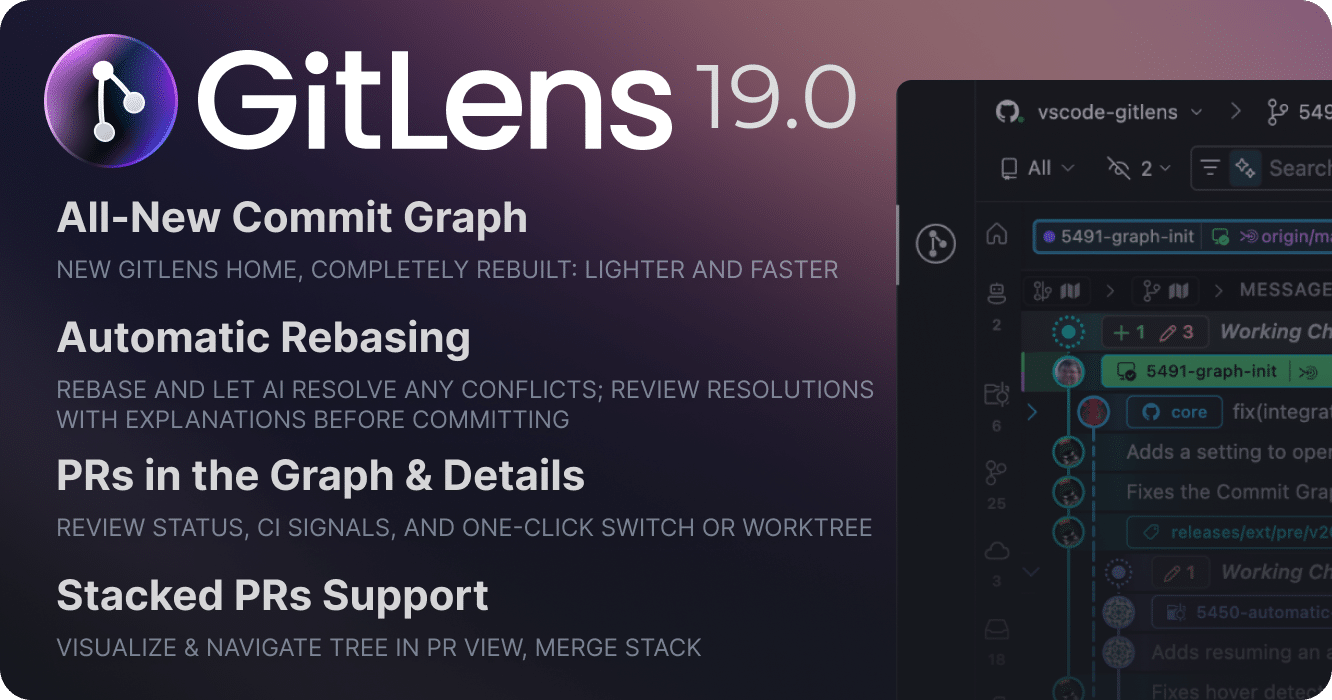
Graph is the New Home
A Graph That Shows You Around
The graph now has your back at every step. Signed out, you get a Get Started with GitLens screen with a rotating spotlight of what GitLens unlocks — or a Verify your email prompt when the connected account isn’t verified. Completing sign-in lands on a welcome that introduces the graph and its walkthrough. Arrive via a specific task — composing, an AI review, comparing, or resolving conflicts — and the screen speaks to that task, then returns you to it once access is restored.
With no repository open, an empty state offers Open a Folder, Clone a Repository, and Start a New Project (or Open Remote Repository in web and virtual environments); Restricted Mode offers Manage Workspace Trust, refreshing to your history the moment trust is granted. A one-time prompt on first entry asks whether you’d rather run the graph vertically in the side bar or horizontally in the bottom panel, and moves it there for you.
Contextual how-tos fill in the rest: the first time you reach a feature — commit details, Compose, Review, conflicts, Resolve, Compare, the agents list, and more — a short tip opens right where you are. Dismiss it for good, or park it on a lightbulb to reopen any time, with “new” dots marking the features you haven’t tried yet.
Your Account
An account pill sits in the graph header, ringed in a color that tracks your entitlement. Opening it rolls up your account, your walkthrough progress, and your AI, Agents, and Integrations setup status — each deep-linking into the matching part of GitLens Settings, where the renamed Show Account in Settings command also lands. The Launchpad pill beside it becomes a compact severity dot — red when anything is blocked, yellow for other actionable work — with the full breakdown on hover.
All-New Commit Graph
The Commit Graph is now drawn by an all-new rendering engine, rewritten from the ground up. Loading, rendering, updating, and scrolling are all significantly faster, it uses substantially less memory, and it’s far more accessible to keyboards and screen readers.
- Grouped columns by default — the Graph and Branches / Tags columns fold together into a compact anchor zone, with
gitlens.graph.lanes.grouped.minandgitlens.graph.lanes.grouped.maxcontrolling how many lanes render inline and how much of the row width they may claim. - Compact lanes by default — a new
gitlens.graph.lanes.densitysetting defaults tocompact, and the author, date, and SHA columns start narrower. - Lane folding — collapsible lane segments get expand/collapse chevrons in a fold strip beside the graph, configurable via
gitlens.graph.lanes.folding.enabledandgitlens.graph.lanes.folding.default. - A responsive row layout — the new
gitlens.graph.stylesetting picks betweentable(single-line rows with columns) andlist(stacked two-line rows), withautoswitching tolistwhen the view is too narrow for the columns — which is what you’ll get in the side bar until you widen or move it. - A sticky timeline — a pill groups scrolled rows into the same relative time buckets as the date column, expanding while you scroll to reveal the range and yielding when it overlaps something interactive, with optional separator lines between date groups (
gitlens.graph.timelineSeparators). - Better columns — inline filter buttons that reveal on hover, breadcrumbs showing the grouping hierarchy, double-click auto-fit that measures real date formats, a wider resize hit area, and a new Quick Refresh button that re-lays out the lanes on demand without a refetch.
- Full keyboard navigation — the graph is now a standard WAI-ARIA tree with a comprehensive set of shortcuts for jumping around, folding lanes, toggling panels, and acting on rows — press ? anywhere in the graph for the full reference.
Always Know Where You Stand
HEAD, its upstream, and your merge target are now called out everywhere the graph can call them out:
- Role-colored reference pills and row markers — HEAD in green, its upstream in a deeper green of the same hue (they’re one branch shown in two places), and the merge target in its own role color. Each of those commits also gets a left-edge indicator that expands on hover, and references sitting on the same commit collapse into one.
- A merge target scroll marker — a full-width line on the scroll bar alongside the existing HEAD and upstream markers, themeable via
gitlens.graphScrollMarkerMergeTargetColor. Right-clicking the rail toggles marker types in place, clicking a marker now selects and focuses its row instead of just scrolling near it, and the optional extra marker types are off by default to cut clutter. - Unpulled and unpushed row decorations — commits waiting to be pulled are decorated in red and commits waiting to be pushed in green, so what’s incoming and what’s outgoing reads at a glance.
- A quick-access overview bar — the working changes (WIP) bar becomes a jumping-off point for your recent worktrees, with an indicator dot on any row carrying uncommitted changes. When the main row isn’t sitting on HEAD it grows a jump pill for hopping to HEAD, the upstream (with ahead/behind), and the merge target. The new
gitlens.graph.overviewBar.visibilitysetting controls when the bar appears —worktreesby default, oralways,dirtyWorktrees, ornever. - New default colors — a perceptually-uniform lane palette for dark and high-contrast themes where no lane dominates, plus retuned HEAD and upstream greens that separate on brightness rather than saturation so they stay distinguishable with color blindness. Existing
gitlens.graphLane1Color–gitlens.graphLane10Colorcustomizations are honored, and branch highlighting now follows a branch’s own lane and stops at its merge base.
Find and Jump Faster
- Type-ahead reference finder — press / anywhere in the graph (or the search icon in the references column header) and type to jump to a branch, tag, or worktree by name. The graph moves as you type, the match’s pill fills and its row flashes, and ↑/↓ step through the rest. Abbreviated path segments work too —
d/f/foofindsdebt/feature/foo. References whose commits aren’t loaded yet are offered dimmed, and Enter fetches and jumps to them. - Jump to the commits a pull or push will move — hovering the Pull or Push button offers a jump to the commits involved, and Alt+click does the same without acting.
- See where a pull would conflict
PRO— the pull preview warns in one line when pulling would hurt: either that uncommitted changes to the same files will block it, or how many files it would conflict in, simulated the way yourpull.rebasesetting says the pull will actually integrate. Requires Git 2.33 or later. - A minimap that shows up when it’s useful — the minimap is now hidden by default and appears while searching, so matches are visible as they stream in. When to show it lives in the new
gitlens.graph.minimap.defaultVisibilitysetting (onSearch,always, orhidden). - Smoother reveals — jumping to a reference, a search result, or a deep link now slides into the target row instead of cutting to it, and reliably lands on it even when the commit has to be paged in first.
- Terminal links open in the Graph — a new
gitlens.terminalLinks.showInsetting (default: the Commit Graph) replaces the old boolean, and ranges likemain..featureorHEAD~3..HEADare now detected and opened as comparisons rather than linking only the trailing SHA.
Branch and Tag Sheets
Selecting a branch or tag reference now opens a sheet for it in the details panel. Each sheet carries an issue and pull request strip, upstream and merge-target relationship cards with tracking status and the relevant sync, rebase, or merge actions (click the counterpart’s name to change it), AI Explain and Generate Changelog actions, and next-step rows tailored to the kind of ref. Tags default their comparison to the newest previous tag; remote branches compare against their merge target.
Sheets also carry Focus and Hide toggles, an Open on Remote chip, and the agent sessions that ref’s worktree can resume. They refresh in place as the graph changes and close when their ref disappears, and actions run against the branch’s worktree when it’s checked out somewhere else.
The Changes Column
A new Changes column shows each commit’s diffstat, with four visualizations you can switch between from the column header: numbers, squares, bar, and bipolar (a two-sided bar). It degrades gracefully as the column narrows — down to a single “churn ring” glyph at its narrowest — and uses positional, grayscale-friendly markers so deletions stay distinguishable without relying on color.
Because computing stats can be expensive on large repositories, the column is off by default and offers a one-time opt-in (gitlens.graph.changesColumn.enabled, with the visualization in gitlens.graph.changesColumn.mode).
Remote Branches in the Branches Side Bar
The Branches panel gains a Show Remote Branches toggle (sharing gitlens.views.branches.showRemoteBranches with the Branches view), with remote branches keeping their prefix, grouping under their remote in tree layout, and showing their remote’s provider icon. Every branch, worktree, and remote-branch row also picks up an inline Focus action, plus pinned and current-branch indicators.
Stacked Pull Requests
GitLens now understands GitHub’s stacked pull requests, so a stack reads as one piece of work instead of a pile of unrelated branches.
Selecting any layer opens its pull request sheet with a stack map — the whole stack laid out in order, so you can see how many layers there are, where you sit among them, and step to any other. In the side bar, a stack’s layers group together in the new Pull Requests panel, and each layer is badged with its position on reference pills and in hovers. Focus Pull Request on any layer scopes the graph to the whole stack rather than the single branch you clicked.
Merging routes through GitHub’s stack-aware merge, with a confirmation naming how many pull requests will land. Launchpad picks up the same context — stacked pull requests show their layer position, and merging one becomes Merge Stack…, running under cancellable progress and reporting any failures.
Pull Requests in the Graph
A new Pull Requests panel lists the repository’s open pull requests, most-recently-updated first, each with a Launchpad-style status indicator when it needs attention, a fork glyph when it came from a fork, and a hover adding CI, review, and change-size signals. Rows lead with a state-aware action — Switch to Branch…, Open in Worktree…, or Open Worktree in New Window… — then Open Pull Request on Remote and Focus, which scopes the graph to the pull request’s branch, offering to fetch it first when it isn’t local yet. When the remote has no integration connected, the panel offers to connect one instead of showing an empty list.
Selecting a pull request anywhere in the graph opens its details sheet — details, description, and stack map, with switch and worktree actions, Compare Changes, Review Changes (an in-place AI review), Review with Agent…, and a split merge button offering merge, squash, or rebase that confirms in place.
AI and Agentic Feature Improvements
Automatic Rebase, Start to Finish
The AI Resolve mode introduced in 18.2 can now drive an entire rebase. Choose Automatic Rebase in the rebase quick menu, or Continue Automatic Rebase on an already-paused rebase, and each conflicted step is resolved, staged, and continued automatically — pausing for review only when confidence falls below the new gitlens.ai.autoRebase.confidenceThreshold setting, or when something genuinely needs you.
The run narrates itself in the Commit Graph‘s Resolve panel rather than a progress notification: which step it’s on, a progress bar, what it’s doing right now, and every conflict already resolved with its strategy, confidence, and reasoning. When automation stops, the same panel fills in with the resolutions it already computed. A Cancel Rebase action restores the branch’s pre-rebase state mid-run, and on completion a per-step summary shows every file’s strategy and reasoning with before/after diffs, plus a validated Undo that refuses if the branch has moved since.
AI Resolve can now consult your repository — when a conflict hunk is too ambiguous on its own, it can read the file, blame or log the lines in question, search for other uses of the symbols involved, and diff the two sides before choosing. Consultation is read-only and bounded, reported as it happens in the Resolve panel, and each resolution’s reasoning cites what it consulted. Your AI file-exclusion rules (gitlens.ai.exclude.files and .aiignore/.cursorignore/.aiexclude) now apply to everything AI reads, not just what it’s asked to change.
A new gitlens.ai.resolveConflicts.customInstructions setting gives AI standing guidance for every conflict it resolves — “prefer the incoming side for lock files”, say — with instructions you type for a single run still applying on top.
The rebase quick menu’s confirm step is now three options — Rebase, Automatic Rebase, and Interactive Rebase — with an Update Branches toggle applying --update-refs to whichever you pick.
Composing Commits
The standalone Commit Composer webview is gone — composition now lives in the Commit Graph‘s details panel. Recompose on a branch, a commit selection, or a single commit resolves a covering range and seeds the inline scope picker, merge topologies and interior ranges included. A new top drag handle scopes a compose to staged changes only, commits only, or an arbitrary range, and recompose anchors on the branch’s worktree, offering to create one when the branch isn’t checked out anywhere.
AI composition itself gets sharper too: commit message convention detection is more accurate, noise hunks are filtered out of proposals, and very large change sets are handled far better.
Code Review
Review mode can now be scoped to unstaged changes only, and reviews of working changes include untracked files — staged into a scratch index rather than your repository’s, so a review can never disturb what you have staged.
New Model and Agent Harness Support
GitLens adds support for Gemini 3.6 Flash and 3.5 Flash-Lite, and expands the set of models available through GitKraken AI — the current OpenAI, Gemini, and Anthropic models straight from your GitKraken account, no API key of your own required.
Per-feature AI model selection is now available for Composing Commits, Reviewing Changes, and Resolving Conflicts, each using a different model from your default.
A new Agents configuration in the GitLens Settings view that lists every detected coding agent grouped by kind, each with a Default agent picker and, for CLI agents, easy controls to install GitKraken MCP and Claude Hooks.
Verify SSH-Signed Commits
A new Edit SSH Allowed Signers editor builds the allowed_signers file Git needs to verify SSH-signed commits. Open it from the Command Palette, or from Add to allowed signers… on an unverified SSH signature in a commit’s signature details. It finds candidate signers in the public keys embedded in your repository’s SSH-signed commits — entirely offline, on any host — and cross-checks them against each signer’s registered SSH signing keys when a GitHub or GitLab integration is connected, marking keys as signed-here, provider-verified, or both. Review each signer’s avatar, email, fingerprint, provenance, and signed-commit count, choose who to include, pick the target file, and optionally point gpg.ssh.allowedSignersFile at it globally or per repository — merging into an existing file without clobbering your manual entries.
A Deeper Settings Page
The GitLens Settings page rebuilt in 18.3 gains new sections and a reorganized category rail, grouped into Setup, Integrations, Views, Editor, and General.
- Account leads the rail — your account, plan, and subscription actions, with your avatar on the rail item once you’re signed in.
- Get Started is where a first open now lands — a four-step setup launchpad (sign in, connect integrations, choose an AI model, set up agents) with a completion ring tracking what’s left.
- Agents lists every detected coding agent grouped by kind, each with a Default picker and, for CLI agents, install controls for GitKraken MCP and Claude Hooks.
- Custom Remotes configures the
gitlens.remotessetting in the UI instead of hand-editing JSON. - Per-feature AI models — Composing Commits, Reviewing Changes, and Resolving Conflicts can each use a different model from your default, with every row naming the model it will actually use and a Use Default action to drop an override.
Performance and Reliability
- Faster, smaller webview payloads — improved compression and payload sizes, batching, and less extension-to-webview chatter over IPC.
- Less Git work — work avoided or delayed, better caching and sharing, leaner Git calls, and improved Git priority queueing to cut latency.
Added
- Adds a new home for GitLens — the Commit Graph now leads the GitLens side bar as its main view (only the default location changes, so a graph you moved yourself stays put, and a one-time prompt offers the bottom panel), adapting to the side bar’s width with compact list-style rows and the details panel below the graph; widen or move the view for the columnar table layout (#5545)
- Adds empty states — with no repository open, offers Open a Folder, Clone a Repository, and Start a New Project actions (an Open Remote Repository action in web/virtual environments), and in a workspace running in Restricted Mode offers Manage Workspace Trust, refreshing to your history as soon as trust is granted (#5408)
- Adds a sign-in experience — signed-out users see a Get Started with GitLens screen with a rotating spotlight of what GitLens unlocks, completing sign-in lands on a welcome that introduces the graph and its walkthrough, and arriving via a specific task (composing, an AI review, comparing, or resolving conflicts) shows messaging for that task and returns you to it once access is restored (#5534)
- Adds an account pill to the header — ringed in a color tracking your entitlement, opening a rollup with your account, walkthrough progress, and AI, Agents, and Integrations setup status, each deep-linking into GitLens Settings; the Show Account command (renamed Show Account in Settings) now opens there too (#5522)
- Adds contextual how-tos (coach marks) — the first time you reach a feature (commit details, Compose, Review, conflicts, Resolve, Compare, the agents list, the overview bar, and more) a short tip opens right where you are; dismiss it for good, or park it on a lightbulb to reopen any time, with “new” dots on the features you haven’t tried yet (#5516)
- Adds What’s New, Help Center, Report Issue (GitHub), and Share Feedback (GitHub) to the graph’s “…” menu and the Welcome view toolbar
- Adds an all-new high-performance rendering engine on the Commit Graph, rewritten from the ground up — loading, rendering, updating, and scrolling are significantly faster, it uses substantially less memory, and it is far more keyboard and screen reader accessible
- Adds column grouping for the Graph and Branches / Tags columns (enabled by default) for a more compact layout, and lane folding to collapse commit histories that aren’t relevant right now
- Adds new perceptually-uniform lane colors for dark and high-contrast themes (existing
gitlens.graphLane1Color–gitlens.graphLane10Colorcustomizations are honored), and branch highlighting that follows a branch’s own lane and stops at its merge base - Adds row markers for HEAD, its upstream, and its merge target — role-colored reference pills (HEAD in a clearer green, its upstream the deeper green of the same hue) with matching markers on the scroll bar — plus row decorations for commits waiting to be pulled (red) or pushed (green)
- Adds a context menu to the scroll marker rail to toggle marker types in place, and clicking a marker now selects and focuses its row instead of just scrolling near it; the optional additional marker types are now off by default to reduce clutter
- Adds previews of what a pull or push would do to the Pull and Push buttons — hovering offers a jump to the commits involved (Alt+click jumps without acting), and the pull preview warns when uncommitted changes would block the pull or how many files would conflict, simulated the way your
pull.rebasesetting will actually integrate (conflict detection requires GitLens Pro and Git 2.33+) - Adds a “quick-access” overview bar for showing and quickly jumping to recent worktrees — use the new
gitlens.graph.overviewBar.visibilitysetting to control when it appears - Adds an indicator dot to working changes (WIP) rows with uncommitted changes, and a “jump pill” on the main WIP row when it isn’t directly attached to HEAD, for easy jumps to HEAD, the upstream, and the merge target
- Adds Apply / Pop Stash… and Apply Copied Changes (Patch) options to working tree (WIP) rows — invoked from another worktree’s WIP row, the changes are applied into that worktree
- Adds a type-ahead reference finder — press
/(or use the search icon in the references column header) and type to jump to a branch, tag, or worktree; ↑/↓ step through matches, and references that aren’t loaded yet are offered too, fetched only when you press Enter - Adds a Show Remote Branches toggle to the side bar’s Branches panel — lists the default remote’s branches alongside local ones (falling back to
originwhen no default remote is set), shared with the Branches view viagitlens.views.branches.showRemoteBranches; remote branches also become pickable in the Focus Branch scope picker - Adds visualization modes for the Changes column — numbers, squares, bar, or a two-sided bar, with compact versions as the column narrows — behind a one-time opt-in overlay to avoid impacting performance by default
- Adds a sticky timeline that names the time period you’re scrolled to, with a new
gitlens.graph.timelineSeparatorssetting to draw dividers between date groups - Adds comprehensive keyboard shortcuts — jump to HEAD, upstream, merge target, or working changes with
h/u/t/w, fold lanes with ←/→, toggle the minimap, side bar, and details withAlt+M/S/D, holdCtrlto highlight the focused branch’s lane, peek the focused commit’s rich hover withi, and press?for the full reference;Escnow closes one thing per press
- Adds an automatic rebase that resolves conflicts end-to-end with AI — choose Automatic Rebase in the rebase quick menu to resolve, stage, and continue each conflicted step, narrated live in the Commit Graph‘s Resolve panel with each file’s strategy, confidence, and reasoning, and a Cancel Rebase action that restores the branch’s pre-rebase state. It pauses for review when confidence falls below
gitlens.ai.autoRebase.confidenceThreshold, and finishes with a per-step summary and a validated Undo (#5450) - Adds repository consultation to AI-powered conflict resolution (Preview) — when a conflict hunk is ambiguous on its own, AI can now read the file, blame or log the lines in question, search for other uses of the symbols involved, and diff the two sides before choosing a resolution. Consultation is read-only and bounded, reported as it happens in the Commit Graph‘s Resolve panel and the automatic rebase, and each resolution’s reasoning cites what was consulted; your AI file-exclusion rules (
gitlens.ai.exclude.filesand.aiignore/.cursorignore/.aiexclude) now apply to everything AI reads (#5581) - Adds a
gitlens.ai.resolveConflicts.customInstructionssetting — standing guidance for AI conflict resolution (e.g. “prefer the incoming side for lock files”), applied to every conflict AI resolves; guidance typed for a single run still applies on top - Adds rich pull request support to the Commit Graph — browse, focus, review, and merge pull requests without leaving the graph
- Adds a Pull Requests panel to the side bar — the repository’s open pull requests, most-recently-updated first, with Launchpad-style status indicators and rich hovers; rows offer switch and worktree actions, Open Pull Request on Remote, and Focus, which scopes the graph to the pull request’s branch — offering to fetch it first (even from a fork) when it isn’t local yet
- Adds a pull request details sheet — selecting a pull request anywhere in the graph opens its details, description, and stack map, with switch and worktree actions, Compare Changes, Review Changes (an in-place AI review), Review with Agent…, and a split merge button (merge, squash, or rebase) that confirms in place
- When the repository’s remote has no integration connected, the panel offers to connect one and fills in without a reload
- Adds support for GitHub’s stacked pull requests
- Badges each layer with its position on ref pills and hovers, and groups a stack’s layers in the new Pull Requests panel
- Focus Pull Request on any layer scopes the graph to the whole stack, and the pull request sheet’s stack map lets you step between layers
- Merging routes through GitHub’s stack-aware merge, with a confirmation naming how many pull requests will land
- Adds stack context to Launchpad — stacked pull requests show their layer position, and merging one becomes Merge Stack…, running under cancellable progress with failures reported
- Improves the Commit Graph‘s details panel — smarter placement and new full-height sheets
- Docks to whichever side of the graph has the room, gains a maximize control (automatic when entering compose, review, resolve, or compare, via
gitlens.graph.details.maximizeOnMode), and double-clicking a splitter resets it - Adds a branch and tag details sheet — selecting a branch or tag reference opens its issue and pull request, upstream and merge-target relationship cards with sync, rebase, and merge actions (rooted at the ref’s own worktree), Focus and Hide toggles, Open on Remote, and AI-powered Explain and Generate Changelog actions — for tags, the changelog covers what shipped since the previous tag
- Adds keyboard support to file trees —
Spacetoggles a row’s checkbox (e.g. staging),Alt+Spaceunchecks a mixed one (matchingAlt+click), andCtrl/Cmd+Fopens and focuses the tree’s search/filter box
- Docks to whichever side of the graph has the room, gains a maximize control (automatic when entering compose, review, resolve, or compare, via
- Adds AI agent session enhancements to the Commit Graph and Home — a Resume Agent Session… option on working tree (WIP) rows to open live sessions or resume past ones, sessions listed in the working-changes and branch details, and completed sessions from the last 30 days available behind a filter toggle in the Agents panel, each with Resume Session and Archive Session actions
- Adds support for locked worktrees — new Unlock Worktree commands, and deleting a locked worktree now surfaces the lock’s reason with an offer to force-delete instead of failing with a raw Git error
- Improves the GitLens Settings page with new sections and a reorganized category rail (#5392)
- Adds an Account section leading the rail — your account, plan, and subscription actions, with your avatar on its rail item when signed in
- Adds a Get Started section, where a first open now lands — a four-step setup launchpad (sign in, connect integrations, choose an AI model, set up agents) with a completion ring tracking what’s left
- Adds an Agents section — every detected coding agent grouped by kind, each with a Default picker and, for CLI agents, install controls for GitKraken MCP and Claude Hooks
- Adds a Custom Remotes section — configures the
gitlens.remotessetting in the UI instead of hand-editing JSON - Adds per-feature AI model controls to the AI section — the model for Composing Commits, Reviewing Changes, and Resolving Conflicts can each be set independently of the default, with each row naming the model it will actually use and a Use Default action to drop an override
- Reorganizes the category rail into Setup, Integrations, Views, Editor, and General groups
- Adds an optional
modeparameter to thegraphcommand deep link (e.g.vscode://eamodio.gitlens/link/command/graph?mode=compose) — opens the Commit Graph directly into Compose or Review (#5226) - Adds an Edit SSH Allowed Signers editor — discovers signers from this repository’s SSH-signed commits and from connected GitHub and GitLab signing keys, then writes an
allowed_signersfile (optionally pointinggpg.ssh.allowedSignersFileat it) so Git can verify SSH-signed commits. Open it from the Command Palette, or from Add to allowed signers… on an unverified signature (#5469) - Adds support for Gemini 3.6 Flash and Gemini 3.5 Flash-Lite AI models
Changed
- Changes the Home, Cloud Patches, and Cloud Workspaces views to be hidden by default — applied once on upgrade too (landing you on the Graph in its new home); each remains available from the Command Palette and stays visible once shown (#5545)
- Changes commit composition to happen in the Commit Graph‘s details panel, now the single place to compose — the standalone Commit Composer editor is gone, and every entry point (the Compose Commits… command, the Source Control view, the GitLens views, Home, the GitKraken MCP tools, and the Interactive Rebase Editor) opens compose in the graph instead. Recompose on a branch, a commit selection, or a single commit works there too, and a new drag handle narrows a compose to staged changes only, commits only, or a range of the two. AI composition also improves — more accurate commit message convention detection, noise hunks filtered out of proposals, and better handling of very large change sets (#5506)
- Changes the rebase quick menu’s confirm step — an Update Branches toggle now applies
--update-refsto whichever rebase you choose (Rebase, Automatic Rebase, or Interactive Rebase), replacing the separate & Update Branches variants (#5450) - Changes paused-rebase auto-open (
gitlens.rebaseEditor.openOnPausedRebase) to only open for rebases you’re driving from GitLens — a newautovalue, now the default, ignores paused rebases started outside GitLens (terminals, agents, other tools), which previously popped open the Interactive Rebase Editor or Commit Graph uninvited; set it totrueto restore the previous behavior (#5686, #4954) - Changes paused merge, rebase, cherry-pick, and revert conflicts to surface in one place — the Commit Graph‘s working changes (WIP) details, or the Interactive Rebase Editor for rebases when the graph isn’t usable
- Changes the Commit Graph‘s paused-operation bar into a state-driven strip — a labeled primary action (e.g. Resolve 3 Conflicts), an all-resolved ready state, a “paused at step m/t” link that jumps to the commit being applied, Continue with Empty Commit where Git offers it, and paused reverts can now be continued end-to-end
- Changes the Commit Graph sidebar to be unpinned by default — it floats over the graph and auto-collapses when it loses focus or on Esc; pin it (or set
gitlens.graph.sidebar.pinned) to restore the shared-space layout (#5447) - Changes the Commit Graph header’s jump-to-reference button into a Focus Branch control — clicking focuses (scopes) the graph to the current branch (clicking again clears it), and Alt-clicking opens the Focus Branch picker; branch and worktree rows in the side bar gain an inline Focus action too (#5556)
- Improves branch pinning in the Commit Graph — the off-screen HEAD and pinned-branch indicators merge into a single waypoints capsule, the pinned branch gets its own scroll bar marker, unpinning now lives on the reference pill itself, and side bar rows show pin and current-branch indicators (#5409, #5626, #5624)
- Changes the Commit Graph header’s Launchpad pill into a compact indicator — a severity dot on the rocket (red when anything is blocked, yellow for other actionable work) with the full breakdown on hover (#5522)
- Changes the Commit Graph minimap to be hidden by default and shown while searching — controlled by a new
gitlens.graph.minimap.defaultVisibilitysetting ("onSearch", the new default,"always", or"hidden");gitlens.graph.minimap.enabledgoes back to a plain boolean for whether the minimap is available at all — setdefaultVisibilityto"always"to keep the previous always-shown behavior (#5598) - Changes where terminal links open — a commit, branch, or tag clicked in the terminal now opens in the Commit Graph by default, configurable via the new
gitlens.terminalLinks.showInsetting (replacinggitlens.terminalLinks.showDetailsView; existing values migrate), and ranges likemain..featurenow open as a comparison - Changes when the Commit Graph side bar’s Worktrees panel loads each worktree’s working change counts — a fast check settles clean vs. dirty and the
+N ~M -Kbreakdown loads only when you hover a row, instead of agit statusper worktree up front - Changes the Pro feature gate to adapt to constrained spaces — the feature list, messaging, and spacing compact in narrow or short placements without hiding content (#5519)
- Improves switching AI models — with a provider already selected, the picker opens directly to its model list, with a Change AI Provider entry keeping provider switching one pick away (#5584)
- Changes GitLens: Reset Stored Data… — adds AI model, GitKraken CLI install, and Commit Graph cache resets, and a full reset now prompts to reload the window
- Improves Commit Graph and commit details performance — reference metadata loads through a bounded pool and streams in as it lands, background worktree probes no longer compete with the graph’s own Git work, holding a navigation key no longer spawns a Git process per row crossed, and commit details open faster and stay interactive during refreshes
- Renames the Home view’s GitHub Issues and GitHub Discussions actions to Report Issue (GitHub) (now opening the new-issue template chooser) and Share Feedback (GitHub)
Fixed
- Fixes blame going stale for open files after you commit, pull, or switch branches outside of VS Code — blame annotations, hovers, and CodeLens kept showing an older commit for lines a newer commit had changed, until the file was reopened or the window reloaded; this affected repositories at any path containing an uppercase character — nearly all of them on Windows and macOS (#5523)
- Fixes diffs opened from GitLens views and details landing at the top of the file instead of scrolling to the first change
- Fixes per-file actions (stage, unstage, conflict options) missing from working-changes file rows in the Commit Graph and Inspect views (#5548)
- Fixes GitLens silently pinning your AI provider to Copilot without you ever choosing it — GitKraken AI is now the only provider selected automatically, nothing is written to
gitlens.ai.modelunless you pick a model yourself, and settings written by the old behavior are cleared on upgrade, leaving choices you made yourself untouched (#5612) - Fixes a scoped AI model selection leaking into the global default — resolving a model for Review or Compose could write that operation’s preferred model into
gitlens.ai.modelfor every other AI feature - Fixes AI conflict resolution failing outright on models that don’t accept a temperature (seen as “upstream AI provider error (OpenAI HTTP 400)” on GPT-5 models via GitKraken AI)
- Fixes AI conflict resolution failing with No active merge, rebase, or cherry-pick conflicts to resolve when conflicts exist without a paused Git operation, such as after a
git stash pop(#5487) - Fixes focusing (scoping) the Commit Graph on a branch sometimes dimming the whole graph instead of re-rooting it, dropping the focused branch’s own commits, doing nothing for remote branches, and the focused branch or its working changes row being filtered out from under its own scope
- Fixes the Commit Graph‘s hidden branches/tags list not identifying which refs are hidden — entries now name their remote, group by type, and refs that no longer exist are no longer listed or counted
- Fixes branches with parentheses in their names (e.g.
feat/(wip)) being treated as a detached HEAD — the working changes row vanished and the toolbar showed a SHA instead of the branch name - Fixes a transient Git or network failure being cached and served as a real answer for the rest of the session — blanked branch/tag lists, an authoritative “no issues” for a branch, or stale commit counts that never recovered
- Fixes a branch deleted or renamed through GitLens leaving its stored base and merge target behind — a new branch reusing the name no longer inherits the dead branch’s merge target
- Fixes AI agent sessions being attributed to the wrong worktree, and sessions needing input sometimes showing Allow/Deny actions that could not work — a live permission ask can also no longer be denied by an unrelated event from the same session
- Fixes AI agent sessions from other AI CLIs (Codex, GitHub Copilot CLI, Cursor, OpenCode, Antigravity) appearing as Claude Code sessions on Home and the Commit Graph (#5715)
- Fixes a transient Launchpad failure (e.g. an expired token at startup) sticking the Commit Graph header on an error state for up to 30 minutes with refresh doing nothing
- Fixes the Commit Graph side bar’s Worktrees panel running per-worktree Git commands while collapsed and without bound — on repositories with many worktrees this could saturate GitLens’s Git queue and hold up other Git work
- Fixes the Commit Graph working changes (WIP) details continuing to show files after they were committed or discarded outside of VS Code
- Fixes working-changes actions invoked from another worktree’s row (copy patch, compose, explain, review) acting on the current worktree instead of the row’s worktree
- Fixes Copy Changes (Patch) producing an empty or incomplete patch — fully-staged selections reported “No changes found to copy”, mixed selections silently dropped their staged changes, and renamed files copied as a bare add of the new path
- Fixes the Commit Graph view’s progress indicator repeatedly flashing while nothing appears to change (most noticeable after the window regains focus)
- Fixes the Commit Graph sidebar list hovers repeatedly opening and closing in narrow viewports, and the sidebar restoring at its minimum width after a reload
- Fixes rows in the Commit Graph side bar panels nudging their trailing decorations to the left on hover
- Fixes search results being invisible on the Commit Graph‘s minimap exactly where you were looking — result markers were drawn underneath the visible-range band
- Fixes working tree (WIP) search results (
type:wip) all being marked at today on the Commit Graph‘s minimap — each worktree’s WIP row is now marked at the commit it’s anchored to - Fixes clearing a natural language search in the Commit Graph silently re-populating the search box a moment later
- Fixes the paused-operation bar offering an enabled Continue while Git was still waiting for you to save and close the commit message tab — the bar now holds an in-progress state until the operation actually settles (#5656, #5668)
- Fixes Recompose failing outright when branches or tags point at commits inside the range being recomposed — it now warns that those references won’t follow the new history and recomposes if you continue (#5515)
- Fixes the Commit Graph‘s compose preview misaligning changes for the second and later proposed commits, and dropping earlier hunks of a file renamed with edits — preview only; applying the compose was unaffected (#5596, #5606)
- Fixes excluding an untracked nested repository from a compose having no effect — it was still sent to AI and still committed; its row in Files Changed also now names the directory instead of being blank (#5611, #5629)
- Fixes leaving the Commit Graph‘s compose or resolve panel discarding your typed AI instructions and Refine state — both are restored when you return
- Fixes a review of your working changes never including untracked files, and failing with No changes found when untracked files were the only unstaged changes (#5586)
- Fixes files you excluded from a review being able to reach AI anyway via a cached pre-exclusion diff (#5630)
- Fixes changing
gitlens.ai.ollama.urlkeeping the previously resolved model and model list — the model is re-resolved against the new server (#5633) - Fixes the compare panel’s “commits in between” count reading 0 when the newer commit was picked first (#5547)
- Fixes signing back in after a sign-out interrupted a Commit Graph comparison reopening the comparison on different references (#5671)
- Fixes the Commit Graph header’s account/subscription state never updating after the view loads — sign-in/sign-out, organization switches, and plan changes now update live instead of requiring a reload (#5513)
- Fixes the account panel not showing your account when you aren’t in an organization — solo accounts now show their avatar, name, and email in Home and the Commit Graph
- Fixes GitLens needing a window reload to notice when you trust a workspace — repositories are now discovered as soon as you grant trust
- Fixes issue and pull request loading failing wholesale when an author’s GitHub account has been deleted — one failing item or connection no longer discards the rest
- Fixes self-managed cloud integrations (e.g. GitHub Enterprise, GitLab Self-Hosted) repeatedly issuing a token request the server rejects on every session refresh, and legacy connections stuck reported as connected with no usable token (#5497)
- Fixes a healthy cloud integration being fully disconnected when a backend error lands during an automatic session refresh — only a definitive “no token” response disconnects it now, so transient failures self-heal (#5569)
- Fixes a webview quietly going stale after it reconnects (e.g. moving the Commit Graph between panels) — change notifications stopped flowing and an active search could be silently dropped
- Fixes Alt/Ctrl/Shift-dependent UI staying engaged when focus moves from a GitLens view to an editor or quick pick with the key held
- Fixes commit details showing the autolinks strip when
gitlens.views.commitDetails.autolinks.enabledis off - Fixes file tree search boxes only matching file names — paths with folder separators (e.g.
src/git/) now match - Fixes the Choose Commit… and Search for Commit buttons in the Inspect view’s empty state doing nothing when clicked
Removed
- Removes the Pro feature badge from the Commit Graph header — the Start New menu now occupies that area (#5447)
- Removes the AI terms confirmation prompt — AI features no longer interrupt your first use to ask you to accept; the large prompt warning (
gitlens.ai.largePromptWarningThreshold) is unaffected - Removes code suggestions from Launchpad — affected pull requests now group under their provider-assigned category
- Removes the Reset Current Branch to Previous Commit command from the Commit Graph and the views
- Removes the
gitlens.graph.highlightRowsOnRefHoversetting — click a reference to pin it and highlight its lineage instead - Removes the GitLens: Toggle Commit Graph command from the Command Palette — use Show Commit Graph instead; Toggle Maximized Commit Graph now just reveals the Graph and stays available for existing keybindings (#5545)
Version 18.3
Thursday, July 9, 2026
GitLens 18.3 brings a more capable Compose mode, follow-up conversations in AI Review, smarter AI conflict resolution, and refreshed provider and model support. Plus, the GitLens Settings page has been completely revamped with a modern, two-pane experience and live, interactive previews.
This release also sharpens working changes and worktree control in the Commit Graph — stash or copy a patch of just the files you select, open a partially-staged file’s staged, unstaged, or combined diff, focus the graph on a single branch or worktree, and more. And with working-changes review now consolidated in the Commit Graph, the Inspect view stays focused on commits and stashes.
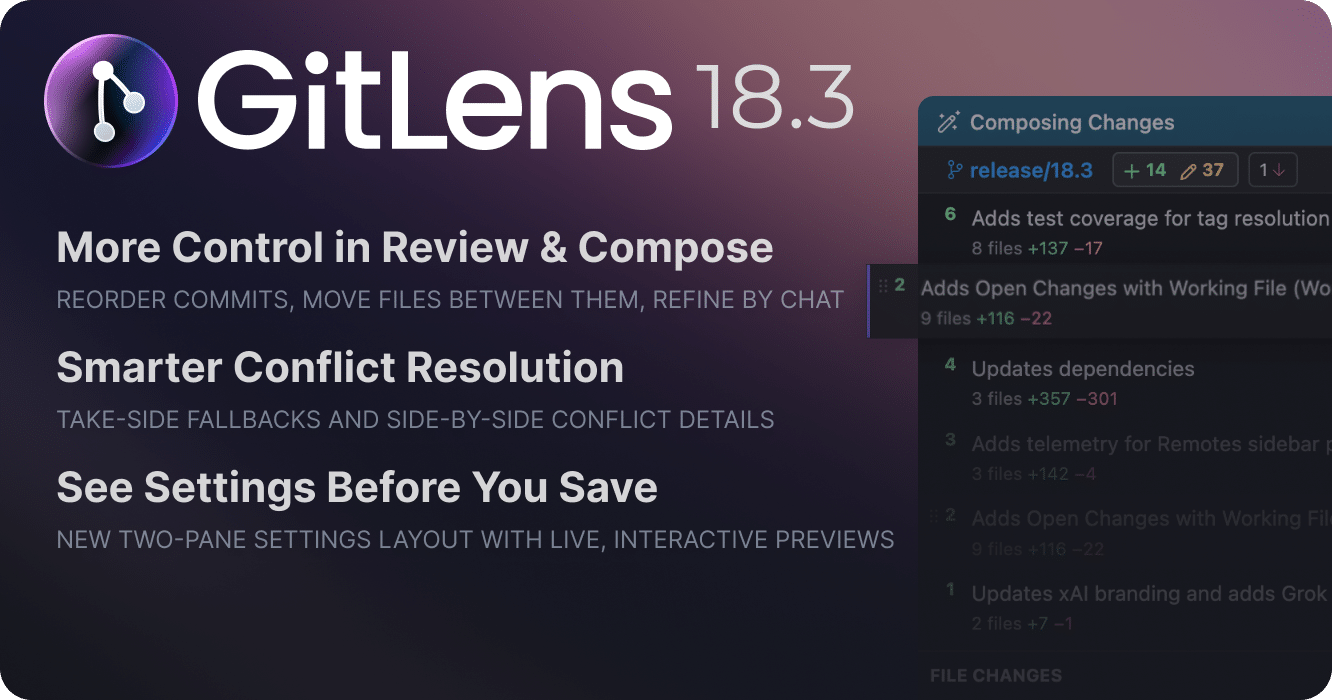
Leveled-up AI Workflows
AI-powered workflows in GitLens get meaningfully stronger, with more capability and increased control:
- A more capable Compose mode — a dual commit/recompose posture, drag to reorder draft commits, drag to move one or more files between draft commits, and multi-diff Open Changes actions right in the curation file trees.
- Conversations in Review — AI Review mode now supports follow-up conversations, with Discard and Refine actions available in both Compose and Review.
- Smarter model selection — the active model appears as a selectable chip across AI inputs, with consumption-rate and recommendation badges for GitKraken AI models.
- Refreshed provider and model support — newer models land across the registries (OpenAI GPT-5.x, Anthropic Claude 5/4.x, DeepSeek V4, Gemini 3.x, and Grok 4.5/4.3), Hugging Face moves to its OpenAI-compatible router, the xAI provider is renamed SpaceXAI following its rebrand, retired models are hidden, and the GitHub Models provider is removed.
Smarter Conflict Resolution
The AI Resolve mode introduced in 18.2 gets a substantial upgrade. Conflicts the AI can’t auto-merge — binary, symlink, submodule, file-mode, add/add, and rename/rename or rename/delete conflicts — are now labeled by type and offer inline Take Current, Take Incoming, and Delete actions instead of dead-ending as needs review (resolving a rename/rename conflict also removes the other side’s renamed file). UTF-16/BOM-encoded files are decoded so their conflicts can be resolved rather than skipped.
Resolve mode also gains a split-panel Conflict Details sheet (current vs incoming history), resolution scoped to selected files, automatic handling of both-deleted and rename conflicts, per-file confidence indicators, and collapsible resolved/pending sections with progress. You can now jump into it straight from the Interactive Rebase Editor — a new Resolve Conflicts in Commit Graph action on its conflicted-files panel opens the graph in Resolve mode for the rebase’s conflicts.
A Reimagined Settings Experience
The GitLens Settings page has been rebuilt from the ground up. Gone is the single, static, scroll-forever page — in its place is a modern two-pane layout with a searchable, grouped, resizable category rail alongside a detail pane that shows live, interactive previews reacting to your changes as you make them.
- Search everything — matches category names, setting labels, and literal setting names (e.g.
gitlens.currentLine.format), scrolls the match into view, and offers an Open in Settings UI escape hatch for settings not surfaced on the page. Press Ctrl/Cmd+F to jump straight to search. - Previews that match reality — format string examples are rendered by the real formatter, so what you see is exactly what GitLens will display.
- New Cloud Integrations and AI categories — view and connect hosting and issue-service integrations, and manage your AI provider and model, GitKraken MCP, default coding agent, and Claude Code hooks, all in one place.
- Connection-aware cues — the category rail shows a connected/total count for Cloud Integrations and a rule count for Autolinks.
Sharper Working Changes & Worktree Control
Working with changes and worktrees in the Commit Graph (and Inspect view) gets more precise across the board:
- Act on just the files you select — select 2+ files in the working changes (WIP) file list and the Stash and Copy (Patch) toolbar buttons retarget to your selection (hold Alt for the whole-scope action), with a matching multi-select Copy Changes (Patch) context menu command.
- Open exactly the diff you mean — a partially-staged file shows as a single row, but you can now open its Staged, Unstaged, or combined changes from the context menu.
- See more at a glance — a working tree change count badge appears on the Commit Graph panel tab (even while collapsed), per-file added/removed line counts show in the WIP file list, and a new
gitlens.sortWorkingChangesBysetting sorts working changes by their staged/unstaged state. - Quick jumps for files and worktrees — Reveal in Explorer View for working files, Open in Integrated Terminal for worktrees, and Copy Changes (Patch) for whole commits and stashes.
- A cleaner WIP bar and headers — the working changes bar scrolls horizontally with the mouse wheel, keeps the primary repository anchored, and stays out of the way unless a secondary worktree has changes, while the details and WIP panel headers are regrouped into clearer clusters.
Focus the Graph on What Matters
New Focus on Branch, Focus on Worktree, and Solo Branch actions let you zero in on the work you care about. Right-click a branch or worktree in the side bar (or a graph row) to focus the graph and minimap on it, or right-click a working tree (WIP) row to focus or solo the graph on that worktree’s branch. A new auto layout also positions the details panel to the right or bottom based on the graph’s width, with Alt+Click to temporarily pin a location.
Consolidated Working Changes Review
Reviewing working changes now lives in one place: the Commit Graph. The Inspect view drops its Overview (working changes) mode to stay focused on commits and stashes, and Launchpad actions (Switch to Branch, Open Details, and PR switch deep links) now open the Commit Graph at the working changes (WIP) row.
Added
- Redesigns the GitLens Settings page with a modern two-pane layout — a searchable, grouped, and resizable category rail paired with a detail pane showing live, interactive previews that react to setting changes as you make them, replacing the previous single-page scroll and its static images (#5372)
- Search matches category names, setting labels, and literal setting names (e.g.
gitlens.currentLine.format), scrolls the match into view, and offers an Open in Settings UI escape hatch for settings not surfaced on the page; Ctrl/Cmd+F focuses the search - Format string examples are rendered by the real formatter, so the preview always matches what GitLens displays
- Adds Cloud Integrations and AI categories — view and connect hosting and issue service integrations, and manage the AI provider and model, GitKraken MCP, default coding agent, and Claude Code hooks
- Shows connection-aware cues in the category rail — a connected/total count for Cloud Integrations and a rule count for Autolinks
- Search matches category names, setting labels, and literal setting names (e.g.
- Adds the ability to stash or copy a patch of only the selected files from the working tree (WIP) file list in the Inspect and Commit Graph views — selecting 2+ files retargets the Stash and Copy (Patch) toolbar buttons to the selection, with the whole-scope action available by holding Alt, plus a matching multi-select Copy Changes (Patch) context menu command (#5384)
- Adds Open Changes, Open Staged Changes, and Open Unstaged Changes options for working tree files that have both staged and unstaged changes in the Inspect and Commit Graph views — a partially-staged file appears as a single row but you can now open its staged-only, unstaged-only, or combined diff from the context menu (#5385)
- Adds a working tree change count badge to the Commit Graph view — mirrors the Source Control view by showing the number of working tree changes on the GitLens panel tab, even while the panel is collapsed; controllable via the new
gitlens.graph.showWorkingTreeBadgesetting (#5383) - Adds an Open in Integrated Terminal option for worktrees in the Commit Graph and the Worktrees view — opens the selected worktree’s folder in the integrated terminal, matching the action already available for repositories and folders (#5386)
- Adds a Reveal in Explorer View option for working tree (WIP) files in the Inspect and Commit Graph views — right-click a staged, unstaged, or conflicted working file to reveal and select it in VS Code’s Explorer view (#5387)
- Adds Focus on Branch, Focus on Worktree, and Solo Branch options to the Commit Graph — right-click a branch or worktree in the side bar (or a graph row) to focus the graph and minimap on it, and right-click a working tree (WIP) row to focus or solo the graph on that worktree’s branch (#5388)
- Adds manual take-side fallbacks and conflict-type labels to the AI Resolve mode in the Commit Graph WIP details panel — conflicts the AI can’t auto-merge (binary, symlink, submodule, file-mode, add/add, and rename/rename or rename/delete conflicts) are now labeled by type and offer inline Take Current, Take Incoming, and Delete actions instead of dead-ending as “needs review”; resolving a rename/rename conflict also removes the other side’s renamed file. Also decodes UTF-16/BOM-encoded files so their conflicts can be resolved rather than skipped (#5393)
- Adds a commit signing indicator to the Commit Graph‘s working changes (WIP) commit box — a key icon appears when commits will be signed (via the repo’s
commit.gpgsignGit config or VS Code’sgit.enableCommitSigningsetting), with the signing format (GPG, SSH, X.509, or OpenPGP) shown on hover - Adds a Start Review with an Agent action to Launchpad pull request items — after selecting a pull request in the Launchpad, you can start an AI agent review that checks out the PR in a worktree and routes straight to the agent picker (or your default agent); available when AI features are enabled (#5395)
- Adds an auto layout for the Commit Graph details panel that positions it to the right or bottom based on the graph’s width, with Alt+Click to temporarily pin a location (#5402, #5403)
- Adds a Copy Changes (Patch) action to commits and stashes in the Inspect and Commit Graph details — copies a patch of the entire commit or stash to the clipboard (#5455)
- Adds per-file added/removed line counts to the working changes (WIP) file list in the Commit Graph details, loaded lazily when the list is visible (#5456)
- Adds a
gitlens.sortWorkingChangesBysetting to sort working changes (WIP) by their Git staged/unstaged state in the Commit Graph details (#5454) - Adds a Resolve Conflicts in Commit Graph action to the interactive rebase editor’s conflicted files panel — opens the Commit Graph in AI Resolve mode for the rebase’s conflicts; available when AI features are enabled (#5413)
- Adds an Open Changes with Working File (Worktree) action to the commit file menu in the Commit Graph details and Inspect view — compares a committed file against its working copy in the sibling worktree whose branch contains the commit (rather than the currently-scoped worktree), with a worktree picker when more than one applies
- Adds an optional
avatarURL template to custom remotes in thegitlens.remotessetting — enables corporate and self-hosted setups to resolve commit-author avatars via a templated URL with${email},${emailName},${domain}, and${size}tokens; identity values are component-encoded before interpolation to keep attacker-controllable commit emails from injecting URL-structural characters, and templates configured via workspace settings require explicit user approval on first use in a trusted workspace (revocable via GitLens: Reset > Approved Avatar URL Templates…) (#302, #5155) — thanks to PR #1636 by Tmk - Adds a Take your agent workflows further step to the Welcome view walkthrough — introduces Kepler, GitKraken’s Agentic Development Environment (ADE), with a Get Kepler call-to-action (#5378)
- Adds a ConfigCat-based feature flag service for A/B testing and experimentation support (#5092)
Changed
- Changes GitLens AI features (Generate Commits, Explain, Generate Pull Request/Changelog, and AI-powered search) to no longer be labeled (Preview), and consolidates their commands under the
gitlens.ai.*namespace (#5463) - Improves the Commit Composer — adds a dual commit/recompose posture, drag to reorder draft commits, drag to move one or more files between draft commits, and multi-diff Open Changes actions in the curation file trees (#5460)
- Improves AI-powered conflict resolution (Preview) in the Commit Graph working changes (WIP) details — adds a split-panel Conflict Details sheet (current vs incoming history), resolution scoped to selected files, automatic handling of both-deleted and rename conflicts, per-file confidence indicators, collapsible resolved/pending sections with progress, and a dedicated merge icon (#5306)
- Improves the AI Review mode with follow-up conversations, plus Discard and Refine actions in Compose and Review (#5461)
- Improves AI model display and selection across AI inputs — shows the active model as a selectable chip and surfaces consumption-rate and recommendation badges for GitKraken AI models (#5425)
- Updates AI provider and model support — migrates Hugging Face to its OpenAI-compatible router, renames the xAI provider to SpaceXAI following its rebrand, and refreshes the model registries, adding newer models (OpenAI GPT-5.x, Anthropic Claude 5/4.x, DeepSeek V4, Gemini 3.x, and Grok 4.5/4.3) and hiding retired ones (#5462)
- Changes commits created from the Commit Graph‘s working changes (WIP) commit box to honor VS Code’s
git.enableCommitSigningsetting — matching the built-in Source Control commit behavior; previously only the repo’scommit.gpgsignGit config was respected - Changes the Commit Graph side bar icons to switch back to the graph and open the details panel when clicked from the visualization/kanban modes, instead of being disabled (#5401)
- Improves the working changes (WIP) bar in the Commit Graph — scrolls horizontally with the mouse wheel, keeps the primary repository anchored, and hides unless a secondary worktree has changes (#5457)
- Reorganizes the details and working changes (WIP) panel headers in the Commit Graph and Inspect views — groups navigation and actions into clearer clusters, folds the Inspect view’s separate navigation bar into the details action row, and adds branch and create context menus (#5459)
- Improves keyboard focus and navigation in the webview tree views — each row is a single tab stop that cycles its inner controls, Space no longer double-toggles checkboxes, multi-select keyboard navigation is fixed, and checkbox focus rings are visible (#5458)
- Changes copying changes to a worktree to no longer prompt to open that worktree afterward
- Changes stashing to use the Commit Graph working changes (WIP) commit-box draft message when one is present
- Renames the Open Worktree File action to Open File (Worktree) for consistency with the new Open Changes with Working File (Worktree) action
Removed
- Removes the Overview (working changes) mode from the Inspect view, making it commit/stash-only — reviewing working changes is now consolidated in the Commit Graph. Launchpad Switch to Branch and Open Details actions, and PR switch deep links, now open the Commit Graph at the working changes (WIP) row instead of the Inspect view; the Launchpad code-suggestion entry points are retired (code suggestions remain available in the Commit Graph) (#5399)
- Removes the Streamline Workflow with the Home View step from the Welcome view walkthrough (#5378)
- Removes the GitHub Models AI provider (#5462)
Fixed
- Fixes Anthropic AI requests failing with a 400 Bad Request when the request includes a system message (e.g. generating or recomposing commits with the commit composer, or AI conflict resolution) — system-role messages are now hoisted into the top-level
systemparameter that Anthropic’s Messages API requires, and unrecognized Anthropic errors now surface their actual message instead of a bare Bad Request (#5426) - Fixes the coding agents integration running the GitKraken CLI during extension startup — the agent-detection probe is now deferred out of the initial render window so it no longer competes with Commit Graph and Home view loading, and a fresh CLI install on first launch no longer leaves the detected agents list empty for up to 5 minutes
- Fixes creating a branch from a remote ref incorrectly setting upstream tracking when the new branch name differs from the remote branch name — e.g. creating
feature/foofromorigin/mainno longer makes it trackorigin/main; affects Create & Switch to Branch, Switch to… → Create & Switch to New Local Branch, and Create Branch in New Worktree (#5360) - Fixes Keep Staged not keeping staged changes when stashing selected files — choosing Keep Staged while stashing specific tracked files no longer drops the
--keep-indexflag, so staged changes are correctly kept intact (#5281) - Fixes pushing a branch that needs a force-push (e.g. after an amend or rebase) silently reporting success without updating the remote — a non-fast-forward (tip of your current branch is behind) rejection is now surfaced as an error instead of being swallowed as non-fatal (#5364)
- Fixes Fetch, Pull, Switch, Reset, and Restore operations silently reporting success when the underlying Git command failed with a message Git treats as a warning (e.g. an unreachable remote, or an invalid ref/revision) — these failures are now surfaced as errors instead of being swallowed as non-fatal
- Fixes the working changes (WIP) stats tooltip in the details header duplicating the visible stats pill instead of describing the change breakdown — the tooltip now reads e.g. 1 file added, 2 files changed in the working tree
- Fixes a stray gap in the Commit Graph header next to the fetch and sync actions when the current branch is already published — the publish action no longer reserves empty space once the branch has an upstream
- Fixes the design of the paused-operation banner (shown during a merge, rebase, cherry-pick, or revert in the Commit Graph/Inspect details and Home) — the Continue action now uses a start icon, and the action buttons’ hover and active states blend into the banner instead of showing a clashing grey toolbar highlight (#5394)
- Fixes selection and folder expand/collapse state not persisting across refreshes in grouped webview tree views when identical paths appear in different groups
- Fixes the AI input in the Commit Graph details stealing keyboard focus when the panel switched modes automatically
- Fixes the Commit Graph showing an incorrect worktree count when a worktree fetch fails or is unsupported
- Fixes the commit-message headline occasionally rendering at the wrong size before autolinks finish loading in the commit details
- Fixes stray menu-popover styling leaking onto nested tooltips
Version 18.2
Monday, June 15, 2026
GitLens 18.2 brings AI-powered conflict resolution into your workflow. When a merge, rebase, or cherry-pick pauses on conflicts, you can now hand the messy parts to AI — it works through your conflicted files in parallel, proposes a resolution for each, and lets you review every change before anything touches your working tree. Refine the whole run with a prompt, give per-file feedback, or take just the resolutions you trust.
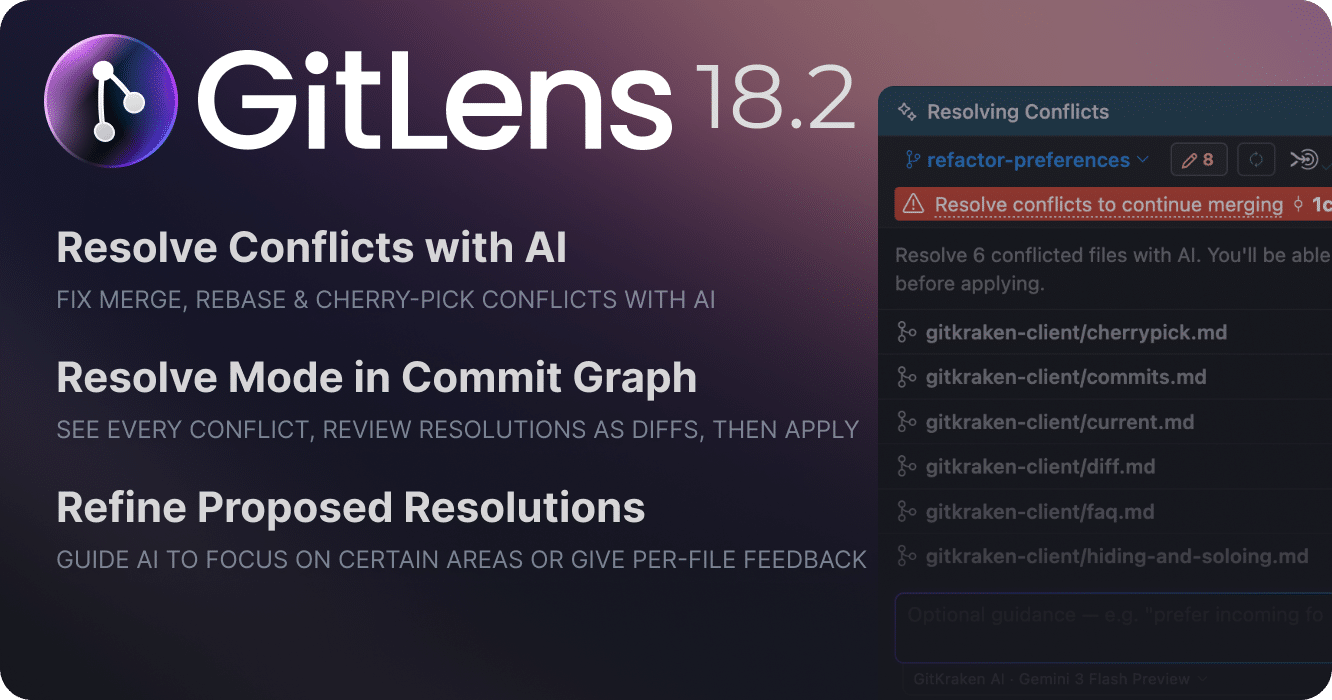
Resolve Conflicts with AI
Merge conflicts can be one of the most disruptive moments in a developer’s day. GitLens 18.2 introduces a brand-new Resolve mode in the Commit Graph details panel that uses AI to work through them for you — across merges, rebases, and cherry-picks alike.
When an operation pauses on conflicts, the working changes (WIP) details panel leads with a Resolve action. Resolve mode opens to a list of your conflicted files — click any file to open it (conflict markers and all) and inspect it first — then hit Resolve to let AI go to work. It resolves files in parallel, streaming its progress as it goes, and for each file reports what it did: merged the changes, kept current, took incoming, deleted, or flagged the file as needs review when it wasn’t confident enough to resolve it automatically.
Nothing is applied until you say so. Every proposed resolution is reviewable as a diff before it lands, and from the results you can:
- Refine the whole run — add a prompt with extra guidance and re-resolve everything at once.
- Give per-file feedback — not happy with a single file? Add a note and re-resolve just that one.
- Apply or Discard — apply the resolutions you trust to your working tree, or discard them and resolve manually. Files marked needs review are left conflicted for you to handle.
You can start a resolution from wherever you run into a conflict:
- The Resolve action on the working changes (WIP) details header and on the paused-operation (merge/rebase/cherry-pick) banner
- Context menus and WIP row buttons in the Commit Graph — Resolve All Conflicts with AI, or scope it to selected conflicted files
- The Command Palette — Resolve Conflicts with AI
- The Resolve Conflict with AI action on individual conflicted files in the sidebar views
Added
- Introduces AI-powered conflict resolution (Preview) — a new Resolve mode in the Commit Graph WIP details panel that uses AI to resolve merge, rebase, and cherry-pick conflicts (#5306)
- Resolves conflicted files in parallel with streamed progress, proposing a per-file resolution (merged, kept current, took incoming, deleted, or flagged as needs review) that you review as a diff before anything is applied
- Adds the ability to refine the whole run with a prompt, give per-file feedback to re-resolve a single file, and apply or discard the proposed resolutions
- Adds entry points across GitLens: a Resolve action on the WIP details header and the paused-operation banner, Commit Graph context menus and WIP row buttons (all conflicts or selected files), the Resolve Conflicts with AI Command Palette command, and a Resolve Conflict with AI action on individual conflicted files in the sidebar views
- Adds clickable file links in the resolve panel that open a conflicted working-tree file so you can inspect it before resolving
Changed
- Changes the working changes (WIP) details header to lead with the Resolve action when conflicts are present, ahead of Compose, Review, and Compare
- Updates the design and readbility of the Pro feature gates (e.g. Commit Graph, Visual History) — with an optional Switch Repos action to move to a repository where the feature is available (#5335)
- Improves the AI weekly usage-limit message with a Get More Credits action to purchase additional AI credits for users who can buy credits, or guidance to contact an org admin for those who can’t (#5298)
Version 18.1
Tuesday, June 9, 2026
GitLens 18.1 introduces powerful new ways to manage your workflow directly from the Commit Graph. You can now squash, drop, reword, and reorder commits without leaving the Graph, as well as push or undo a commit in a single click. A new working changes bar at the top of the Graph also makes it easier than ever to jump between worktrees and track changes.
This release also improves the working changes (WIP) experience, allowing you to discard changes, copy as a patch, add co-authors, and jump between changes and commits. Finally, we’ve added multi-select file actions to the Details and Inspect views, and refined the experimental Agent Activity Treemap with a live, decaying heatmap.
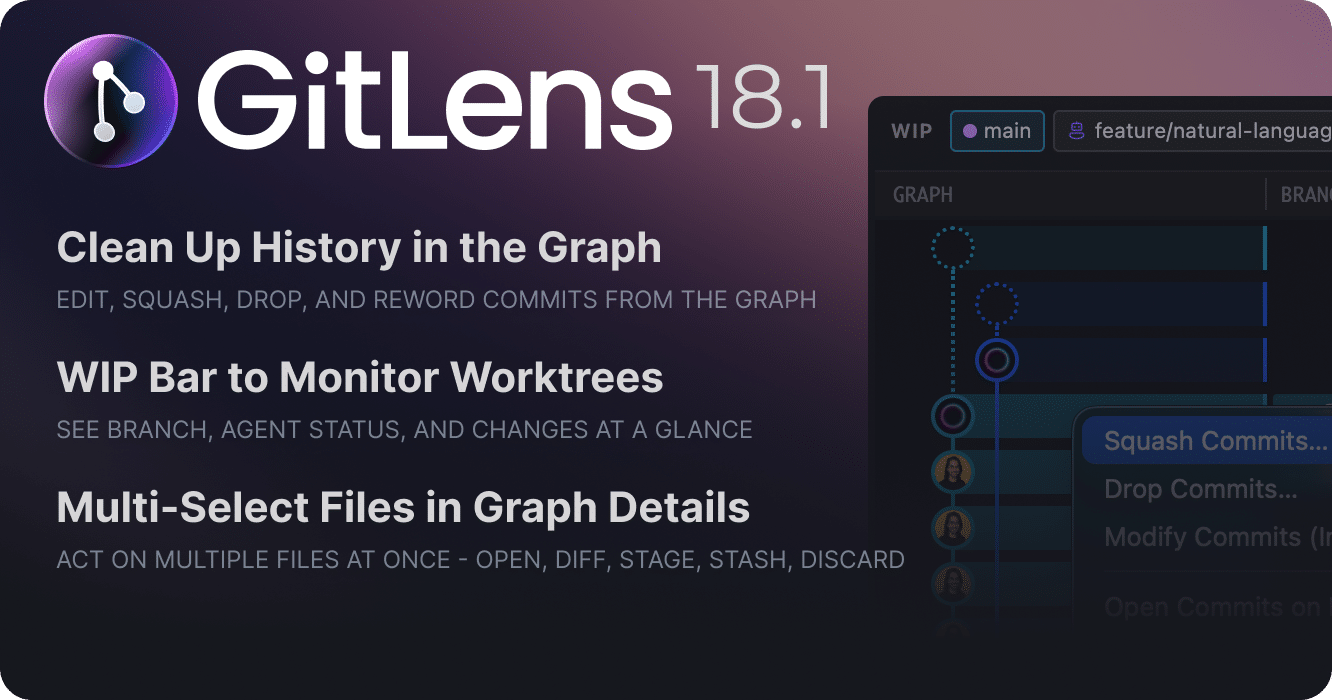
Edit History, Directly in the Commit Graph
You no longer need to drop into the Interactive Rebase Editor for everyday history edits — the Commit Graph now does them inline. Right-click a commit on the current branch to Reword its message, or select two or more contiguous commits to Squash them into one (reviewing and editing the combined message, or keeping just the oldest). Select any set of commits to Drop them outright. And when you do want the full editor, a new Modify Commits (Interactive Rebase) action opens the Interactive Rebase Editor scoped from the commits you selected, ready for squashing, rewording, reordering, dropping, and editing.
A Deeper Working Changes Experience
The working changes (WIP) experience across the Commit Graph and Inspect view gets a major lift in 18.1 with more actions and better visibility of working changes across worktrees.
- Working changes bar — a horizontal bar above the Graph shows a pill for every worktree with uncommitted changes (primary and secondary alike), with its branch, agent status, and a hover breakdown of changed files. Click a pill to reveal and select that worktree’s changes and open its details.
- Discard changes — discard working changes per-file or in bulk, with safe partial discard for files that have both staged and unstaged changes (the first discard drops only the unstaged portion, preserving what’s staged).
- Copy Changes (Patch) — copy a unified diff of your uncommitted changes to the clipboard; copies staged changes by default and unstaged on Alt-click when both are present.
- Add Co-authors — a button on the working changes commit box opens the contributor picker and appends the selected co-authors directly to the Graph’s commit message.
- Jump between changes and commit — a new action in the working changes header selects the branch tip commit your changes are based on, complementing the existing jump from a commit to its working changes.
Working changes file lists now also honor VS Code’s scm.defaultViewSortKey setting (keeping unresolved conflicts at the top), and partially staged (mixed) files are counted and badged more clearly.
Multi-Select File Actions
You can now multi-select files in the Commit Graph details and Inspect view to act on several at once — Ctrl/Cmd+click to toggle, Shift+click for a range, and Ctrl/Cmd+A to select all. Batch actions are available from the context menu and toolbar: open files, open selected changes as a multi-diff, open on remote, and copy paths or relative paths — plus stage, unstage, stash, and discard for working changes.
Quick Commit Actions: Push to Commit, Undo, and Publish
- Push to Commit — commits ahead of the branch’s upstream now show an unpushed indicator that doubles as a one-click action to push up to (and including) that commit, also available in the commit’s context menu.
- Undo Commit — a HEAD commit row surfaces an inline undo button when hovered, focused, or selected, alongside the existing context-menu action. Undo now works for the HEAD commit of any worktree, targeting the correct working tree for secondary worktrees, not just the active one.
- Publish Branch — a Publish Branch action appears in the Graph header when the current branch has no upstream, publishing it in one click just left of Fetch.
Navigate and Discover in the Graph
- Back/forward navigation — Back and Forward buttons in the commit and working changes detail headers step through previously-viewed commits, stashes, and working changes, re-selecting the row in the Graph where possible.
- Keyboard shortcuts reference — a new keyboard icon in the Graph’s sidebar rail opens a reference listing all supported navigation, search, open, and commit shortcuts with platform-aware key labels.
- Open Worktree File — a new action in the commit file menu opens a committed file from the worktree whose branch contains the commit — handy in multi-worktree repos where the file’s working copy lives outside the currently-scoped worktree.
- Responsive sidebar — the Graph’s sidebar icon rail now compacts in short layouts, hiding count badges and tightening spacing, then folding overflowing icons into a “…” menu, restoring them as space grows.
Agent Activity Treemap Improvements
The experimental Agent Activity Treemap now reads as a living heatmap. Touched files fade over a configurable window after each tool call instead of switching on and off, reads and edits blend as cyan/amber weighted by recency, and a soft pulse marks the file an agent is reading or editing right now. Sub-agent file activity rolls up to the parent session, and a new gitlens.graph.experimental.visualizations.activityDecay setting (30 seconds to 30 minutes, default 5 minutes) — with a matching picker in the treemap toolbar — controls the decay window.
Added
- Adds a
gitlens.graph.searchAutocompleteOnFocussetting to control whether search autocomplete suggestions appear automatically when focusing or clicking the search input in the Commit Graph (#5287) - Adds the ability to copy working changes to other opened worktrees from the Commit Graph (#5288)
- Adds the ability to discard working changes from the working changes (WIP) file list in the Commit Graph and Inspect view — per-file or in bulk, with safe partial discard for files that have both staged and unstaged changes (a first discard drops only the unstaged changes, preserving the staged portion) and a bulk action that switches to discarding staged changes when no unstaged changes remain (#5296)
- Adds an Add Co-authors button to the Commit Graph‘s working changes (WIP) commit box that opens the contributor picker and appends the selected co-authors to the commit message (#5297)
- Adds a Copy Changes (Patch) button to the working changes (WIP) file list in the Commit Graph and Inspect view that copies a unified diff of the uncommitted changes to the clipboard — copies staged changes by default and unstaged changes on Alt-click when both are present, otherwise copies all changes (#5302)
- Adds the ability to jump from the working changes (WIP) to its commit in the Commit Graph — a down-arrow in the working changes header selects the branch tip commit the changes are based on, complementing the existing action to jump from a commit to its working changes (#5303)
- Adds an Undo Commit row adornment to the Commit Graph — surfaces an inline undo button on a HEAD commit row when hovered, focused, or selected, alongside the existing context-menu action
- Adds support for undoing the HEAD commit of any worktree from the Commit Graph — the adornment and context-menu action now target the correct working tree for secondary worktrees, not just the active one (a distinct Undo Commit on Worktree label makes the target clear) (#5311)
- Adds responsive compaction to the Commit Graph‘s side bar icon rail in short layouts — hides the count badges and tightens spacing, then folds the overflowing icons into a “…” menu (with their labels and counts) as the rail runs out of room, restoring them as it grows (#5313)
- Adds a keyboard shortcuts reference to the Commit Graph — opened from a new keyboard icon in the graph’s sidebar rail — listing all supported navigation, search, open, and commit shortcuts with platform-aware key labels (#5312)
- Adds back/forward navigation to the Commit Graph details panel and Inspect view — Back/Forward buttons in the commit and working changes (WIP) detail headers step back through previously-viewed commits, stashes, and working changes, best-effort re-selecting the row in the Commit Graph (#5316)
- Adds the ability to push up to (and including) a specific commit from the Commit Graph — commits ahead of the branch’s upstream show an unpushed indicator that doubles as a one-click Push to Commit action, also available in the commit’s context menu (#5314)
- Adds an Open Worktree File action to the commit file menu in the Commit Graph details and Inspect view that opens a committed file from the worktree whose branch contains the commit — useful in multi-worktree repos where the file’s working copy lives outside the currently-scoped worktree, with a worktree picker when more than one worktree applies (#5317)
- Adds a working changes bar to the Commit Graph — a horizontal bar above the graph with a pill for each worktree that has uncommitted changes or unpushed commits (primary and secondary worktrees alike), showing its branch and agent status, with an up-arrow (↑) marking unpushed work and a hover breakdown of changed files and commits to push; clicking a pill reveals and selects that worktree’s working changes in the graph and opens its details (#5301)
- Adds heat decay, read/edit color blending, and a live pulse to the experimental Agent Activity Treemap — touched files now fade over a configurable window after each tool call instead of switching on and off, reads and edits blend as cyan/amber weighted by recency, and a soft pulse marks the file an agent is reading or editing right now
- Adds a
gitlens.graph.experimental.visualizations.activityDecaysetting (30 seconds to 30 minutes, default 5 minutes) with a matching decay-window picker in the treemap toolbar - Rolls sub-agent file activity up to the parent session so the heatmap reflects what a session’s sub-agents are reading and editing
- Adds a
- Adds the ability to squash multiple commits from the Commit Graph — select two or more contiguous commits on the current branch, right-click, and choose Squash Commits to combine them into one, then review and edit the combined commit message (or keep only the oldest commit’s message) (#5161)
- Adds the ability to drop multiple commits from the Commit Graph — select commits on the current branch, right-click, and choose Drop Commits to remove them (#5161)
- Adds the ability to reword a commit’s message from the Commit Graph — right-click a commit on the current branch and choose Reword Commit (#5161)
- Adds a Modify Commits (Interactive Rebase) action to the Commit Graph that opens the interactive rebase editor scoped from the selected commit(s) for squashing, rewording, reordering, dropping, and editing (#5161)
- Adds a Publish Branch action to the Commit Graph header that appears when the current branch has no upstream — publishes (pushes and sets the upstream of) the current branch in one click, sitting just left of Fetch and collapsing to its icon when the header is too narrow (#5327)
- Adds the ability to multi-select files in the Commit Graph details and Inspect view to act on several at once — Ctrl/Cmd+click to toggle, Shift+click for a range, and Ctrl/Cmd+A to select all — with batch actions from the context menu and toolbar: open files, open selected changes (multi-diff), open on remote, copy paths and relative paths, and (for working changes) stage, unstage, stash, and discard (#5328)
- Adds a
gitlens.advanced.repositorySearch.enabledsetting to control whether GitLens scans workspace folders to discover Git repositories — when disabled, GitLens relies solely on VS Code’s built-in Git/SCM integration to report when repositories are opened or closed - Adds the ability to stash only the staged changes from the working changes (WIP) file list in the Commit Graph and Inspect view — when both staged and unstaged changes are present, the Stash action stashes only the staged changes by default (Alt-click to stash all)
Changed
- Improves graph selection reliability and performance
- Honors VS Code’s
scm.defaultViewSortKeysetting when sorting working changes (WIP) file lists in the Commit Graph, while keeping unresolved conflicts at the top (#5289) - Changes the Add as Co-author action in the Commit Graph to append the co-author to the graph’s working changes (WIP) commit message box instead of writing to the Source Control input and switching to the Source Control view (#5294)
- Improves Commit Graph update performance by skipping redundant re-renders when content is structurally unchanged
- Improves performance in large workspaces by only watching a repository’s working tree while its node is expanded in the views
- Improves resilience of GitHub requests by retrying transient gateway and network failures (502, 503, 504) with exponential backoff, restricted to idempotent reads
- Improves commit feedback and error handling when committing working changes (WIP) in the Commit Graph — locks inputs with a spinner during commits and surfaces classified, actionable errors for signing, pre-commit hook, and conflict failures (#5290)
- Improves how partially staged (mixed) files are counted and displayed in the Commit Graph file tree badges (#5291)
- Improves resilience when VS Code updates GitLens in the background — surfaces an actionable Reload Window prompt when a lazily-loaded feature can no longer be found, instead of a cryptic error
- Changes the Apply Stash command labels to Apply / Pop Stash across the command palette, view context menus, Commit Graph, and tooltips to clarify that both apply and pop are available
Fixed
- Fixes opening the Commit Graph in multi root workspace to the correct repo (#5276)
- Fixes commit signing not being detected as enabled when only VS Code’s
git.enableCommitSigningsetting is on (withoutcommit.gpgsignset in Git config) — GitLens-driven commits (e.g. the Commit Composer) now sign in this case - Fixes the
gitlens.advanced.similarityThresholdsetting being ignored when computing Git status — rename detection in status, working changes (WIP), and stash file lists used Git’s default threshold (50%) instead of the configured value - Fixes the
gitlens.advanced.similarityThresholdsetting being ignored when listing changed files for a diff — rename detection used Git’s default threshold (50%) instead of the configured value - Fixes force push from the Push command always using
--force-with-lease(and--force-if-includes) and ignoring VS Code’sgit.useForcePushWithLeaseandgit.useForcePushIfIncludessettings — the confirmation could offer a plain--forcewhile GitLens still pushed with lease; it now honors the configured preference - Fixes Stash Unstaged Changes also stashing staged changes when an untracked file is involved — including untracked files no longer drops the
--keep-indexflag, so staged changes are correctly kept intact (#5281) - Fixes push from the Commit Graph silently pushing to a wrong remote branch when the local branch tracks a differently-named upstream (e.g.,
feature/footrackingorigin/main) — now correctly pushes to the configured upstream branch instead of creating a new remote branch (#5304) - Fixes the working changes (WIP) Generate Commit Message in the Commit Graph losing its result when the selection changes while a message is generating — the generation now continues and the message lands in the originating worktree’s commit input (or its saved draft if you’ve navigated away) (#5295)
- Fixes the commit details metadata bar in the Commit Graph and Inspect view not surfacing a reachable tag when a commit is contained only in tags (and not any branch) — now shows the most relevant tag with a tag icon and color, matching how branches are shown (#5293)
- Fixes incorrect GitLab avatars being shown when multiple GitLab users share the same name (#2205)
- Fixes the repository picker being incorrectly skipped when an action targets a repository that isn’t surfaced in VS Code — for example, using the stash action on a secondary worktree’s working changes when that worktree isn’t open in VS Code (#5292)
- Fixes potential runtime errors when formatting invalid or unparseable dates (#4922)
- Fixes an issue where unchecking Interactive Rebase Editor in the GitLens settings UI would not persist — the checkbox would revert to checked after changing another setting or reopening the settings UI (#5277)
- Fixes an issue where the GitKraken CLI was not auto-installed on hosts where MCP auto-registration is unsupported (older VS Code, Windsurf, JetBrains, Trae, Kiro, Zed, etc.), preventing Claude hooks installation and agent dispatch in Start Work and Start PR Review flows (#5280)
- Fixes the Commit Graph intermittently flashing a “No commits” message during concurrent Git operations
- Fixes styling in rendered markdown (commit message hovers, autolinks, and details) being stripped in webviews by the stricter content-security policy introduced in v18.0.0
- Fixes the
gitlens.advanced.skipOnboardingsetting not being honored, so onboarding surfaces could still appear even when it was enabled - Fixes the Commit Graph details panel showing stale working changes after the view regains visibility (#5322)
Version 18.0
Wednesday, May 27, 2026
GitLens 18 turns the Commit Graph into a workbench: an embedded details panel lets you inspect, compare, review, stage, and commit without switching views, while a new overview sidebar puts your work and associated agent sessions within easy reach. AI agents become first-class citizens, integrated deeply within your workflows — see sessions associated with your current branch in the details panel, plus monitor active sessions with contextual actions wherever you work in GitLens. This release also adds branch pinning, multi-worktree WIP rows, a focused graph scope for the branch you care about, and a wide range of performance and quality-of-life improvements throughout the Graph.
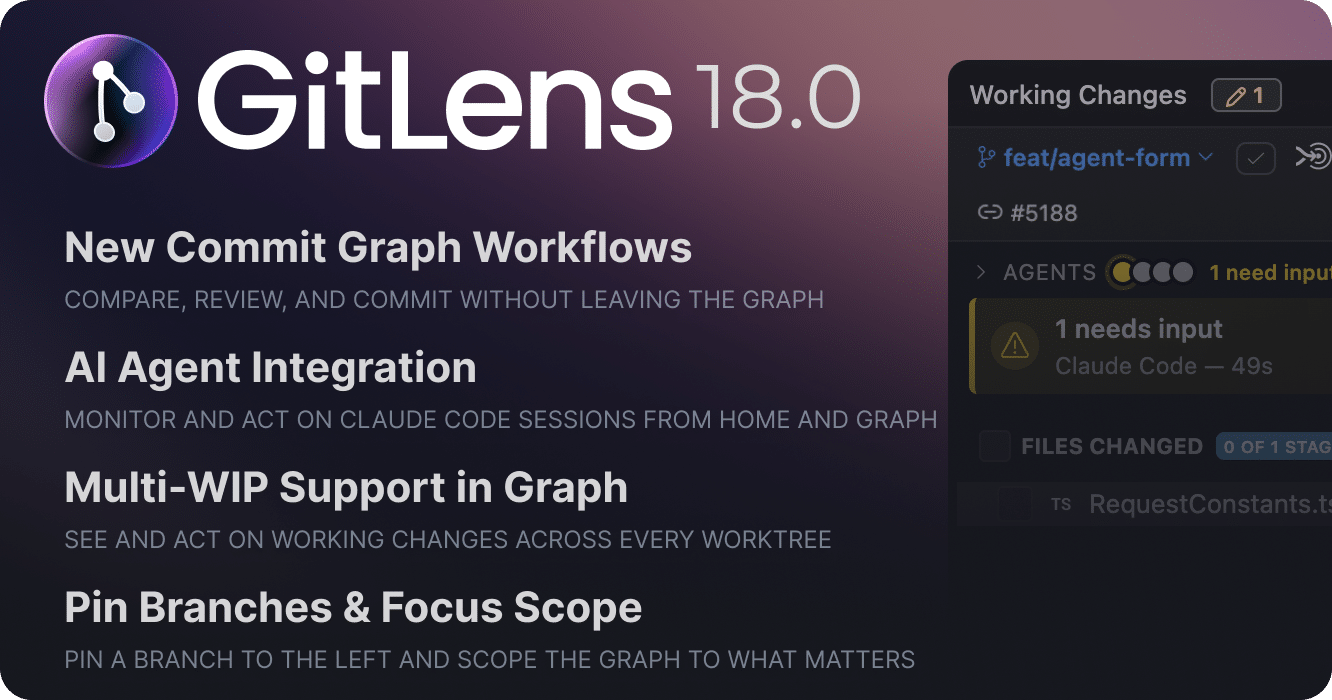
The Commit Graph, Now a Workbench
The Commit Graph is no longer just a place to read history — it’s where you work. A new embedded details panel allows you to inspect commits, working changes, compare branches, conduct reviews with AI, and compose commits without leaving the context of your Graph. The panel can be anchored to the right (the default) or to the bottom of the Graph — hold Alt while clicking the details toggle to switch between the two.
This revamped commit details panel adds richer file-tree actions, multi-diff support, and quick toggles to jump into Compose, Review, and Compare modes.
Review and Compose, Directly in the Graph
Both Commit Composer and a new AI Code Review tool are now available right inside the Graph’s details panel. Switch into compose mode to generate organized commits from your working changes, with multi-diff editor support for previewing proposed commits. Switch into review mode to get an AI-powered review of your changes, with summaries that identify focus areas with severity indicators, so you can check your work before you ship.
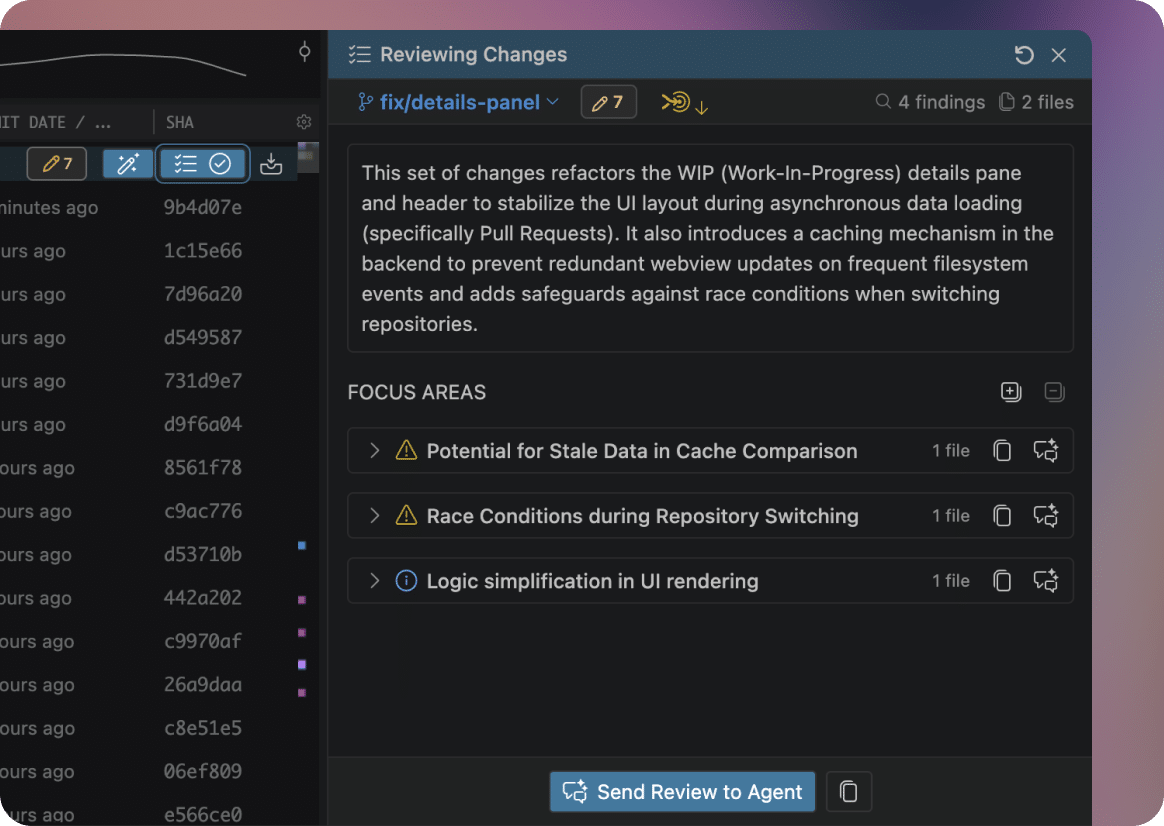
AI Agents in GitLens
GitLens 18 introduces support for integrating AI coding agents, starting with Claude Code. Agent status is now surfaced throughout GitLens so you can monitor, focus, and act on parallel agent sessions without leaving the IDE and context from GitLens.
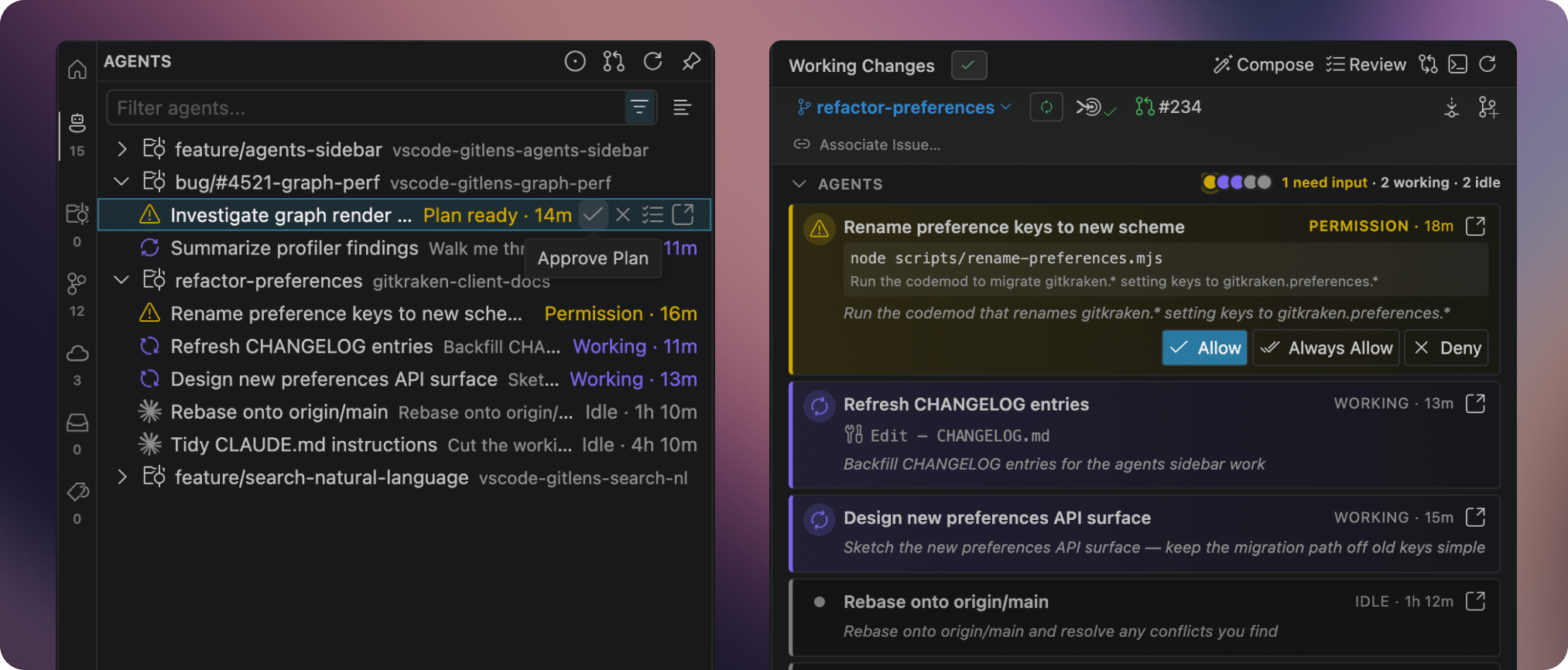
Your agents’ status, deeply integrated — A new agent status pill appears on Home view branch cards, the Commit Graph overview cards, the Commit Graph commit details panel, and the new Agent Sessions sidebar panel. Pills are color-coded by state (running, idle, waiting for input, etc.), with subtle animations when sessions are active or when an agent is waiting for your input. Sessions awaiting input also surface on overview cards so you can find what needs attention at a glance.
Agent Sessions panel — A new panel in the Home view and the Commit Graph sidebar lists all your agent sessions in a streamlined view, with the same rich status hovers and quick actions as the inline pills. Switch between list and tree layouts to organize sessions by workspace or worktree.
Claude Code hooks integration — Install Claude Code hooks directly from GitLens via the Home view banner, the Commit Graph header, the agents sidebar banner, or the integrations menu. Hooks give GitLens real-time visibility into Claude Code session state. A dedicated command lets you uninstall hooks at any time.
Agent Kanban (Experimental) — A new experimental Agent Kanban view turns the Commit Graph into an interactive board for tracking your active AI agent sessions. Toggle it from the graph sidebar (‘Show Agent Kanban‘) to see sessions partitioned across four columns: Needs Input, Working, Idle, and Inactive. From each session card you can approve or deny pending agent permissions, view a proposed plan, and jump straight to the session’s working changes.
The Agent Kanban view is enabled by default and can be toggled with the gitlens.graph.experimental.kanban.enabled setting.
Multi-Worktree WIP Rows
The Graph now displays a work-in-progress row for each worktree, not just the active one, so you can see, review, and act on changes across all your parallel work without switching. Each WIP row shows live file stats, supports the full set of WIP actions (commit composition, conflict resolution, generating commit messages, and more), and updates in real time as files change. WIP scrollbar markers help you quickly locate uncommitted changes, with a configurable theme color and a setting to toggle them on or off.
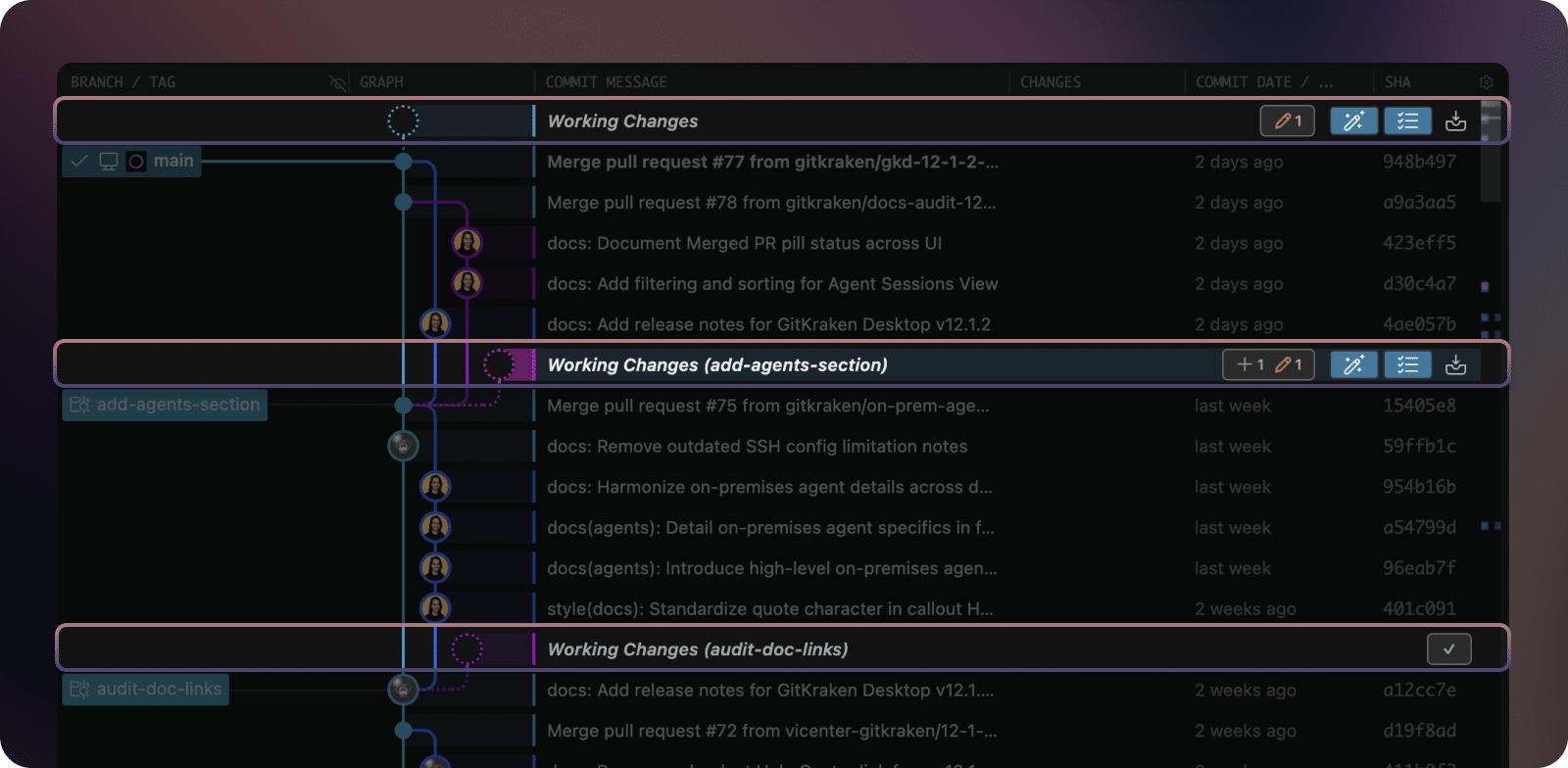
Commit Graph Sidebar
The expandable sidebar introduced in 17.12 gets new, powerful views and actions in 18.0:
- Overview panel — surfaces active and recent branches as cards with WIP changes, upstream tracking status, pull requests, associated issues, contributor avatars, and quick actions (Switch, Open Worktree, Fetch, Publish Branch, and compare actions). Rich hover popovers expand each card with the full action set, autolink chips, and Launchpad mergeability tinting.
- Agent Sessions panel — see all your active agent sessions with status pills, branch/worktree associations, and quick actions to keep your agents unblocked.
- Remote actions — full context-menu support for remotes alongside branches, tags, stashes, and worktrees.
- Worktree parity — worktrees now have the same context-menu actions as branches, including AI-powered explain and generate changelog actions.
- Tree-mode layout toggle has moved into the filter actions area for a cleaner, more contextual placement.
- Pin or overlay — pin the sidebar in place, or float it as an auto-collapsing overlay over the Graph.
Visualizations in the Graph
GitLens 18.0 brings powerful new ways to visualize your repository directly in the Commit Graph. A more capable Visual History view has been integrated into a Visualizations mode that now hosts new experimental Treemap views to visualize changes by file, commit, and agent activity.
Open the visualizations by clicking on the ‘Show Visualizations’ pulse icon at the bottom of the Graph sidebar, then use the switcher in the header to move between the Visual History timeline and the new Treemap views.
Visual History
The Visual History view renders your repo’s history as a time-bucketed view of activity, with author avatars, configurable additions/deletions colors, and richer hover, zoom, scroll, brush, slider scrub, and slice filtering interactions. Scope the history down to specific files and folders, and slice the changes by branches rather than authors if needed.
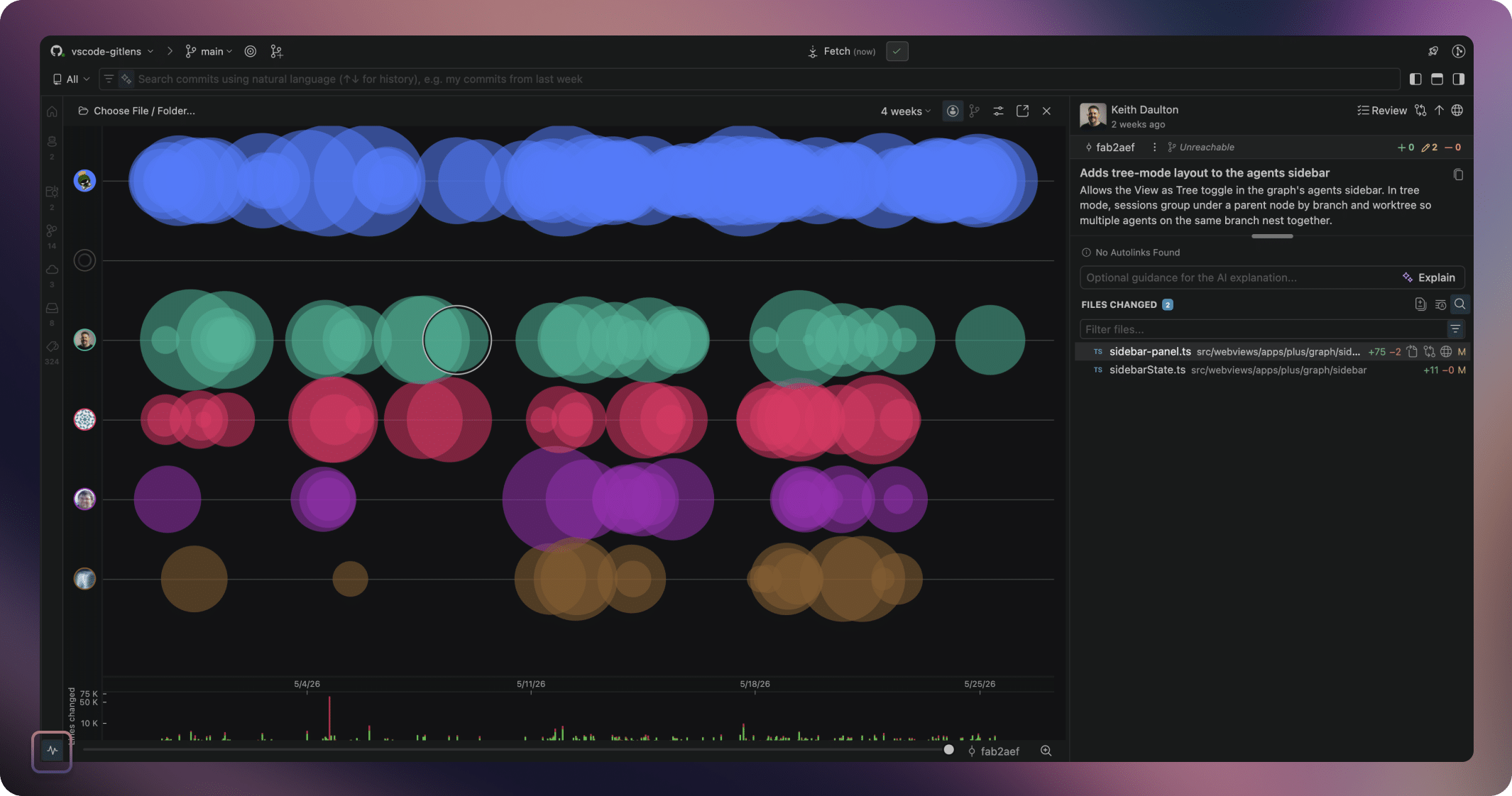
Treemap Visualizations (Experimental)
As an alternative to the Visual History timeline, the Commit Graph now offers three Treemap views that lay your repository out spatially. Each supports hover tooltips, click-to-zoom into folders, and breadcrumb navigation to track and retrace your path:
- Files Treemap — lays out your files and folders as nested rectangles, sized by their footprint, for a bird’s-eye view of how the repository is structured.
- Commits Treemap — highlights where development is concentrated by sizing files and folders according to commit activity, making your most-changed areas stand out at a glance.
- Agent Activity Treemap — projects live AI agent presence onto your file structure in real time, distinguishing the files an agent is reading from the ones it’s editing.
The Treemap visualizations are enabled by default and can be toggled with the gitlens.graph.experimental.visualizations.enabled setting. When disabled, only the Visual History is available.
Focus on the Work You Care About
You can now pin a branch to the leftmost column of the Commit Graph so it always stays visible as a reference, even as other branches come and go. Pin or unpin from the row’s context menu, and click the pinned ref in the Graph header to jump straight to it.
A new focused branch mode on the Commit Graph header lets you focus the Graph on a single branch, with a searchable tree or list view to pick the focus. While scoped, the Graph renders along the focused branch’s first-parent line (with the “Simplify Merge History” toggle automatically applied), and the minimap zooms to the relevant range. Clear visual indicators show when the Graph is scoped or modified by filters. The minimap settings have moved into the minimap itself, and dedicated header buttons toggle the sidebar, minimap, and details panel.
Conflict Resolution Workflows
Conflict resolution now reaches into the Commit Graph and Interactive Rebase editor:
- Resolve conflicts directly from the Graph’s WIP details panel, with merge-conflict status surfaced inline
- Conflict resolution actions are also available in the Interactive Rebase editor’s conflict file list, with dedicated diff-left/diff-right icons
- The Interactive Rebase editor now shows a dismissible banner during the planning phase clarifying that closing the tab automatically starts the rebase
Open the Graph in a New Window
A new “Open in New Window” command opens the Commit Graph in a detached window for multi-monitor workflows. It’s now the primary action in the Graph view’s menus, with “Open in Editor” available as a modifier-key alternative.
Performance and Reliability
GitLens 18 continues to invest in performance and stability improvements:
- Faster Graph details loading — commit metadata is now eagerly rendered from graph rows to instantly populate the details panel and skip IPC delays, with cached base file contents during compose sessions to eliminate redundant git reads.
- Smarter caching — granular TTLs based on ref mutability (5 minutes for full SHAs, 60 seconds for symbolic refs), cached branch merged-status checks, cached left/right commit counts for comparisons, and shared branch metadata across worktrees.
- Lazy enrichment — branch overview enrichment shifts from eager bootstrap to lazy loading, dramatically reducing initial resource contention during graph rendering.
- Better cancellation — abort signals now propagate through the Git command queue, RPC layer, and webview enrichment, so cancelled work stops instead of running to completion.
- Coalesced refresh — working-tree change emissions are coalesced into a single event per tick, eliminating redundant UI refreshes
- Startup improvements — Git and MCP providers now register in parallel, and the CLI version check is deferred to reduce extension activation time.
Added
- Introduces an all-new Commit Graph experience — a comprehensive redesign that pulls commit inspection, AI workflows, comparisons, branch focus, and working-change management directly into the graph
- Adds an embedded details panel — replaces the standalone Graph Details view with an integrated panel that handles commit details, working changes, branch comparisons, AI reviews, and commit composition without leaving the graph
- Adds a
gitlens.graph.details.locationsetting to anchor the details panel at the bottom or right, with Alt+click on the details button to toggle - Adds an integrated AI Compose mode — provides a much improved AI-powered commit composition directly within the graph, with per-commit include/exclude toggles, multi-diff editor support, a virtual filesystem provider for synthesized per-commit diffs, cancellable generation, parallel/background operation, and copy and send-to-agent actions
-Adds an integrated AI Code Review mode — surfaces severity-tagged findings with tooltips, copy and send-to-agent actions on outputs, and PR/issue/autolink context input (#5235) - Adds an integrated Compare mode — opens comparisons directly inside the graph instead of the Search & Compare view, with Ahead/Behind/All Files tabs, working tree comparisons for peer worktrees, AI-powered explaination and changelog generation, and an Open in Search & Compare action to persist ad-hoc comparisons
- Adds a refined header with WIP (work-in-progress) status and stash action
- Adds a unified UI/UX for scoping and filtering the graph
- Adds an Agent Branches option to filter the graph to show only the branches or worktrees with active or recent agent activity
- Adds a Focus Branch option to scope the graph to just the changes on specific branch via a new branch selector (or the new Overview or Agents side bar), with merge-target anchoring
- Adds all new experiences to the graph Side Bar
- Adds pinned and overlay modes — overlay mode floats over the graph instead of pushing it aside, with auto-collapse on focus loss and a pin/unpin toggle in the panel header
- Adds an Overview side bar panel — surfaces active and recent branches as rich cards with WIP stats, upstream tracking, associated pull requests, issues, and agents, as well as quick actions and rich hover details
- Clicking on an Overview card instantly focuses (scopes) the graph to just the changes on the selected branch
- Adds an Agents side bar panel — surfaces active and recent agents with their activity, associated branches/worktrees
- Clicking on an agent row instantly focuses (scopes) the graph to just the changes on the selected wokrtree, and selects the agent in the details panel
- Adds a Visualizations mode to the side bar — houses the all-new Visual History, and 3 experimental treemap visualizations
- Visual History — rebuilt from the ground up to provide a better experience with dynamical loading and dealing with many contributors and/or branches
- Files Treemap — an experimental spatial visualization of file layout within the repository color coded by file type, with hover tooltips, deep zoom-to-folder, and tracking breadcrumbs
- Commits Treemap — an experimental spatial visualization of commit activity within the repository colorized as a heatmap
- Agent Activity Treemap — an experimental spatial visualization of realtime agent activity. See where your agents are currently reading and editing across your repository
- Adds an experimental Agent Kanban mode to the side bar — an interactive Kanban board grouping active agent sessions by state (Working, Idle, Inactive, Needs Input), with inline plan view and permission approval directly from session cards
- Adds comprehensive context menu support for worktrees in the sidebar and Commit Graph — brings feature parity with branches, including Reveal in File Explorer, AI-powered actions (explain WIP, generate changelog), Open in Terminal, and Copy Path
- Adds an all new way to manage worktrees and working changes (WIP)
- Changes working changes (WIP) rows to always be visible regardless of whether or not there are uncommitted changes
- When there are uncommitted changes, the Details Panel now allows you to review, stage, and commit your changes, or leverage the all-new Compose and Review modes to have AI review and automatically compose your changes into a set of well-structured commits
- When there are no uncommitted, the Details Panel transforms into a hub to guide you to the next steps — like pulling, pushing, drafting a PR, reviewing, recomposing, etc. Everything to help you get your changes merged faster (#5218)
- Adds support for working changes (WIP) rows from secondary worktrees
- Selecting a WIP rows provides file actions, conflict resolution, and live-updating stats for non-active worktrees, plus Open in Integrated Terminal and Open Worktree in New Window actions on the header
- Adds the ability to discard uncommitted changes
- Adds smart push/pull on the WIP details panel header — offers Force Push when a branch is both ahead and behind its remote
- Adds conflict resolution actions to the WIP details panel
- Adds the ability to share working changes as a Cloud Patch directly from the WIP header
- Adds persistence of in-progress commit messages and amend state per worktree — drafts are restored when switching contexts, the original message is restored on Undo Commit, and per-worktree search box and filter preferences persist across sessions
- Adds Jump to Working Changes — quickly navigate from the selected commit to the most relevant WIP node in the same lane, with primary-worktree fallback
- Adds bulk staging operations — Stage All and Unstage All, with Alt-click on mixed-state checkboxes to unstage all currently staged items
- Adds auto-fetch while the Commit Graph is visible and focused, yielding to VS Code’s built-in Git auto-fetch when enabled, with a fetch button popover to manage settings and a minimum interval floor to prevent excessive fetching
- Adds search and filtering improvements — adds a
type:wipoperator to filter to working changes, and column header filters with interactive pickers for authors, refs, and files - Adds the ability to pin and unpin branches — pinned branches persist across sessions with a jump-to-pinned-branch actionn (#5139, #5181)
- Adds inline row actions for commit and stash rows including open all changes (Alt to compare against working tree) and apply/drop stashes
- Adds a floating “HEAD” indicator to the graph to quickly jump to the HEAD commit
- Adds a completely rebuilt minimap with better performance and zoom controls and clearer markers
- Adds minimap and scrollbar markers for worktrees — surfaces uncommitted changes on the minimap and scrollbar with a configurable theme color and a toggle setting
- Adds an Open in New Window toolbar view action — opens the graph in a detached window for multi-monitor workflows, with Open in Editor available as the Alt+click alternative
- Adds comprehensive AI agent integration throughout GitLens
- Adds an agent status framework with Claude Code support using Claude Code Hooks (must be installed) — surfaces sessions across the Home view, Commit Graph overview cards (#5170), WIP rows, Commit Details, Agents side bar panel, and the experimental Agent Kanban mode
- Adds an Agent Branches visibility mode to the Commit Graph that filters branches to only those with active or recently active agents
- Adds an agent picker to Start Work and Start Review flows, plus a default-agent picker, Switch Default Agent command, and Start Work/Start Review in Agent actions in the Home and Commit Graph views
- Adds support for opening agent sessions hosted in other VS Code windows
- Adds a Resume in Terminal fallback when an agent session fails to open or is active in another VS Code window
- Adds notifications for peer-discovered agent session permissions
- Adds an experimental Agent Kanban mode — an interactive Kanban board grouping active agent sessions by state
- Adds conflict resolution actions to the Interactive Rebase editor conflict file list
- Adds a close-tab warning banner to the Interactive Rebase editor — displays a dismissible informational banner during the planning phase to clarify that closing the tab automatically starts the rebase (#5123)
- Adds a
gitlens.rebaseEditor.openBehaviorsetting to control where the Interactive Rebase editor opens when automatically reopened on a paused rebase —auto(default) opens beside only when a multi-pane layout already exists;besidealways opens in a side group - Adds Seti file icon theme support for webviews — files in webview trees now display the correct Seti glyph
- Adds folder actions in Details Panel and Inspect view
- Adds a unified onboarding reset command that consolidates the previous Banners and Usage Tracking resets into a single restore-first-time-experience action
Changed
- Switches the Commit Graph sidebar to be visible by default for new installations in overlay mode
- Switches Open Worktree in New Window to be the primary action and Open Worktree to be the alternative across views and the Commit Graph
- Improves the default Interactive Rebase editor density to a more spacious layout
- Improves Commit Graph performance and responsiveness — content-fingerprint deduping of full-state pushes, incremental row-stats sending, avatar omission for unchanged rows, in-memory WIP caches, and debounced repository event coalescing
- Improves branch overview enrichment performance — tiered caching using stored merge targets as cache keys, lazy loading, and parallelized metadata fetches
- Improves Git diff performance — switches diff operations to
numstat+summaryinstead ofname-statusparsing - Improves Git command result caching — granular TTLs based on ref mutability (5-minute cache for full SHAs, 60-second failsafe for symbolic refs), plus caching for left-right commit counts, merge bases, and per-branch config lookups
- Improves performance for GitHub virtual repositories — adds caching for commit details, counts, merge bases, paged branches/tags, and default branches, plus deduping of in-flight GraphQL requests
- Improves the Commit Graph minimap colors and contrast for better theme accessibility, and adds out-of-view proxy handles and improved scope zoom rendering
- Improves the Connect More Agents picker to only show agents that don’t already have the GitKraken MCP installed, with a clearer empty state when all detected agents are already connected (#5142)
- Improves repository visibility detection with promise-based caching to prevent redundant computation
- Improves Git command priority inference — keeps polymorphic history commands at normal priority, requires expensive full-history walks to opt into background priority
- Improves the default and maximum limits for concurrent background Git processes
- Improves branch comparison default target logic — automatically suggests the merge target of a branch as the default right-side reference and uses branch names instead of SHAs for stability
- Improves stash reachability filtering — uses Git’s authoritative stash metadata via the
%ssubject parsing instead of expensive parent-timestamp tracking - Improves AI error handling and network detection — distinguishes between “No Network” and “Unreachable” states, with automatic retry on network failures and a recursive cause-chain analysis for better diagnostics
- Improves header and breadcrumb responsiveness across webviews — priority-based collapsing with compact icons and overflow popovers for narrow views
- Migrates from
node-fetchto native fetch and adopts VS Code’s built-in proxy support — removes the customgitlens.proxysetting in favor of standard VS Code and OS proxy settings - Migrates the webview component library to WebAwesome, modernizing selects, overlays, sliders, and tooltips with workspace-color-aware highlights
Fixed
- Fixes an issue where starting an interactive rebase forced a split-pane layout when git paused for a
reword— the Interactive Rebase editor now opens as a hidden background tab alongside the commit message editor instead of stealing the active tab (#5203) - Fixes an issue where untracked files were missing from the Compare Working Tree with… file list unless manually staged with
git add -Nfirst (#5158) - Fixes an issue where the Interactive Rebase editor would auto-open during the brief teardown window after a rebase completed (or on non-interactive rebases), showing stale or empty state (#5217)
- Fixes an issue where the Interactive Rebase editor would show a blank state when opened on a repository outside the workspace (e.g., from a terminal) (#5229)
- Fixes an issue where the terminal integration relaunch warning persisted due to stale environment variable state (#4977)
- Fixes an issue where MCP reinstallation could fail when the proxy binary was locked on Windows (#5126)
- Fixes an issue where stashing staged changes was not using the
--stagedflag (#5138) - Fixes an issue where the currently selected option is not visually distinguishable in select-style menus on the Home view (agent workspace filter, recent timeframe filter) and elsewhere (Visual History period menu, Commit Graph overview filter) — most noticeable on light themes (#5259)
- Fixes an issue where diff hunks could be missing for renamed or copied files in editor gutters and hovers — rename detection was inadvertently filtering out valid diffs
- Fixes an issue where stash apply and pop actions could fail silently due to missing stash numbers, producing invalid
stash@{undefined}references, and where the Commit Graph would not refresh when a stash was dropped - Fixes an issue where GitLens would automatically re-open repositories that the user had explicitly closed via the SCM interface
- Fixes an issue where the File History context menu actions on commits and folders launched a standalone editor instead of integrating with the embedded Visual History in the Commit Graph
- Fixes an issue where the SCM grouped views could intermittently “detach” — alt commands have been removed from SCM grouped views due to flakey/sticky alt detection in VS Code
- Fixes an issue where the Compare Working Tree “Show All Diffs” button used inverted diff direction
- Fixes an issue where authentication errors could surface noisy notifications and break-on-exception breakpoints instead of returning safe defaults
- Fixes various race conditions and stale-state issues across the Commit Graph during repository, branch, and worktree switches — including phantom anchors after removing the last secondary worktree, cross-repo data contamination during rapid swaps, lost state notifications during in-flight updates, and forced reloads during panel restoration
- Fixes an issue where the working tree comparison could incorrectly include untracked files for revision-range diffs
