

Last updated: November 2026
Use these Settings pages to change how Kepler itself looks and behaves:
- General: language, the chat’s send key, the default editor, windows and dialogs, keeping agents running, and usage insights
- Notifications: which agent events notify you, on the desktop and in Kepler
- Appearance: light or dark appearance and themes, the Dashboard’s views, the chat, the terminal font, and the code font and diff layout
- Voice: dictation, with its models and learned words, and read aloud
- Keyboard shortcuts: look up and change Kepler’s keyboard shortcuts
General
Use General to choose Kepler’s language, which key sends a chat message, which editor opens your files, how its windows open, whether agents keep running when your machine would sleep or Kepler quits, and whether Kepler keeps usage statistics on your computer.
Language
Language has 1 setting:
| Setting | What it controls | Default | Options |
|---|---|---|---|
| Language | The display language for Kepler’s interface | English | English, Español |
The language also applies to Kepler’s native dialogs.
Chat
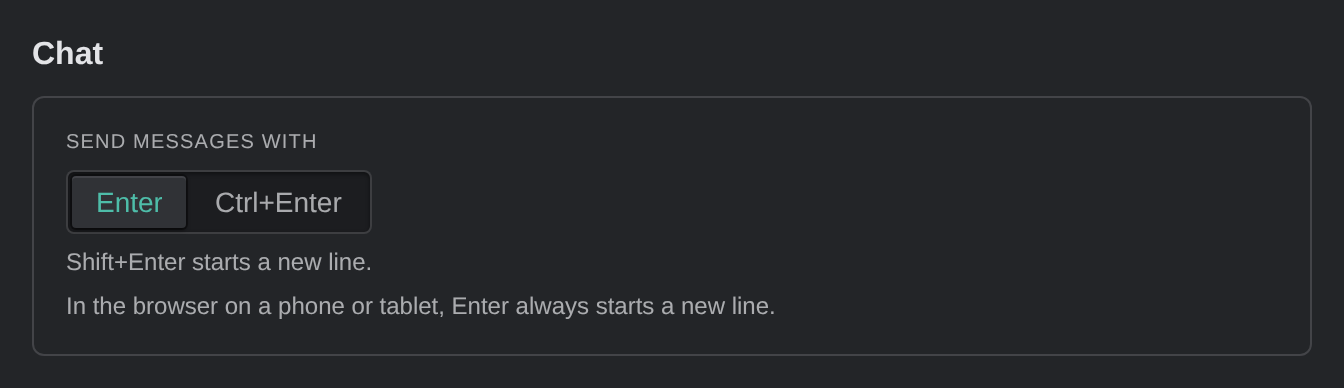
Send messages with chooses the key that sends a message from the chat box: Enter, the default, or Ctrl/⌘ + Enter. With Enter, Shift + Enter starts a new line. With Ctrl/⌘ + Enter, Enter starts a new line.
Default editor
Default editor has 1 setting:
| Setting | What it controls | Default |
|---|---|---|
| Open files and folders in | The app that Open in and Ctrl/⌘ + Shift-click on a file link use. The options are Last used app, each editor Kepler finds on this machine, and your system’s default app | Last used app |
With your system’s default app, files open without line numbers, and folders open in Finder, Explorer, or your file manager. If Kepler cannot open any editor from the window you are in, the setting says so.
Windows and dialogs
These settings set how windows and folder dialogs work on this machine:
| Setting | What it controls | Default |
|---|---|---|
| Restore windows on launch | Reopens the windows you had open, with their size, page and connection. Turn off to start with one window. | On |
| Always use the custom folder picker | Local windows open your system’s folder dialog, and windows connected to another machine use Kepler’s own folder picker, which can browse that machine. Turn this on to use Kepler’s picker in every window | Off |
A change to Restore windows on launch takes effect the next time you start Kepler.
Keep agents running
These settings keep agent work running when the machine would otherwise stop it. They apply to the machine the agents run on, so in a window connected to a remote machine, they apply to that machine:
| Setting | What it controls | Default |
|---|---|---|
| Keep this machine awake while agents work | Blocks sleep while an agent session is starting, running, or waiting for your input, and while Remote Access is connected | On |
| Keep agents and terminals running after Kepler quits or restarts | Agents and terminals stay alive while Kepler is closed or updating, and reconnect afterwards. When off, quitting or restarting Kepler ends them. | On |
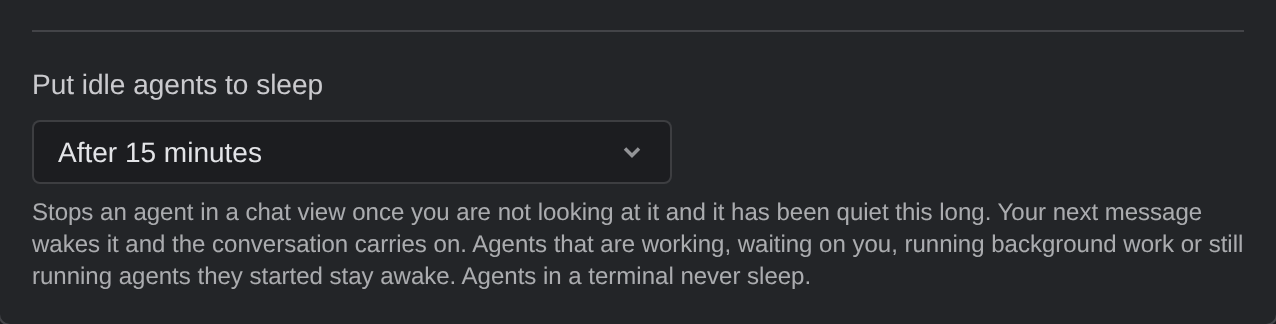
| Put idle agents to sleep | How long a chat agent can sit idle before Kepler stops it, from After 5 minutes to After 1 hour, or Never | After 15 minutes |
Keep this machine awake while agents work also counts Claude Code sessions running outside Kepler. The screen can still turn off. If Kepler cannot keep the machine awake, the setting says why under the switch.
Keep agents and terminals running after Kepler quits or restarts applies from the next session you start. If agents and terminals cannot start on this machine, the setting says why.
Put idle agents to sleep stops chat sessions you have left alone, and their status reads Asleep. Your next message wakes a session, and the conversation carries on. Agents that are working or waiting on you stay awake. See Session status.
Insights
Insights has 1 setting:
| Setting | What it controls | Default |
|---|---|---|
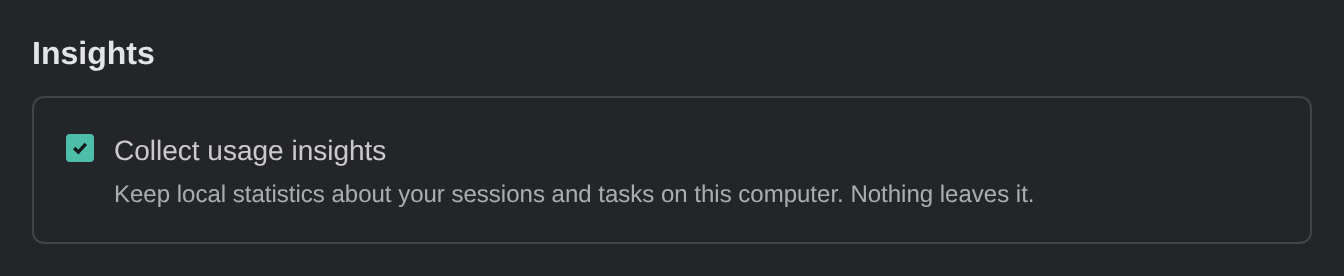
| Collect usage insights | Keep local statistics about your sessions and tasks on this computer. Nothing leaves it. | On |
Ask Kepler uses these statistics to answer questions about your agent work, such as tokens and cost, how long agents waited on you, and how often you hit a usage limit.
Notifications
Use Notifications to choose which agent events Kepler tells you about, and where. Desktop notifications show while Kepler is in the background, and In Kepler alerts show while you are using it. Sessions started outside Kepler notify you only once they are on a task. Kepler saves these settings on this machine.
What to notify you about
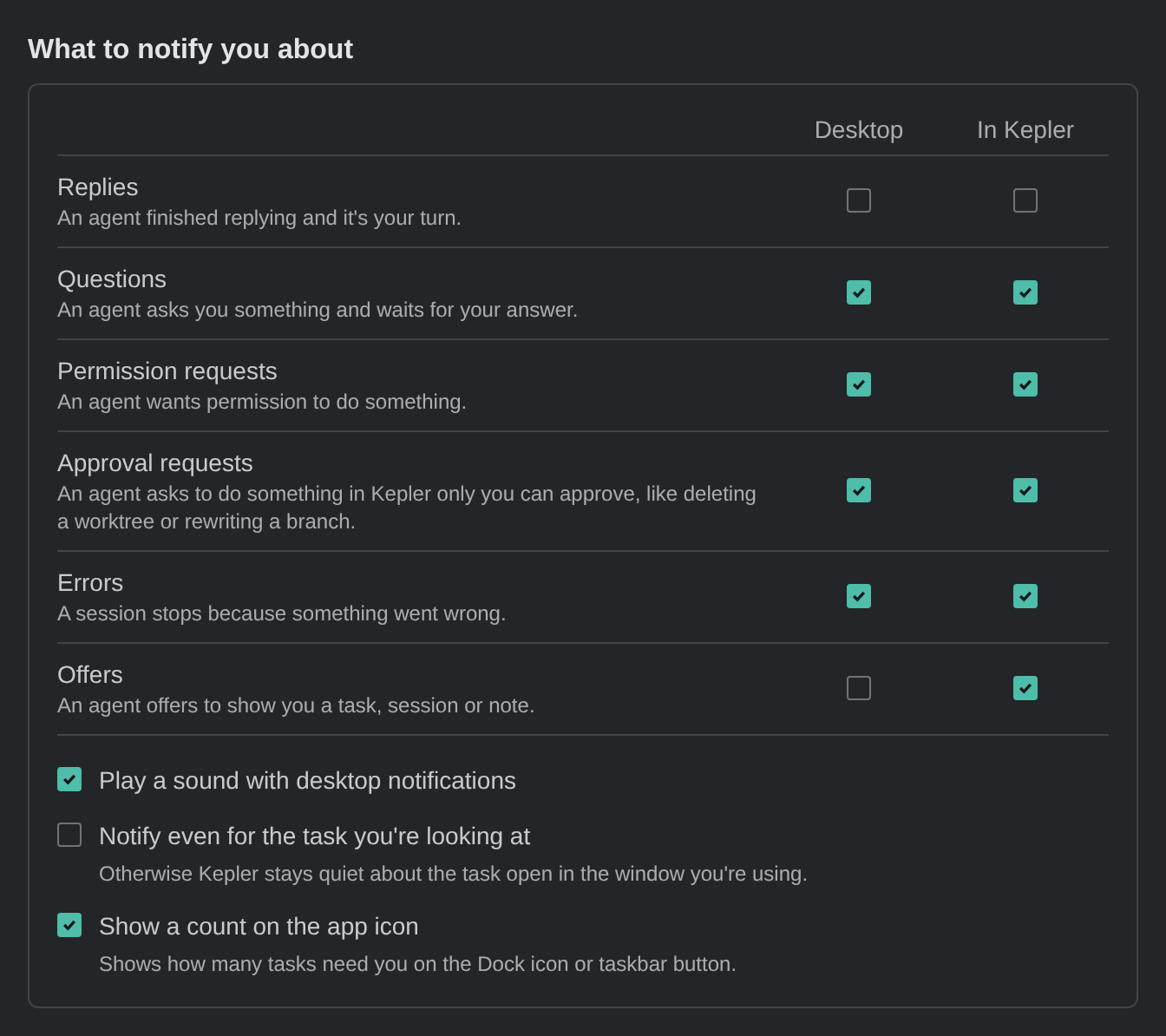
What to notify you about has a Desktop and an In Kepler box for each event. The following table lists the events and their defaults in the desktop app:
| Event | When it fires | Desktop | In Kepler |
|---|---|---|---|
| Replies | An agent finished replying and it’s your turn. | Off | Off |
| Questions | An agent asks you something and waits for your answer. Also fires when a plan is ready for your review | On | On |
| Permission requests | An agent wants permission to do something. | On | On |
| Approval requests | An agent asks to do something in Kepler only you can approve, like deleting a worktree or rewriting a branch. See Approvals | On | On |
| Errors | A session stops because something went wrong. | On | On |
| Offers | An agent offers to show you a task, session or note. | Off | On |
In a browser connected to Kepler, every Desktop box starts off. Until you set Approval requests yourself, it follows Permission requests. When you turn on the first Desktop box, Kepler sends a sample notification so your OS asks for permission.
These settings appear under the grid:
| Setting | What it controls | Default |
|---|---|---|
| Play a sound with desktop notifications | Whether a desktop notification makes the OS notification sound | On |
| Notify even for the task you’re looking at | Otherwise Kepler stays quiet about the task open in the window you’re using. | Off |
| Show a count on the app icon | Shows how many tasks need you on the Dock icon or taskbar button. Desktop app only | On |
To silence desktop notifications from one remote machine only, use Mute notifications from host on that machine in Remote environments.
Appearance
Use Appearance to choose light or dark and a theme, and to set up the Dashboard’s views, the chat, the terminal, code text, and diffs. Kepler saves these settings on this machine.
Theme
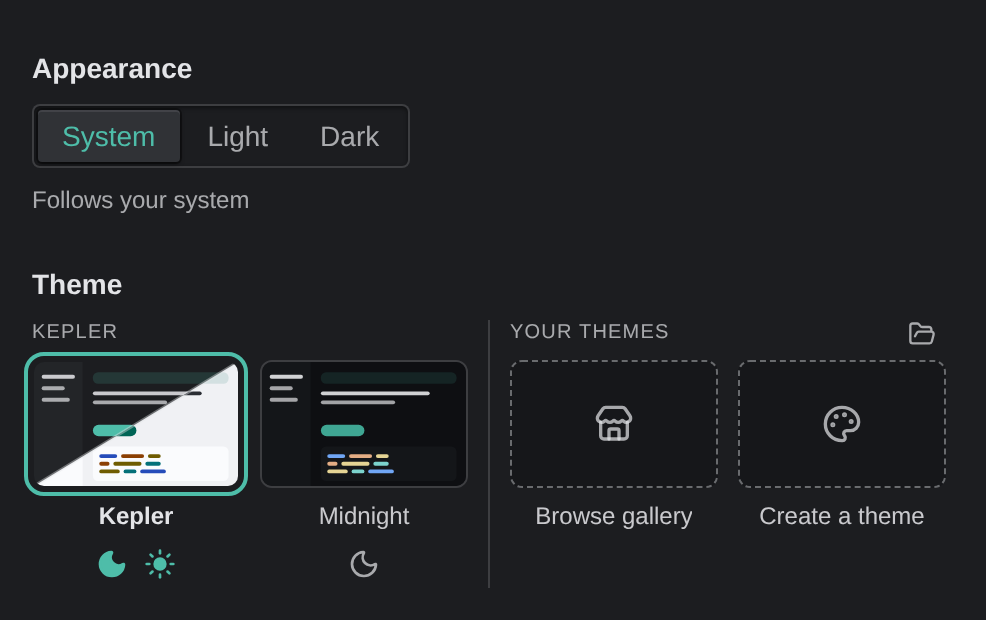
The Theme section has 2 parts: Appearance, which picks whether Kepler looks light or dark, and Theme, which picks the colors for each. Themes color the whole app, including code views, diffs, syntax, chat code blocks, and terminals.
Appearance has 3 options:
| Option | What it does |
|---|---|
| System | Follows your system. Kepler uses your dark theme when your OS is dark and your light theme when it’s light, and switches when the OS does. The default |
| Light | Always uses a light theme |
| Dark | Always uses a dark theme |
Under Theme, each theme is a tile. The Kepler group holds the built-in themes:
- Kepler, which has a dark and a light version. It’s the theme a fresh install uses for both.
- Midnight, a near-black theme that has only a dark version.
How you pick a tile depends on Appearance:
- On System, each tile has a moon and a sun. Click the moon to use the theme when your system is dark, or the sun to use it when your system is light. Click the tile itself to use it for both.
- On Light or Dark, click a tile to use it for that appearance.
The tile in use reads In use now.
Agent CLIs and other terminal programs that support it match your theme too.
Your themes
Your themes lists the themes you have added, with 2 more tiles, Browse gallery and Create a theme. Open themes folder, beside the heading, opens the folder that holds your themes, ~/.kepler/themes. Each profile other than the default keeps its own themes folder.
A theme file follows these rules:
- It is a
.jsonor.jsoncfile, so comments are allowed. - A single file can hold a family of up to 8 themes, such as a dark and a light version.
- Each theme has an id and a name, and
extendsone of Kepler’s base themes:midnight,dark, orlight. The theme then overrides that base’s colors, and can add code colors and aterminalblock. - The
terminalblock sets the terminal’s background, foreground, cursor, selection, and 16 ANSI colors.
Kepler reads up to 64 theme files, and reloads a file each time you save it.
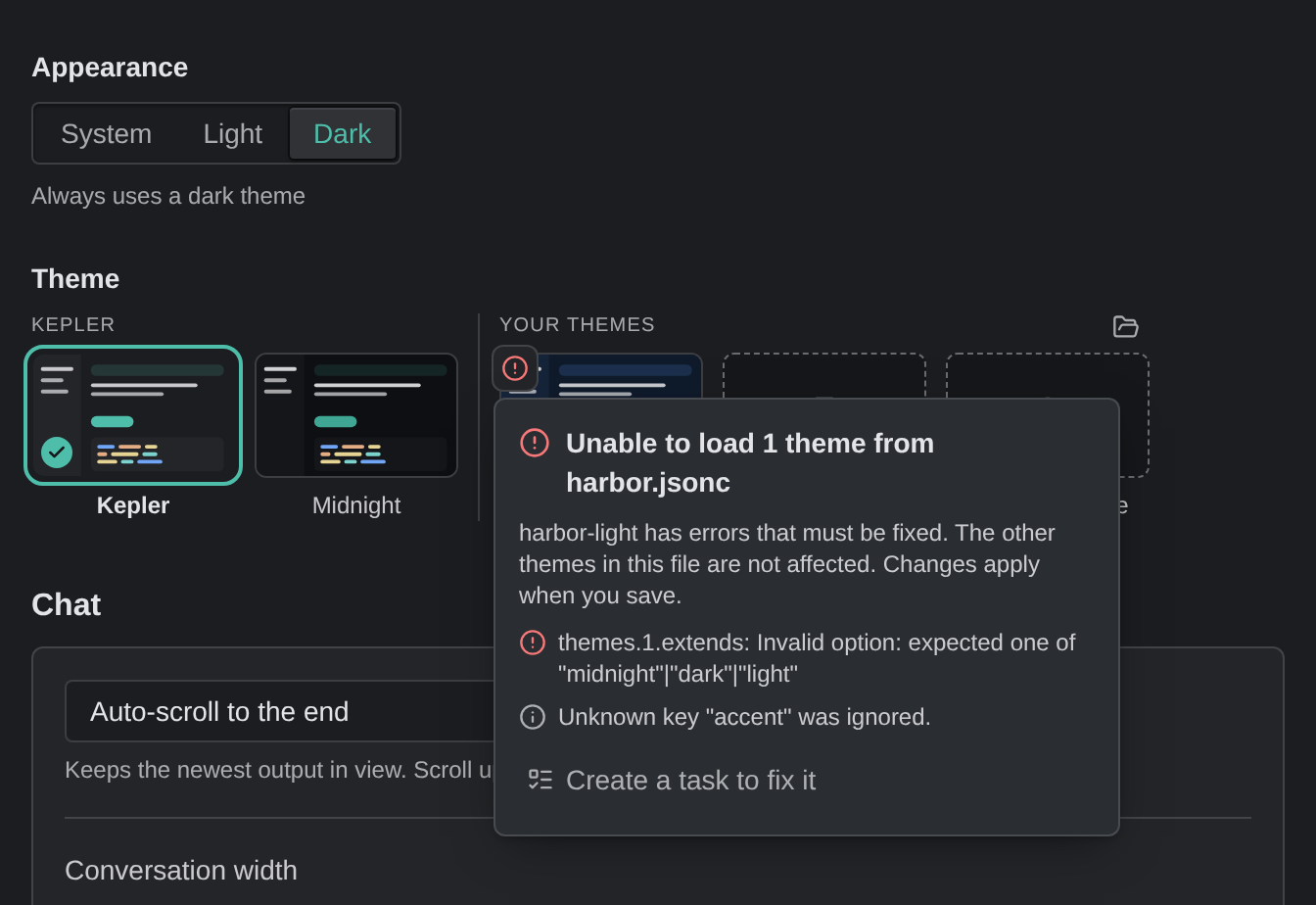
If Kepler cannot fully read a theme’s file, its tile shows Has problems or Has warnings. To see what is wrong, click the badge. Each problem gives its line and column, or names the setting it is in, such as themes.1.extends.
A file with warnings still works. Kepler leaves out a theme that has errors, and still loads the other themes in its file. To fix a file, use one of these options below the list of problems:
- Create a task to fix it gives the file to an agent.
- In the desktop app, Open file opens the file in your editor, at the error’s line when there is one. Changes apply when you save.
A tile’s More actions for theme menu has Show in folder and Move to Trash (Move to Recycle Bin on Windows).
Theme gallery
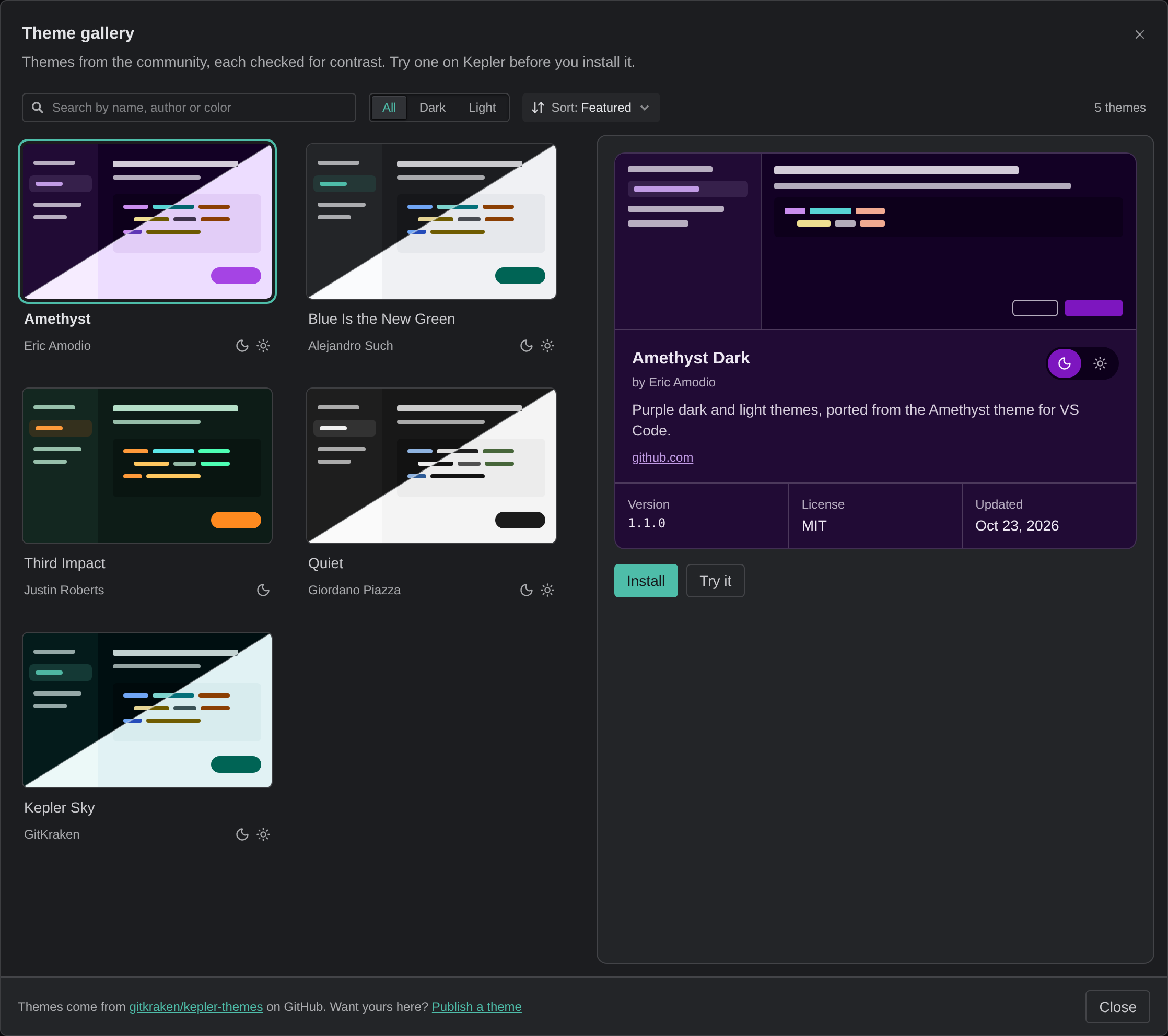
Browse gallery opens the Theme gallery of community themes, each checked for contrast, which you can try before you install. The gallery needs an internet connection. It has the following controls:
- Search themes, which matches a theme’s name, author, tags, or description.
- Show, which filters to All, Dark, or Light themes.
- Sort:, with Featured, Newest, or Name.
Click a theme to see its details card, with its author, its dark and light variants, its version and license, and any contrast warnings. Then choose one of the following:
- Install adds the theme to Your themes without changing the theme on screen. The button then reads Use.
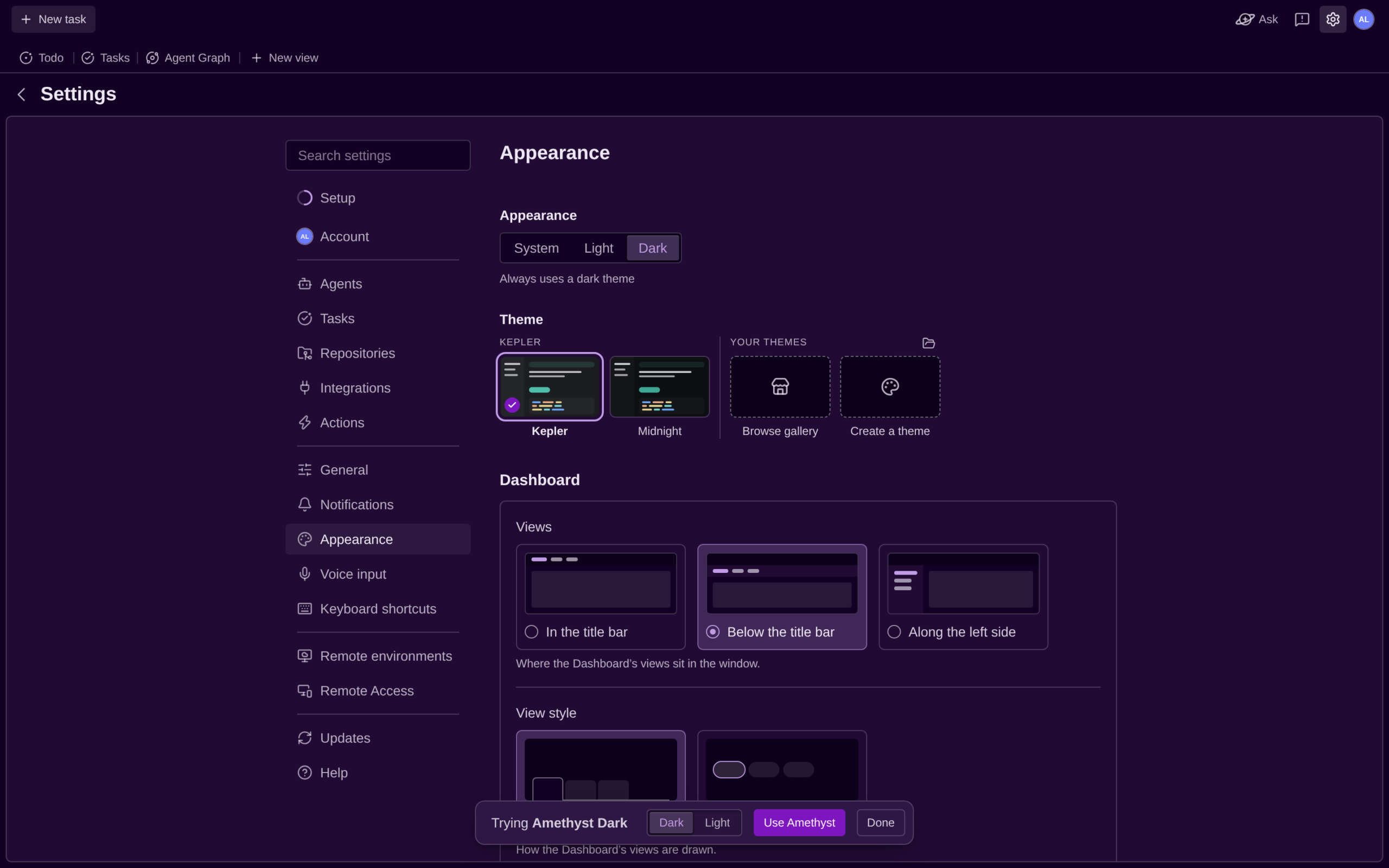
- Try it closes the gallery and paints the whole window in the theme, so you can open a diff or a terminal to judge it. In the bar at the bottom, click Use theme, or Done to return to the gallery.
If a theme you already have uses the same id, Kepler asks before it replaces that file, and moves the old file to the Trash. A gallery theme you installed and have not edited offers Update to version on its tile when a newer version is published. The gallery’s themes come from gitkraken/kepler-themes on GitHub, where you can also publish your own.
Create a theme
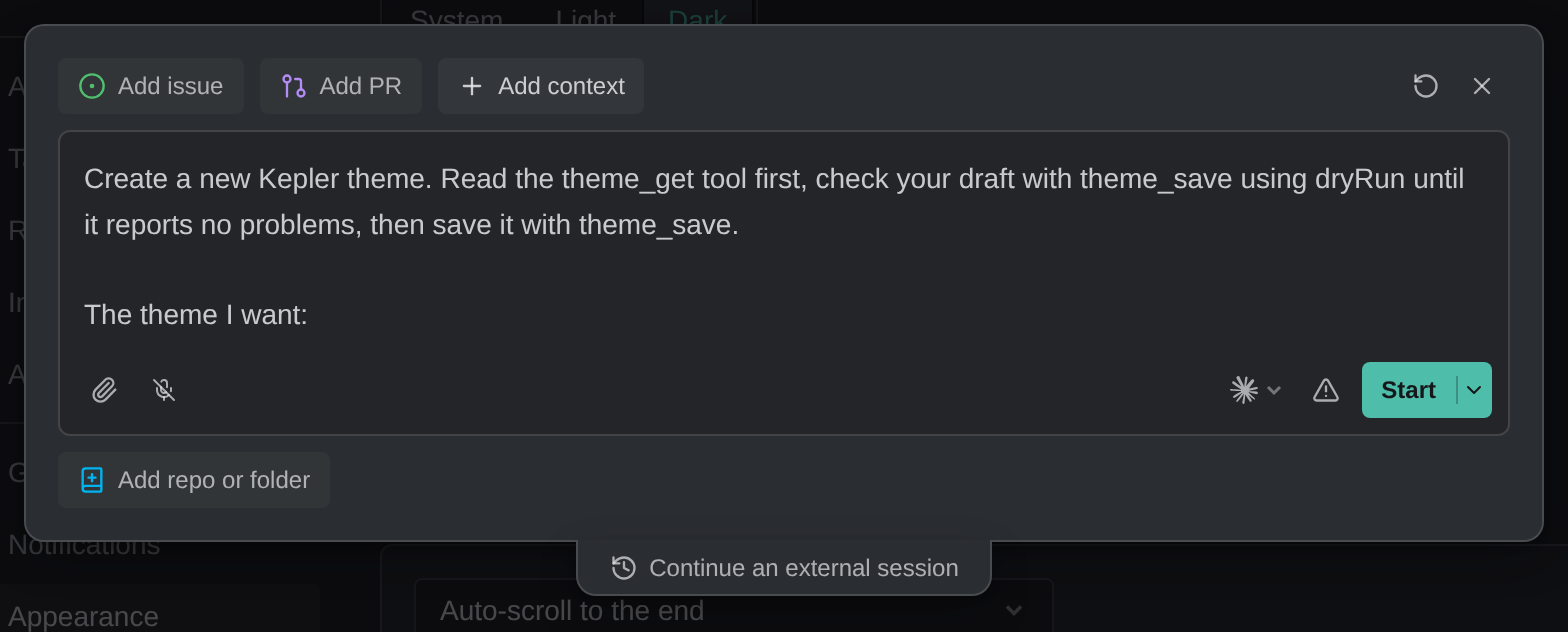
Create a theme opens the New task composer with a prompt already written for an agent, ending in The theme I want: for you to describe it. You do not need to attach the themes folder: the agent checks the theme’s format and contrast, then saves it to Your themes. Create a task to fix it, on a broken theme file, starts the same kind of task with that file’s problems listed.
Themes in a remote window
Themes and your choice of theme belong to this computer. Every window, including one connected to a remote environment, lists and installs themes in this computer’s themes folder and gallery.
In a window connected to another machine, the picker adds an On host group with that machine’s themes:
- A theme you do not have offers Install theme on this computer.
- A theme that differs from your copy offers to update or replace your copy, and is marked Update to version, Older than yours, or Differs from yours.
Kepler asks before it updates or replaces your copy, and moves your copy to the Trash (the Recycle Bin on Windows). It never replaces your copy on its own.
Dashboard
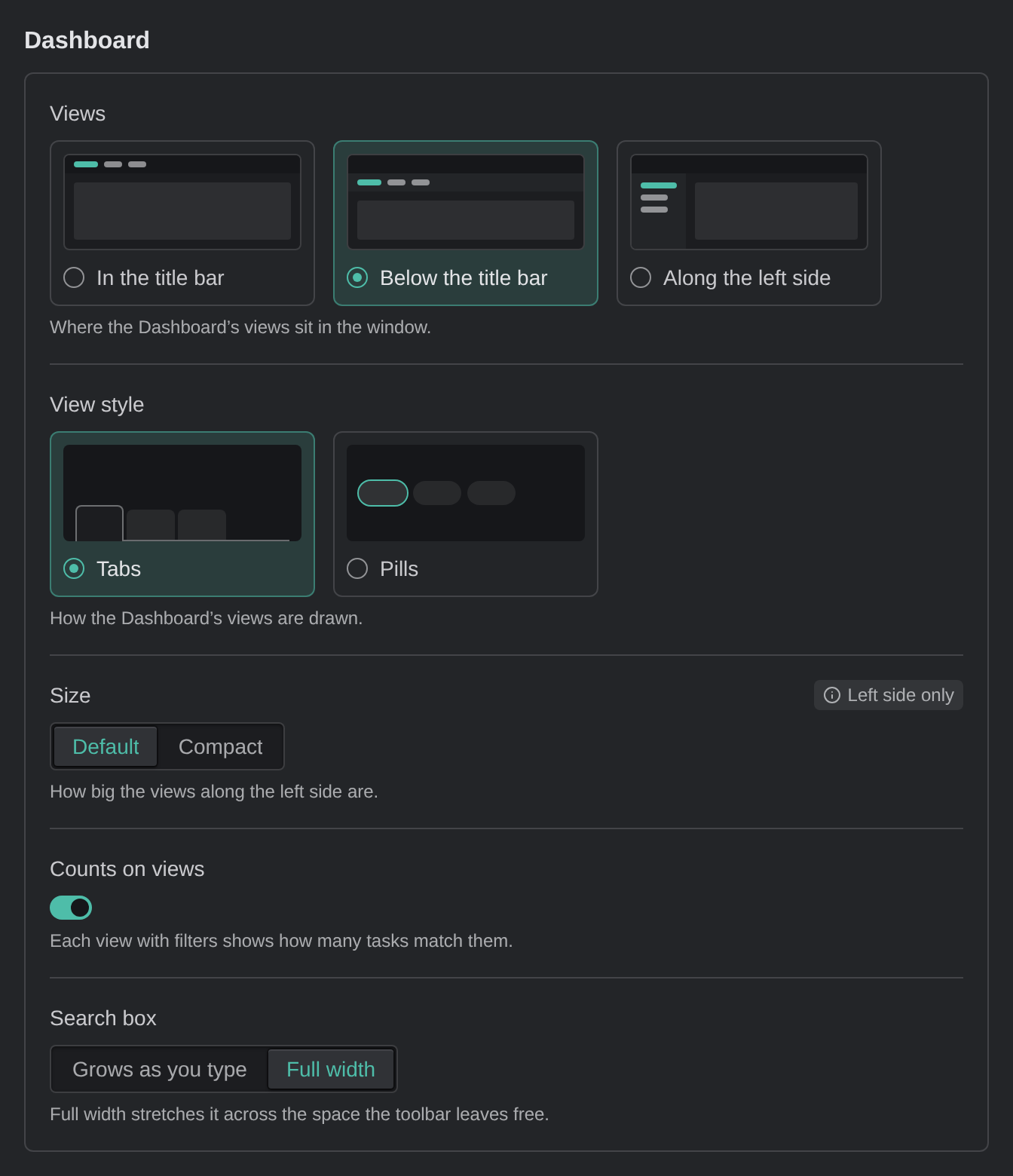
These settings set where the Dashboard’s views sit and how they look:
| Setting | What it controls | Default | Options |
|---|---|---|---|
| Views | Where the Dashboard’s views sit in the window | Below the title bar | In the title bar, Below the title bar, Along the left side |
| View style | How views in or below the title bar look | Tabs | Tabs, Pills |
| Size | How big views along the left side are | Default | Default, Compact |
| Counts on views | Shows how many tasks match each view’s filters | On | On, Off |
| Search box | How wide the Dashboard’s search box is | Full width | Grows as you type, Full width |
With Along the left side, the Settings button moves to the bottom of the views.
Chat
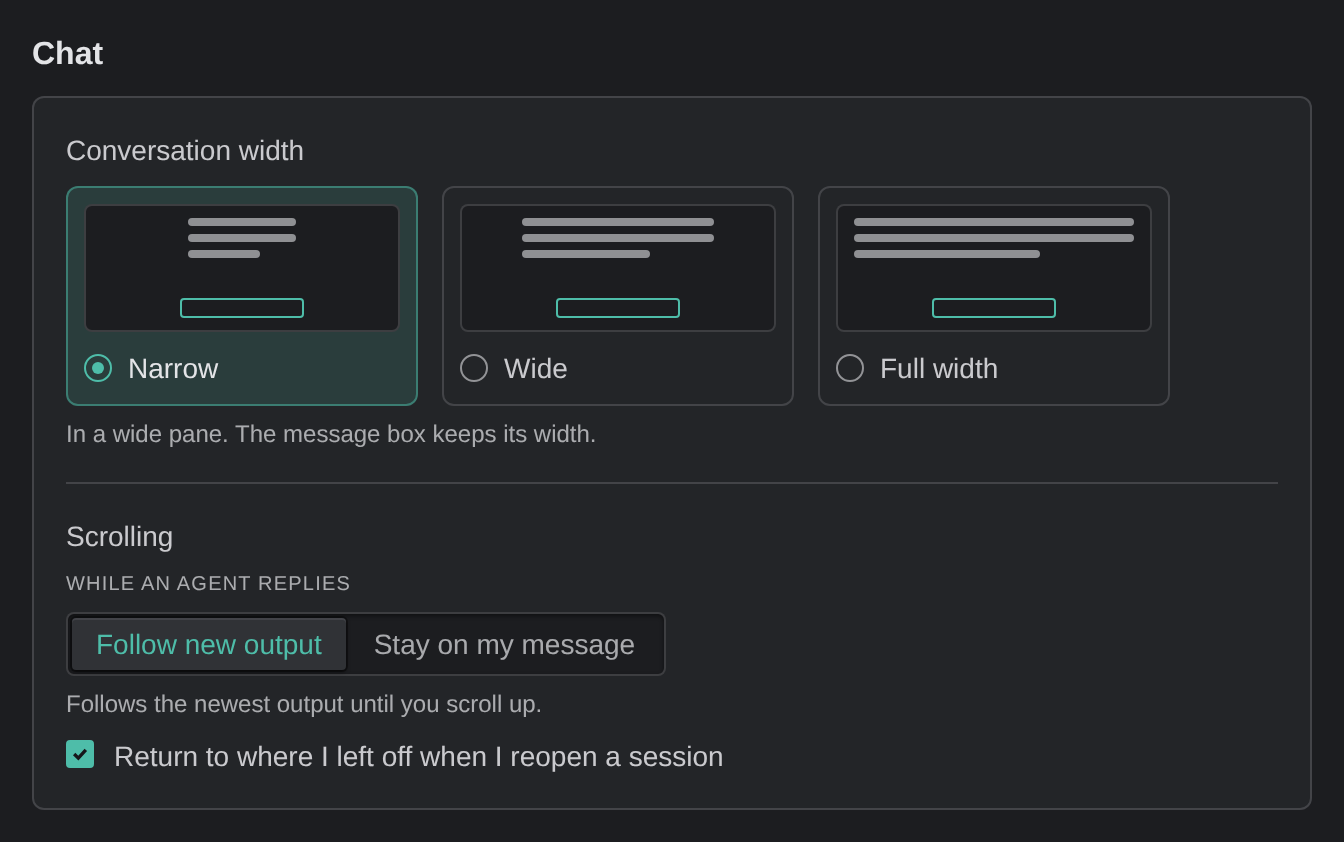
These settings set how wide a session’s conversation grows and how it scrolls:
| Setting | What it controls | Default |
|---|---|---|
| Conversation width | How wide the conversation grows in a wide pane: Narrow, Wide, or Full width | Narrow |
| Scrolling › While an agent replies | Follow new output keeps the newest output in view until you scroll up. Stay on my message keeps your message in view | Follow new output |
| Scrolling › Return to where I left off when I reopen a session | Whether a session reopens where you left it | On |
Terminal
These settings control Kepler’s embedded terminals:
| Setting | What it controls | Default |
|---|---|---|
| Font › Family | Separate fonts with commas. The terminal uses the first one installed on this machine. | Empty, which uses your platform’s standard monospace fonts |
| Font › Size | Terminal font size in pixels, from 8 to 32 | 13 |
| Font › Line height | Spacing between lines, from 1 to 2 | 1.2 |
| Show the message box under terminal sessions | Adds Kepler’s message box, for attachments and voice, under an agent’s terminal | Off |
The grayed text in Family is an example, not the value in effect. If Kepler cannot find a font you name, the field says so, and the terminal uses the next name in your list. Family and Size save when you press Enter or leave the field. Code views use this family too, unless you set one under Code.
Embedded terminals
Each Kepler terminal belongs to a worktree. Opening a terminal starts a shell in that worktree’s folder, so you do not need to cd into it, and the shell loads your profile the same way an interactive login shell would. Use Ctrl/⌘ + J to show and hide the terminal panel, New terminal to open another terminal, and Close terminal to end one.
Use terminals for work next to an agent session: running tests while the agent writes code, checking Git state, or reproducing something the session did not show. A terminal starts in one worktree and stays there, so for work that spans several repositories, use a standalone terminal.
Code
These settings set how diffs and code look:
| Setting | What it controls | Default |
|---|---|---|
| Diff layout | The layout diffs open in: Stacked or Split | Stacked |
| Font › Family | The font for diffs, file views, and code in chat. Leave it empty to use the terminal’s font | Empty |
| Font › Size | Text size in diffs and file views, from 10 to 24 | 13 |
To switch a single diff without changing the default, use the layout button on the file’s header in the Changes overlay. See Review What a Coding Agent Changed.
Voice
Use Voice to talk to your agents instead of typing, and to have their replies read aloud. Both run on this machine, so nothing you say or hear leaves it. Kepler saves these settings on this machine.
Dictation
Dictation is the microphone in the chat prompt. It turns on once a model is downloaded. To choose and download a model, see Set up dictation in Settings.
| Setting | What it controls | Default |
|---|---|---|
| Model | The on-device model that dictates: Qwen3-ASR 1.7B, Qwen3-ASR 0.6B, or Whisper. Each row has Download, and Remove… once downloaded | None until you download one |
| Dictation language | With Qwen3-ASR, the language you speak. Whisper ignores it | Auto-detect |
| When you stop talking | Insert the text, send the prompt, or keep listening | Insert the text so you can edit it |
| Learned words | Words Qwen3-ASR learned from your fixes, and suggestions to approve. See Teach dictation your words | Empty |
Read aloud
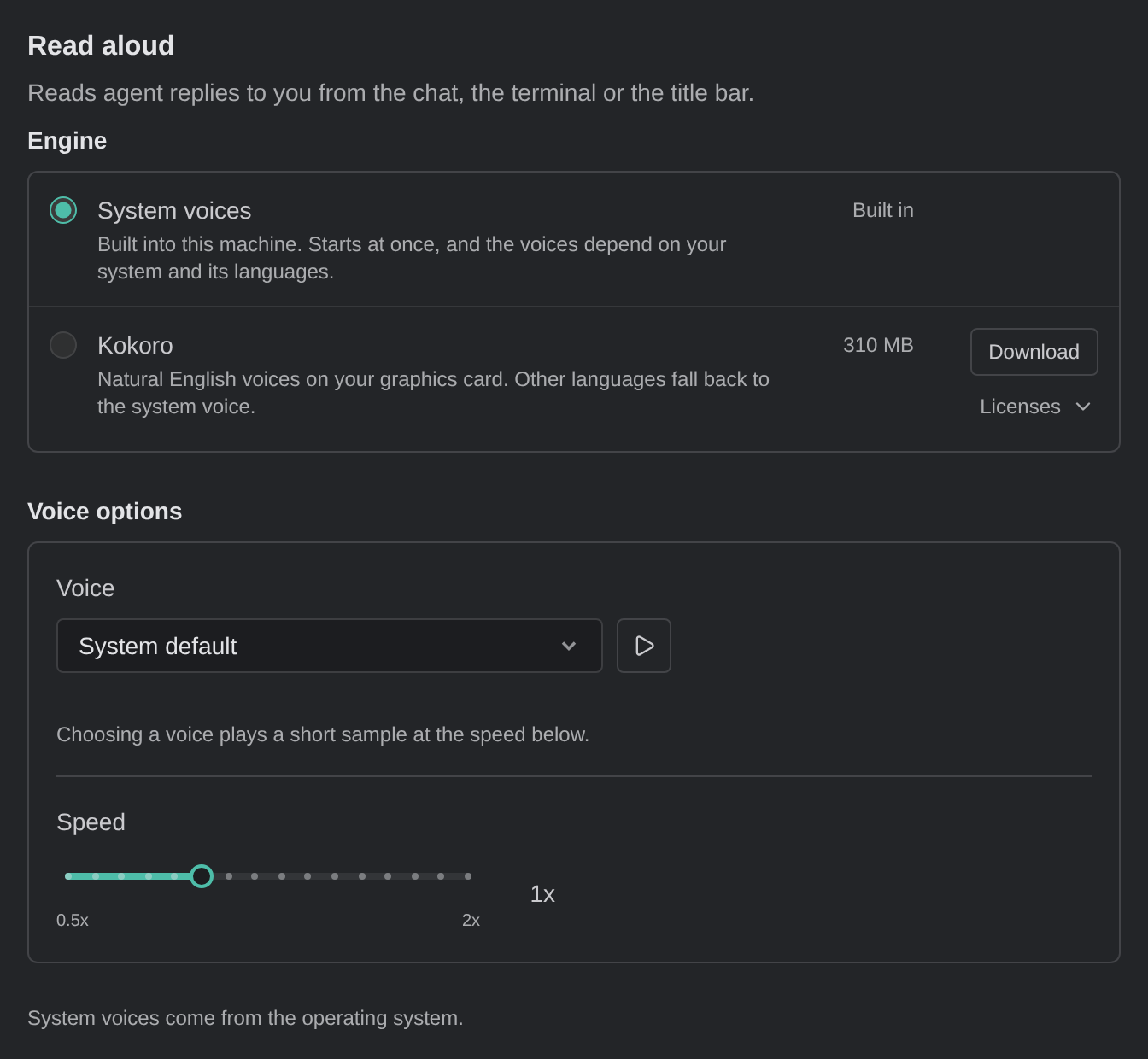
Read aloud reads agent replies to you from the chat, the terminal, or the title bar. To use it, see Read aloud.
| Setting | What it controls | Default |
|---|---|---|
| Voice engine | System voices, or Kokoro, natural English voices that need a download | System voices |
| Voice | The voice that reads | System default |
| Speed | How fast Kepler reads | 1x |
Keyboard shortcuts
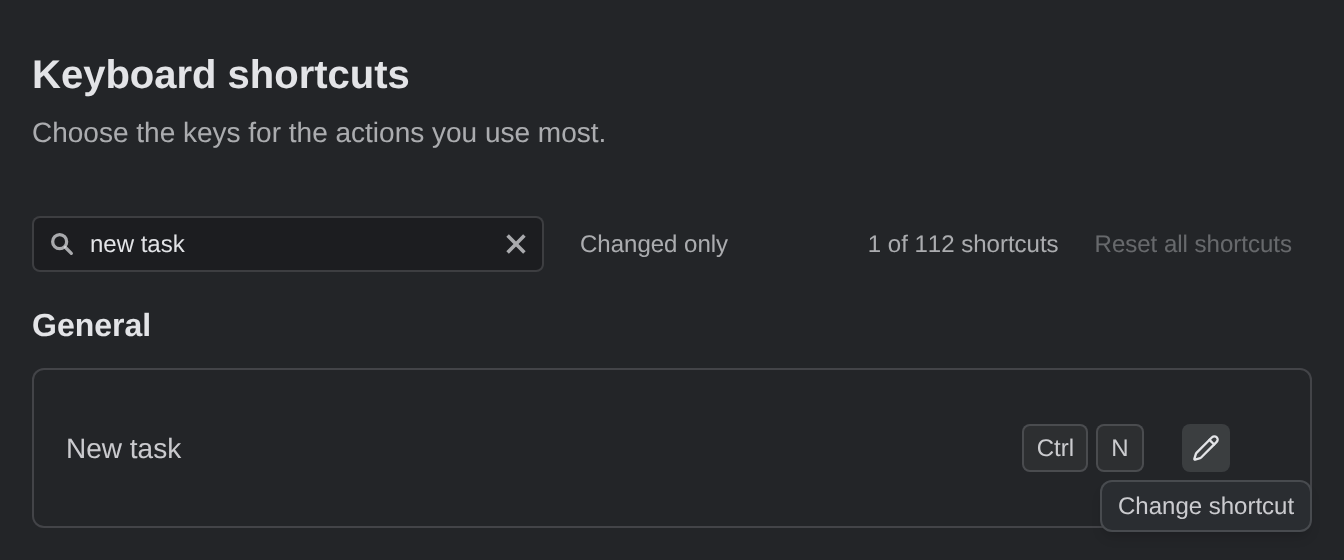
Use Keyboard shortcuts to look up Kepler’s shortcuts and choose your own keys. The page lists every command in 6 groups: General, Navigation, Dashboard, Task page, Chat, and Changes and code views. A command without a key shows None. Menu items and button tooltips show each command’s keys, including the ones you set. For a few tab shortcuts that Settings does not list, such as reopening a closed tab and jumping to a tab by position, see Task View.
Change a shortcut
- Find the command, or type its name in Search shortcuts.
- Click the pencil (Change shortcut) on its row. If the command already has a key, a menu opens: choose Change shortcut, Add another shortcut, or Remove followed by the key.
- Press the new keys. Escape cancels, and Backspace removes the shortcut.
You can also start from the command palette: a command’s Change shortcut action opens this page at that command, ready for the new keys.
If the keys already belong to another command, Kepler names it, and Replace moves the keys to this command. Kepler refuses keys it needs elsewhere, such as the key that sends chat messages, and says why.
A changed row offers Reset to default. Changed only lists only the shortcuts you changed, and Reset all shortcuts puts every shortcut back to its default after you confirm. A row with a lock, such as Copy the selection or the focused item or Dismiss / Cancel, cannot be changed.
Default shortcuts
The tables list the default keys.
General shortcuts
The General group holds app-wide shortcuts:
| Action | Shortcut |
|---|---|
| Open settings | Ctrl/⌘ + , |
| Toggle Ask Kepler chat | Ctrl/⌘ + K or Ctrl/⌘ + L |
| Toggle Ask Kepler terminal | Ctrl + ` |
| New Ask Kepler chat | Ctrl/⌘ + Shift + K or Ctrl/⌘ + Shift + L |
| New task | Ctrl/⌘ + N |
| Open quick launcher (global) | Shift + Alt/⌥ + N |
| New window | Ctrl/⌘ + Shift + N |
| Quit | Ctrl/⌘ + Q |
| Zoom in | Ctrl/⌘ + = |
| Zoom out | Ctrl/⌘ + – |
| Reset zoom | Ctrl/⌘ + 0 |
| Toggle full screen | F11, or ⌘ + ⌃ + F on macOS |
| Minimize | Ctrl/⌘ + M |
| Reload | Ctrl/⌘ + R |
| Hide Kepler | ⌘ + H (macOS only) |
| Hide others | ⌘ + ⌥ + H (macOS only) |
| Copy the selection or the focused item | Ctrl/⌘ + C |
| Close window | Ctrl/⌘ + Shift + W |
| Toggle terminal | Ctrl/⌘ + J |
| New session | Ctrl/⌘ + T |
| Rename task | F2 |
| Delete task | Ctrl/⌘ + Shift + Backspace |
| Manage remote environments | Ctrl/⌘ + Shift + R |
| Toggle side panel | Ctrl/⌘ + B |
| Open file | Ctrl/⌘ + O |
| Open folder | Ctrl/⌘ + Shift + O |
| Go to file | Ctrl/⌘ + P |
| Go to task or command | Ctrl/⌘ + Shift + P or F1 |
| Change search scope | Alt + S, or ⌘ + ⌥ + S on macOS |
| Dismiss / Cancel | Escape |
Go to task or command and Open folder are also in the app menu, as View › Command Palette… and File › Open Folder….
Navigation shortcuts
The Navigation group moves you between tasks, tabs, and regions:
| Action | Shortcut |
|---|---|
| Go to next in Needs attention | None |
| Go to next in Unread | None |
| Go to what needs you next | F8 |
| Previous tab | Ctrl/⌘ + Shift + [, or Ctrl + PageUp on Windows and Linux |
| Next tab | Ctrl/⌘ + Shift + ], or Ctrl + PageDown on Windows and Linux |
| Move tab left | Ctrl/⌘ + Alt/⌥ + [, or Ctrl + Shift + PageUp on Windows and Linux |
| Move tab right | Ctrl/⌘ + Alt/⌥ + ], or Ctrl + Shift + PageDown on Windows and Linux |
| Focus next region | F6 |
| Focus previous region | Shift + F6 |
| Close tab or panel | Ctrl/⌘ + W, or Ctrl + F4 on Windows and Linux |
| Go back | Alt + ←, or ⌘ + [ on macOS |
| Go forward | Alt + →, or ⌘ + ] on macOS |
Go to next in Needs attention opens the next session waiting on you, and Go to next in Unread opens the next unread reply. Go to what needs you next (F8) does both, waiting sessions first, and skips what is already on screen. F8 works even from a focused terminal.
Dashboard shortcuts
The Dashboard group works on the Dashboard’s tasks and detail panels:
| Action | Shortcut |
|---|---|
| Move panel left | Ctrl/⌘ + Alt/⌥ + Shift + ← |
| Move panel right | Ctrl/⌘ + Alt/⌥ + Shift + → |
| Move panel up | Ctrl/⌘ + Alt/⌥ + Shift + ↑ |
| Move panel down | Ctrl/⌘ + Alt/⌥ + Shift + ↓ |
| Move task to the previous Progress stage | Ctrl/⌘ + Shift + ← |
| Move task to the next Progress stage | Ctrl/⌘ + Shift + → |
| Focus detail panel 1 to 8 | Ctrl/⌘ + 1 to Ctrl/⌘ + 8 |
| Focus last detail panel | Ctrl/⌘ + 9 |
| Previous item in list | Alt/⌥ + Shift + ↑ |
| Next item in list | Alt/⌥ + Shift + ↓ |
| Switch to older panel | Ctrl + Shift + Tab |
| Switch to newer panel | Ctrl + Tab |
| Solo detail panel | Ctrl/⌘ + Shift + M |
| Maximize panel terminals | Ctrl/⌘ + Shift + J |
| Toggle changes pane | Ctrl/⌘ + Shift + G |
| Toggle task list peek | Ctrl/⌘ + Shift + B |
| Toggle resources pane | Ctrl/⌘ + Shift + E |
| Find in dashboard | Ctrl/⌘ + F |
Task page shortcuts
The Task page group works on a task’s page:
| Action | Shortcut |
|---|---|
| Focus chat | Ctrl/⌘ + 1 |
| Focus changes | Ctrl/⌘ + 2 |
| Focus resources | Ctrl/⌘ + 3 |
| Switch sessions | Ctrl + Tab |
| Switch sessions, oldest first | Ctrl + Shift + Tab |
| Maximize terminal drawer | Ctrl/⌘ + Shift + J |
| Show or hide the preview in Add resources | Ctrl/⌘ + Alt/⌥ + P |
Chat shortcuts
The Chat group works in a session’s conversation:
| Action | Shortcut |
|---|---|
| Find in conversation | Ctrl/⌘ + F |
| Previous message | Ctrl/⌘ + Alt/⌥ + ↑ |
| Next message | Ctrl/⌘ + Alt/⌥ + ↓ |
| Interrupt & send | Ctrl/⌘ + Shift + Enter |
| Send after this turn | Alt/⌥ + Enter |
| Switch between terminal and transcript | Ctrl/⌘ + Shift + X |
Changes and code view shortcuts
This group has 2 lists. The Changes list works in the Changes view:
| Action | Shortcut |
|---|---|
| Filter changed files | Ctrl/⌘ + P |
| Previous file | Alt/⌥ + ↑ |
| Next file | Alt/⌥ + ↓ |
| Next change | F7 |
| Previous change | Shift + F7 |
| Toggle changes sidebar | Ctrl/⌘ + B |
| Open all changes | Ctrl/⌘ + Shift + A |
| Comment on selection | Ctrl/⌘ + Shift + C |
| Edit working copy | Ctrl/⌘ + E |
The Code views list works in any code view, such as a diff or a file you have opened:
| Action | Shortcut |
|---|---|
| Find in file or diff | Ctrl/⌘ + F |
| Next match | F3, or ⌘ + G on macOS |
| Previous match | Shift + F3, or ⌘ + Shift + G on macOS |
| Match case | Alt + C, or ⌘ + ⌥ + C on macOS |
| Match whole word | Alt + W, or ⌘ + ⌥ + W on macOS |
| Use regular expression | Alt + R, or ⌘ + ⌥ + R on macOS |
| Find only in changes | Alt + L, or ⌘ + ⌥ + L on macOS |
Shortcuts that depend on where you are
Some keys do different things depending on where you are:
- Ctrl/⌘ + 1, Ctrl/⌘ + 2, and Ctrl/⌘ + 3 focus a detail panel on the Dashboard but a column on the task page.
- Ctrl + Tab switches detail panels on the Dashboard and sessions on the task page.
- Ctrl/⌘ + Shift + [ and Ctrl/⌘ + Shift + ] step through the Dashboard’s views on the Dashboard, and through a panel’s tabs when the panel or the task page has focus. Ctrl/⌘ + Alt/⌥ + [ and Ctrl/⌘ + Alt/⌥ + ] move the current view or tab.
- Ctrl/⌘ + Shift + J maximizes the panel’s terminals on the Dashboard and the terminal drawer on the task page.
- Ctrl/⌘ + B shows or hides the changes panel in the Changes view, docks or hides the task list on the Dashboard, and docks or hides the context panel on the task page.
- Ctrl/⌘ + P filters changed files in the Changes view and opens Go to file elsewhere.
- Ctrl/⌘ + F finds in the Dashboard from its list or header, finds in a file or diff in a code view, and finds in the conversation elsewhere.
- Ctrl/⌘ + Shift + G shows or hides changes in a Dashboard detail panel, and, on macOS, moves to the previous match in a code view.
- Ctrl/⌘ + C on a focused row, chip, or link copies what it names, such as a task’s Kepler link, a pull request or issue link, a file path, or a commit hash. In a text field, a terminal, or a text selection, it copies as usual.
Previous item in list and Next item in list work even while you type in the open panel’s chat.
Open quick launcher works while Kepler is in the background. Its row has a Global badge. Close tab or panel, Toggle full screen, Minimize, and Reload work only in the desktop app.
On Windows and Linux, a focused terminal passes Ctrl + W, Ctrl + L, and Ctrl + B to the shell. To toggle the Ask Kepler chat from a terminal, press Ctrl + K: the shell does not keep that key. Ctrl + ` always toggles the Ask Kepler terminal, even from a terminal.
Hold the Go back or Go forward key to keep moving through your history.
Send feedback, Show release notes, Show About Kepler, Check for updates, and Clean up worktrees have no default key, nor do commands such as Open documentation, Appearance: Dark, and Dashboard layout: Board. To use one from the keyboard, give it a key on this page.
